

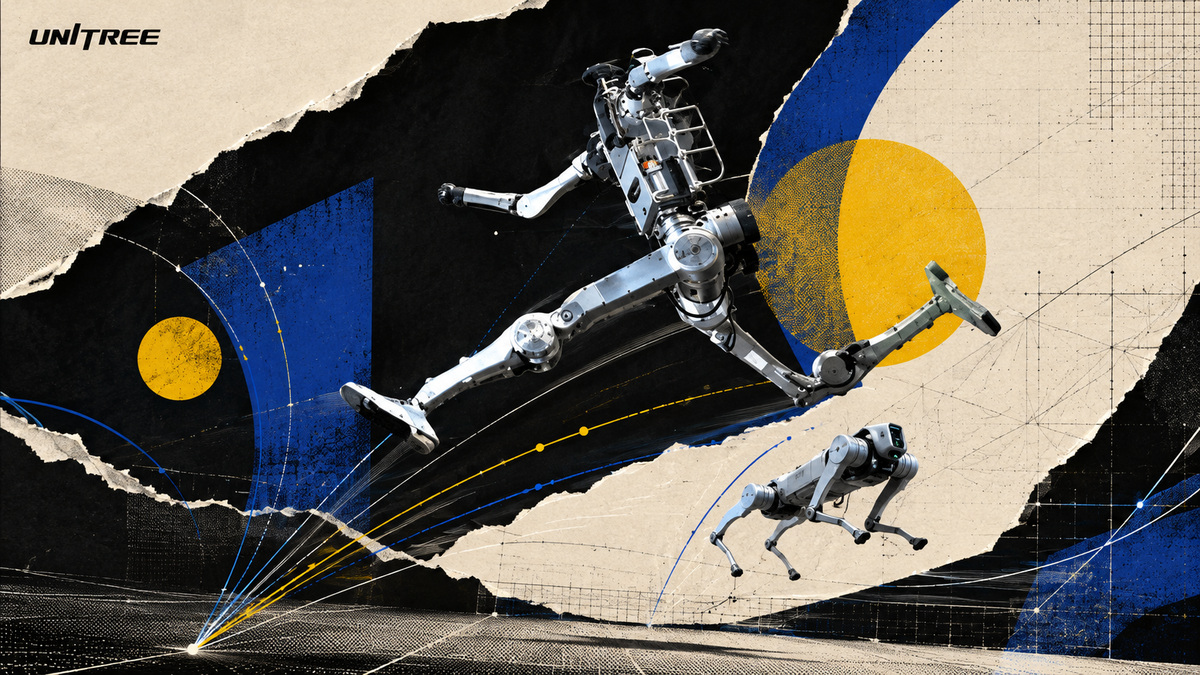
Unitree Robotics has built a humanoid that can out-jump and out-sprint the fastest people alive, and it did it in a little over three months. On 17 August the Chinese firm released footage of a prototype nicknamed “Superman,” a two-legged machine with 0.85-metre legs that springs two metres straight up from a standing start and reaches a top speed of 12.66 metres per second. Both numbers beat the human benchmarks: the standing high-jump record sits around 1.9 metres, and Usain Bolt’s peak instantaneous speed during his world-record sprints was roughly 12.42 metres per second.
The clip, posted to Unitree’s account on X, shows the robot moving beside a person for scale, and that framing is deliberate. This isn’t a rig bolted to a test bench. It’s a free-standing humanoid performing explosive, athletic movements next to the species it’s being measured against, from a company that has spent the past year turning viral demos into a genuine commercial lead in cheap humanoids.
The timing is what gives the Unitree Superman robot its charge. In five days’ time Beijing hosts the second World Humanoid Robot Games, and for the first time the programme includes a long jump. A machine that can clear two metres flat has arrived precisely as the world’s robot makers prepare to compete at exactly that kind of task.
The physics of a two-metre leap
Start with the legs, because they’re the tell. At 0.85 metres, Superman’s legs are shorter than an adult sprinter’s, yet the robot launches its whole mass more than twice their length into the air. That ratio is what separates a hydraulics-era stunt from what Unitree is showing here: dense, fast-acting electric actuators and control software quick enough to fire them in the right sequence, all coordinated in the fraction of a second a vertical jump allows. Boston Dynamics spent years making Atlas do backflips on custom hardware. Unitree says it produced this from a standing start in just over three months.
The speed claim deserves the same care. A top speed of 12.66 metres per second edges past Bolt’s fastest recorded instant, but it’s a peak, not an average. Bolt’s mean pace across his 9.58-second 100 metres was about 10.4 metres per second, and holding a top speed is a different problem from touching it. A number clocked in a demo reel is not the same as a robot that can sprint a full hundred metres, let alone do anything useful at the end of it. What the figure does prove is headroom: the actuators can move the frame faster than a human body can move itself, which is the harder engineering barrier to clear.
The second World Humanoid Robot Games run from 22 to 26 August at Beijing’s National Speed Skating Oval, the “Ice Ribbon” built for the 2022 Winter Olympics. The scale has jumped in a year. Organisers report 2,056 robots entered by 666 teams from 16 countries across six continents, with Brazil fielding a national squad, according to China Daily — roughly double the robots and 138 per cent more teams than the inaugural 2025 event. New disciplines this year include long jump, weightlifting, tug of war and table tennis, sitting alongside athletics, football and martial arts.
Unitree is already one of the loudest names in that field, and it treats these spectacles as marketing that money can’t easily buy. Its robots danced at the 2026 Spring Festival Gala; its quadrupeds and H-series humanoids sell into research labs and factories worldwide at prices that undercut Western rivals by an order of magnitude. Dropping a record-breaking jumper the week before the games keeps the company’s name at the front of every preview, and signals to buyers and competitors alike that its athletic ceiling is still rising.
The reaction online split the way it always does with Unitree. Some see a machine that could bound over rubble in a disaster zone, reaching people faster than a human team and carrying loads no single rescuer could. Others look at the same clip and see a fast, powerful, cheap platform that a military could adapt, a worry sharpened by Unitree’s roots in a country where the line between commercial and defence robotics is thin. The company has stuck to its usual line, stressing safe applications and framing the prototype as a research milestone with more improvements to come.
That tension won’t resolve at a sporting event, but the games will at least move the argument onto measurable ground. If Superman, or something like it, actually lands a competitive long jump in Beijing next week, the gap between a controlled demo and a repeatable, judged performance starts to close — and every claim Unitree made this week becomes testable in public. Watch the long jump. It’s where the marketing meets the tape measure.








