

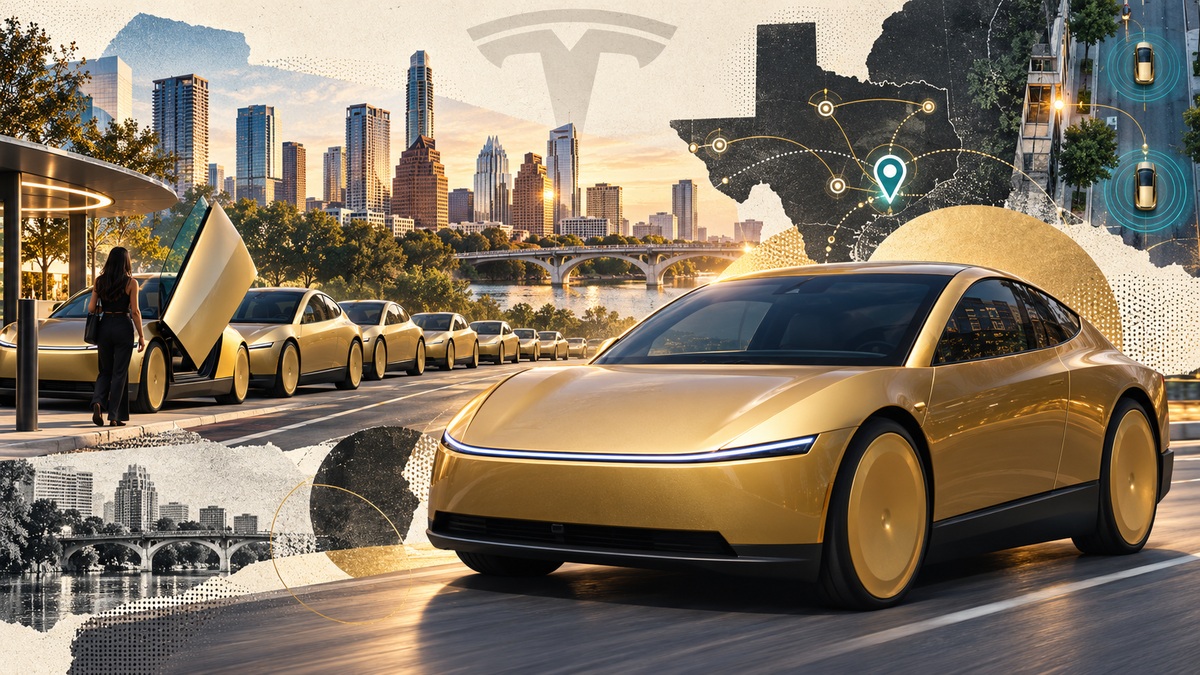
The Tesla Cybercab began carrying paying passengers in Austin this week, with rides in the two-seat robotaxi opening through the Robotaxi app after a launch event in the Texas capital on Thursday 3 September.
The launch itself was invitation only, a closed downtown event that surprised fans who had expected a public unveiling. Paying rides in the surrounding days did the introduction instead.
The Cybercab is the first vehicle in Tesla’s fleet with no steering wheel or pedals. Riders enter through upward-opening doors into a two-seat cabin built around a 22-inch touchscreen with theatre, music and gaming apps, voice control and Tesla’s Grok assistant.
“The future has arrived in Austin,” Tesla posted on X the day after the event, and the same account framed the service in bigger terms: “Cybercab is democratizing clean transportation for all.”
The operation starts small and fenced. About 45 Cybercabs are registered among roughly 420 autonomous vehicles in Texas, rides run inside geofenced zones from 6am to 10pm seven days a week, and remote operators monitor the cars and can step in during emergencies. The cars run Tesla’s Full Self-Driving software on its AI4 computer.
Fares for the Cybercab itself have not been the marketing hook so far, but Tesla has form on aggressive pricing. Its Model Y robotaxi service opened at a flat US$4.20 a ride last year before prices rose as the service area expanded past Waymo’s Austin footprint.
The vehicle itself is built for cheap kilometres. A single motor of about 219 horsepower draws on a 47 to 48 kWh battery for an efficiency of roughly 5.5 miles per kWh, with estimated range between 293 and 418 miles depending on configuration and a curb weight near 3,113 pounds. Climate and seat settings are controlled from the rider’s phone, and cargo space is minimal.
Production is already running at volume for a vehicle this new. Pilot builds began at Giga Texas in February with full production from April, Tesla is targeting a price under US$30,000, and the company talks about reaching millions of units annually once more plants come online.
Musk has made the economics the whole argument against Waymo. Hours before launch he circulated a comparison putting Waymo’s new Ojai vehicle at a Morgan Stanley-estimated US$125,000 against an Ark Invest production cost estimate near US$18,000 for the Cybercab. “And this doesn’t even take into account the operational efficiency of Cybercab,” Musk wrote on X.
Ark Invest’s projections carry the same story into running costs, at US$0.20 per mile for the Cybercab by 2030 against US$0.40 for Waymo’s generation on the same horizon. On the vehicle-cost figures Musk shared, a million dollars of fleet capital buys about 55 Cybercabs against 8 Ojai units.
Waymo still holds the scale advantage for now. The Alphabet company runs more than 500,000 paid rides a week across 11 metropolitan areas, against Tesla’s few hundred registered robotaxis in Texas, and rides in the Cybercab are booked and paid through the Robotaxi app inside its limited zones.
The Austin fleet is the front edge of a wider network. Tesla already runs modified Model Y robotaxis in Austin, Dallas, Houston, Miami, Orlando and Tampa, plus the San Francisco Bay Area with a safety driver on board, and Nevada has granted it a permit capped at 10 vehicles on the Las Vegas Strip after Tesla requested 5,000.
The Cybercab has been appearing far from Texas as it heads toward volume. Camouflaged units spent the winter cold-weather testing on New Zealand roads, the closest the program has come to Australian conditions so far.
Regulators are watching the wider technology rather than waving it through. The US National Highway Traffic Safety Administration has an Engineering Analysis open into Tesla’s consumer Full Self-Driving software, covering about 3.2 million vehicles, and Tesla reports third quarter production and delivery figures in early October, the first to cover the Cybercab’s volume ramp.








