

No Result
View All Result
Techord
Subscribe
  • AI
  • Tech
  • Robotics
  • Science
  • Gadgets
  • AI
  • Tech
  • Robotics
  • Science
  • Gadgets
No Result
View All Result
No Result
View All Result
Techord
Subscribe
Home Science

Australian Astronomers Confirm the Most Distant Fast Radio Burst

Aman Chamlagain by Aman Chamlagain
October 10, 2026
in Science
0
Australian Astronomers Confirm the Most Distant Fast Radio Burst
0
SHARES
2
VIEWS
Share on FacebookShare on Twitter

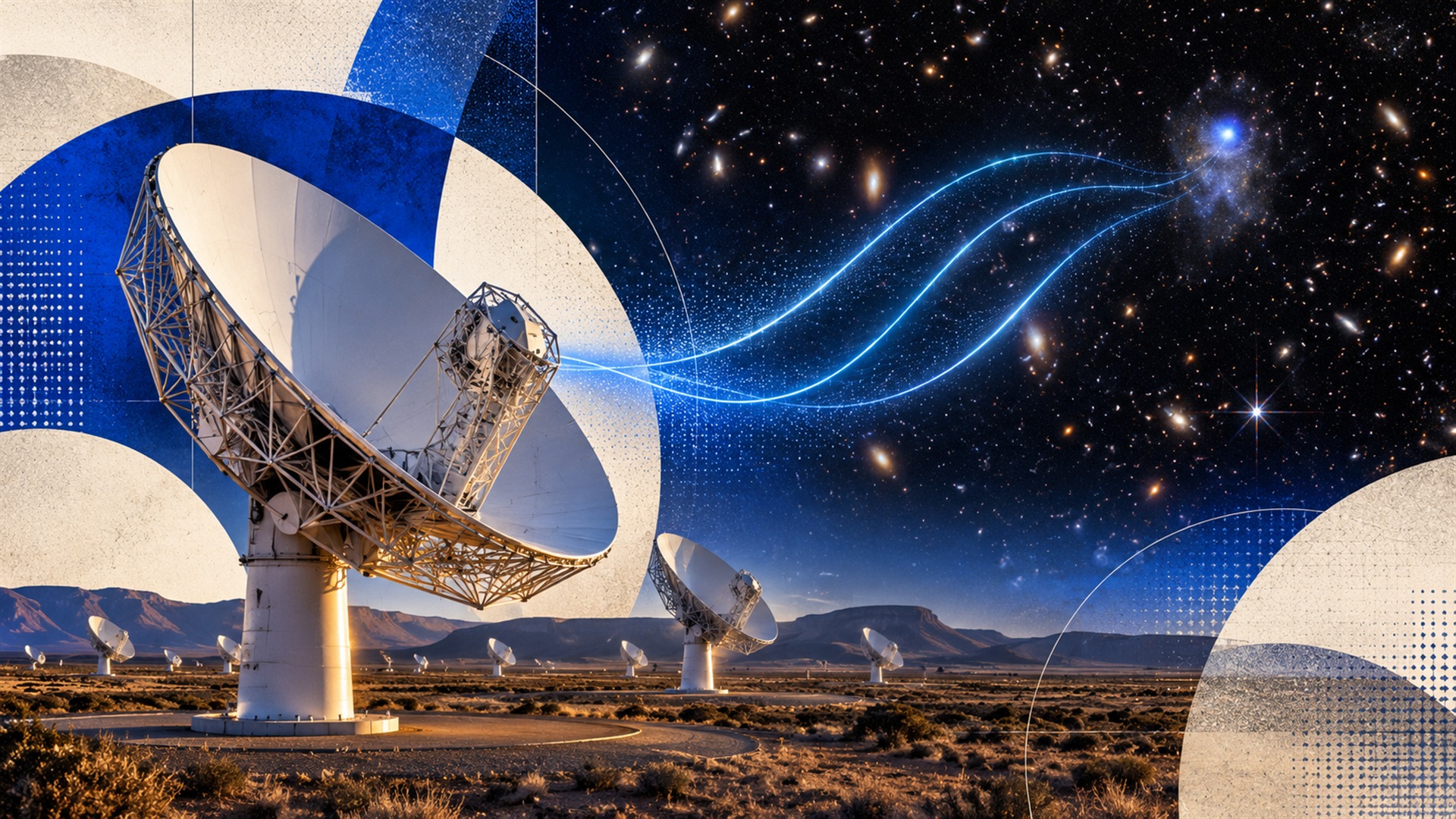
A University of Sydney-led team reported on 8 October that it had used the James Webb Space Telescope to identify the host galaxy of the most distant fast radio burst confirmed to date. The findings place the event when the universe was roughly three billion years old. The discovery gives astronomers a new way to examine what produces these brief, powerful signals early in cosmic history.

Fast radio bursts (FRBs) – enigmatic, millisecond-long flashes of radio emission from the distant universe – were first discovered in 2007.

Their origins are difficult to pinpoint, but Webb found the host galaxy to the most distant FRB seen to date. https://t.co/nd2NQqrRdX pic.twitter.com/UrE8yBX6N1

— NASA Webb Telescope (@NASAWebb) October 8, 2026

The burst itself arrived well before this month’s announcement. The MeerTRAP team detected it with South Africa’s MeerKAT telescope on 4 March 2024, giving it the name FRB 20240304B. Radio observations suggested an unusually distant source, but confirming that distance required identifying and studying the galaxy where the burst originated.

Webb supplied a measurement that ground-based observations had not secured. Its infrared camera found the host, and spectroscopy established a redshift of 2.148. The published spectrum shows how characteristic features in the galaxy’s light appear at shifted wavelengths. As the universe expands, light travelling through it is stretched; measuring that shift helps astronomers place the galaxy in cosmic history.

The two Webb instruments contributed different kinds of evidence. A camera provides an image, while a spectrograph separates incoming light into wavelengths. ESA’s NIRSpec guide explains how that information can reveal properties including composition and motion. In this case, spectroscopy turned a faint object at the right position into a host with a measured redshift.

The host also turned out to be unexpectedly small and young. The researchers describe an actively star-forming dwarf galaxy, rather than the substantially more massive system they had anticipated. That environment supports the possibility that some bursts come from young magnetars, highly magnetic neutron stars. It does not conclusively establish the physical mechanism responsible for this burst or every other fast radio burst.

Australian researchers have already shown another reason these signals are valuable. A 2020 study, described by CSIRO, used fast radio bursts to investigate ordinary matter spread thinly between galaxies. Different radio wavelengths experience different delays while passing through this material. Combining that information with reliable distances helps researchers investigate matter that is difficult to observe directly.

An earlier distance milestone demonstrated how far that approach might reach. In a 2023 report, CSIRO described a burst whose signal had travelled for about eight billion years. That was a separate event, detected by ASKAP in 2022. It provides background to the new record and shows how successive discoveries extend the environments astronomers can examine.

The latest result also illustrates why discovery dates need careful treatment. Detecting a flash, locating its source and understanding its host can involve different telescopes and years of follow-up. October’s news is the confirmed distance and the host’s properties. Describing Webb as having just detected the original radio burst would confuse those distinct contributions.

Further observations will help test whether similarly distant bursts favour young galaxies. Each well-characterised source adds evidence about the objects producing the signals and the material their light crosses. The Sydney-led work has extended that investigation into an earlier universe, while keeping the central mystery of fast radio bursts open.

Tags: AstronomyJames WebbspaceUniversity of Sydney
Aman Chamlagain

Aman Chamlagain

Aman Chamlagain is the founder and editor of Techord, the Australian technology news site he started in 2026. He writes across the site's coverage of artificial intelligence, robotics and consumer tech, with a consistent interest in what global technology decisions mean for people living and working in Australia. His reporting tends to follow the same thread: the distance between what a company announces and what actually ships, and who carries the cost of that gap. He covers the major AI labs and the models they release, robotics as it moves from demonstration into real work, and the hardware readers are weighing up buying. He also sets Techord's editorial standards, including its rules on primary sourcing, verbatim quotes and disclosed AI use. Aman handles tips, corrections and pitches personally. He can be reached at amannchamlagai07@gmail.com.

  • Trending
  • Comments
  • Latest
SpaceX IPO Draws $150 Billion in Demand, Doubling Its Target Ahead of Historic Debut

SpaceX IPO Draws $150 Billion in Demand, Doubling Its Target Ahead of Historic Debut

September 5, 2026
Apple Appoints New Leader to Advance Non-Invasive Blood Glucose Monitoring Project

Apple Appoints New Leader to Advance Non-Invasive Blood Glucose Monitoring Project

August 14, 2026
Bosch Partners with UK Startup Humanoid to Manufacture HMND 01 Robots at Scale

Bosch Partners with UK Startup Humanoid to Manufacture HMND 01 Robots at Scale

September 8, 2026
Nvidia CEO Jensen Huang Says Field of Study Won’t Matter in the AI Era

Nvidia CEO Jensen Huang Says Field of Study Won’t Matter in the AI Era

August 14, 2026
Nvidia CEO Jensen Huang Says Field of Study Won’t Matter in the AI Era

Nvidia CEO Jensen Huang Says Field of Study Won’t Matter in the AI Era

0
Apple Appoints New Leader to Advance Non-Invasive Blood Glucose Monitoring Project

Apple Appoints New Leader to Advance Non-Invasive Blood Glucose Monitoring Project

0
BYD Launches Dolphin G DM-i, Its First Vehicle Designed Exclusively for Europe

BYD Launches Dolphin G DM-i, Its First Vehicle Designed Exclusively for Europe

0
Hyundai Launches Atlas Robot World Cup Campaign Ahead of Massive 25,000-Unit Factory Rollout

Hyundai Launches Atlas Robot World Cup Campaign Ahead of Massive 25,000-Unit Factory Rollout

0
Editorial collage of Singapore's waterfront skyline with a schematic link between Singapore and Australia.

Australian AI Companies Target Singapore’s Enterprise Market

October 15, 2026
Editorial illustration of an Arkeus Warden sensor with a separate Drone Forge portfolio aircraft in the background.

Drone Forge and Arkeus Explore New Sensing Capabilities for Autonomous Aircraft

October 15, 2026
Editorial collage of Kingswood railway station and a Hume Highway bridge with restrained amber monitoring motifs.

NSW Trials Smart Sensors to Detect Danger on Railways and Highways

October 15, 2026
Editorial montage of CSIRO's yellow uncrewed survey vessel on coastal water and seagrass in murky water below.

Australian Researchers Trial Robots to Map Seagrass in Murky Water

October 15, 2026

Recent News

Editorial collage of Singapore's waterfront skyline with a schematic link between Singapore and Australia.

Australian AI Companies Target Singapore’s Enterprise Market

October 15, 2026
Editorial illustration of an Arkeus Warden sensor with a separate Drone Forge portfolio aircraft in the background.

Drone Forge and Arkeus Explore New Sensing Capabilities for Autonomous Aircraft

October 15, 2026
Editorial collage of Kingswood railway station and a Hume Highway bridge with restrained amber monitoring motifs.

NSW Trials Smart Sensors to Detect Danger on Railways and Highways

October 15, 2026
Editorial montage of CSIRO's yellow uncrewed survey vessel on coastal water and seagrass in murky water below.

Australian Researchers Trial Robots to Map Seagrass in Murky Water

October 15, 2026
Techord

Techord: Australian technology news.

Techord is an Australian technology publication covering AI, robotics, science, gadgets and electric vehicles, with news and context for Australian readers.

Browse Categories

  • AI

Recent News

Editorial collage of Singapore's waterfront skyline with a schematic link between Singapore and Australia.

Australian AI Companies Target Singapore’s Enterprise Market

October 15, 2026
Editorial illustration of an Arkeus Warden sensor with a separate Drone Forge portfolio aircraft in the background.

Drone Forge and Arkeus Explore New Sensing Capabilities for Autonomous Aircraft

October 15, 2026
  • About Techord
  • Contact
  • Privacy Policy
  • Terms
  • Submit a Tip

© 2026 Techord. All rights reserved.

Welcome Back!

Login to your account below

Forgotten Password?

Retrieve your password

Please enter your username or email address to reset your password.

Log In
No Result
View All Result
  • Home
  • AI
  • Robotics
  • Science
  • Future Tech
  • Big Tech
  • Latest News

© 2026 Techord. All rights reserved.


