

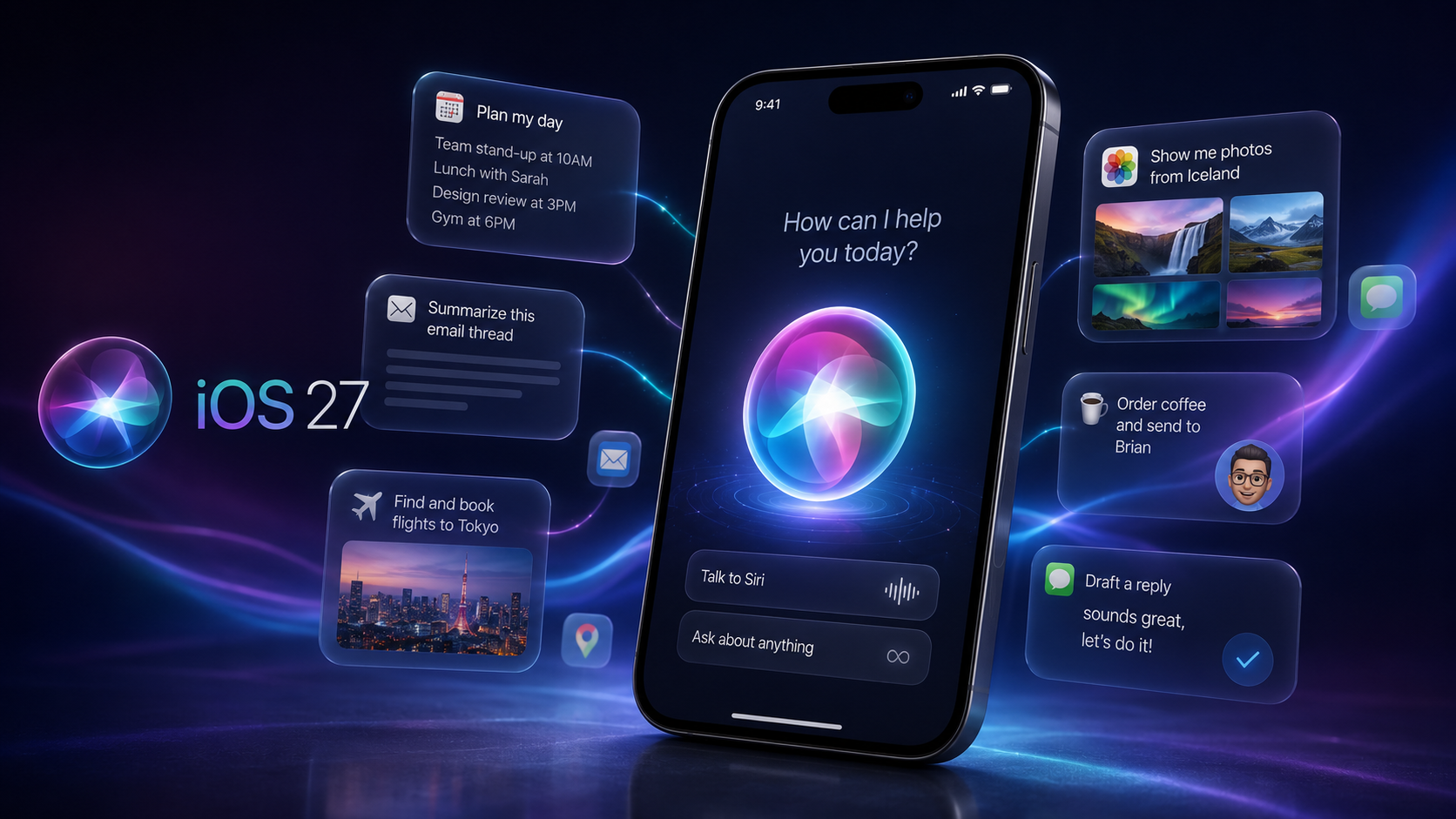
With WWDC 2026 kicking off on June 8, the technology world is buzzing over a wave of substantial leaks and previews regarding iOS 27. According to multiple reports, Apple is reportedly centering this entire update around a ground-up rebuild of Siri, aiming to transform the long-criticized voice assistant into a true conversational, agentic AI. This ambitious effort represents one of the most significant reimaginings of Siri since its introduction, reflecting Apple’s determination to remain competitive in an AI landscape increasingly dominated by sophisticated conversational systems.
The most credible details, largely mapped out by Bloomberg’s Mark Gurman, paint a comprehensive picture of what users can expect from the iOS 27 Siri overhaul. Among the most visually striking changes is a fundamental redesign of how Siri appears and behaves on the device. Rather than the familiar floating glowing sphere positioned at the bottom of the screen, Siri is reportedly moving to the top of the device, signaling a complete rethinking of how users interact with the assistant in their daily routines.
Central to this interface redesign is deeper integration with the Dynamic Island. Triggering Siri via voice or the power button will reportedly activate a fresh animation directly inside the Dynamic Island, with quick web searches and minor tasks popping out from this area in rich text cards. Complementing this, a new “Search or Ask” gesture will allow users to swipe down from the top-center of the screen to reveal a full-screen, text-friendly interface. To accommodate this new real estate, the traditional Notification Center is reportedly being relocated to a top-left swipe, representing a notable shift in the fundamental navigation patterns that iPhone users have grown accustomed to over many years.
Perhaps most intriguingly, swiping further down into the new interface will reportedly launch a dedicated, standalone Siri chatbot app built to compete directly with established players like ChatGPT and Claude. This app is expected to include persistent chat histories, both text and voice modes, and an attachment picker for documents and images. The introduction of such a dedicated application would mark a significant strategic move, positioning Siri as a serious contender in the increasingly crowded field of conversational AI assistants and signaling Apple’s intent to capture a share of this rapidly growing market.
Beneath the surface, the architectural changes powering Siri are equally significant. Apple has reportedly re-engineered Siri’s core system by utilizing Google Gemini technology for complex cloud queries, while relying on Apple’s own on-device models to maintain user privacy. This hybrid approach reflects a pragmatic balance between leveraging powerful external AI capabilities and preserving the privacy protections that have become a cornerstone of Apple’s brand identity. Additionally, iOS 27 is expected to allow users to link and route their queries directly to alternative third-party AI agents, such as ChatGPT or Claude, downloaded from the App Store, offering users unprecedented flexibility in choosing their preferred AI experience.
The enhanced Siri is also expected to demonstrate significantly improved personal and screen context awareness. For instance, users will reportedly be able to ask Siri to check their schedule for open appointment slots and scan for overlapping events seamlessly. This deeper contextual understanding would enable Siri to function as a more capable and proactive assistant, anticipating user needs and handling complex, multi-step requests with greater intelligence and reliability than previous iterations.
The integration of advanced AI extends prominently into Apple’s native multimedia applications. Within the Camera app, Siri is expected to replace the older Visual Intelligence tool as a primary shooting mode, allowing users to snap a photo to instantly run a reverse image search or request AI-powered photo analysis. The Photos app is similarly set to receive powerful new generative AI tools, including a feature called “Reframe” that automatically shifts an image’s perspective and another called “Extend” that uses generative AI to fill in details beyond the original crop. Apple is also reportedly testing natural-language voice prompts for editing, enabling users to issue commands such as asking Siri to make a photo’s background darker, further blurring the line between conversational interaction and creative control.
As Apple pushes harder into resource-intensive AI capabilities, the demands on hardware are reportedly leading to changes in device support. Early leaks suggest that iOS 27 will drop support for the iPhone 11 series and the second-generation iPhone SE, reflecting the increasing computational requirements of the new software. Furthermore, the advanced “Apple Intelligence” capabilities will likely remain restricted to the iPhone 15 Pro, the iPhone 16 series, and the upcoming iPhone 18 lineup. This tiered approach to feature availability underscores the substantial processing power required to deliver the most advanced AI experiences, while also highlighting the ongoing tension between innovation and broad device compatibility. As WWDC 2026 draws near, anticipation continues to build around what could prove to be a transformative update, one that may finally position Siri as a credible and competitive force in the era of conversational artificial intelligence.








