

No Result
View All Result
Techord
Subscribe
  • AI
  • Tech
  • Robotics
  • Science
  • Gadgets
  • AI
  • Tech
  • Robotics
  • Science
  • Gadgets
No Result
View All Result
No Result
View All Result
Techord
Subscribe
Home Science

Breakthrough Wearable Ultrasound Devices Promise to Transform Cardiac Care and Prenatal Monitoring

Aman Chamlagain by Aman Chamlagain
August 14, 2026
in Science
0
Breakthrough Wearable Ultrasound Devices Promise to Transform Cardiac Care and Prenatal Monitoring
0
SHARES
6
VIEWS
Share on FacebookShare on Twitter

Two research teams have independently unveiled wearable ultrasound devices that could fundamentally reshape cardiac care and prenatal monitoring, with both studies published in leading scientific journals within the past week. Together, these advances signal a promising shift toward noninvasive, continuous medical monitoring and treatment, offering glimpses of a future in which sophisticated care can be delivered through devices as unobtrusive as an adhesive patch. The convergence of these breakthroughs underscores the remarkable pace of innovation occurring at the intersection of engineering, genetics, and medicine.

The first of these innovations comes from engineers at MIT, who published their results on June 2 in Nature Biomedical Engineering, describing a postage-stamp-sized ultrasound sticker capable of regulating heart rhythms without surgery. The device pairs with a technique called sonogenetics, in which heart cells are genetically engineered to respond to sound waves. When the sticker’s tiny transducers emit ultrasound pulses through the chest, modified ion channels in cardiac cells open, allowing calcium to flow in and triggering the cell to beat. This elegant approach represents a creative fusion of acoustic engineering and genetic modification, opening an entirely new pathway for influencing the heart’s behavior from outside the body.

The results of the MIT team’s testing have proven encouraging. In experiments on rats with severe arrhythmias, the sticker quickly restored normal heart contractions, demonstrating the potential of the technology to address dangerous irregularities in heart rhythm. The research team envisions a two-step clinical process consisting of a one-time gene therapy injection to sensitize heart cells, followed by continuous use of the wearable sticker connected to a pocket-sized battery pack. This vision points toward a treatment paradigm that could eventually offer an alternative to the invasive procedures that currently define cardiac rhythm management.

The significance of this work is best understood against the backdrop of existing cardiac care. As co-corresponding author Gengxi Lu observed, “Pacemakers are one of the most important and widely used human implants, and they have saved millions of lives. But they are invasive, and they make direct contact with the beating heart. The dream for many years has been noninvasive heart stimulation with ultrasound.” This long-held aspiration carries substantial practical weight, given that around 3 million adults in the United States currently live with surgically implanted pacemakers. The MIT team, led by professor Xuanhe Zhao, plans to combine the pacing sticker with their earlier ultrasound imaging sticker to create a single integrated device that monitors the heart in real time and delivers corrective pulses whenever it detects an arrhythmia.

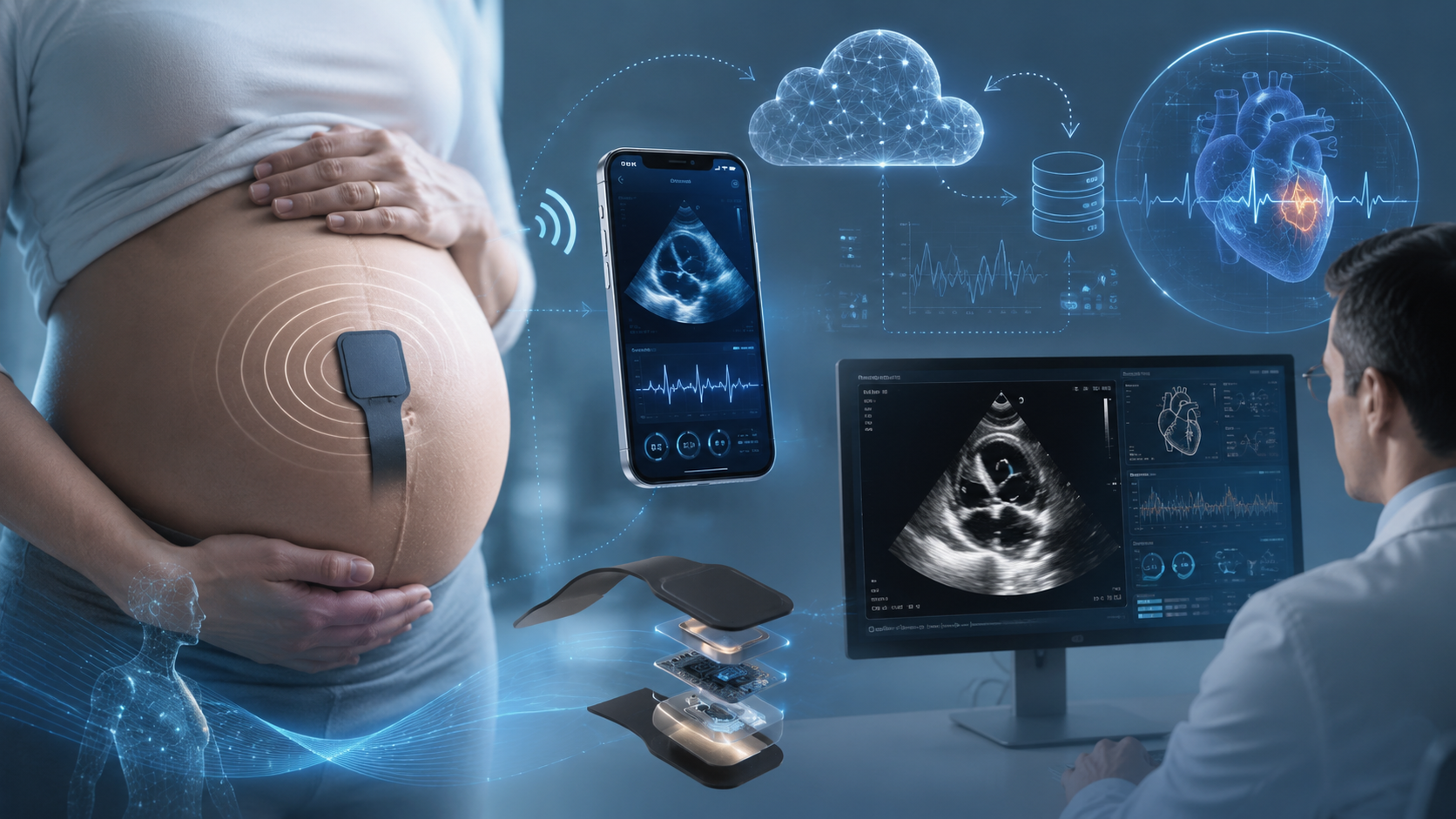
In a parallel development, engineers at UC San Diego, Stanford University, and the University of Oxford published research on May 26 in Nature Biotechnology, describing a device called UPatch. This soft adhesive ultrasound patch continuously monitors fetal blood flow and anatomy for hours at a time, addressing a critical need in prenatal care where continuous observation can prove invaluable. The device was validated across 62 pregnancies, including cases complicated by gestational diabetes, pre-eclampsia, and abnormal fetal growth, demonstrating its applicability across a range of challenging clinical scenarios that demand careful and sustained monitoring.

Researchers develop wearable ultrasound patch for continuous #FetalMonitoring.  Published in @Nature, the UPatch could help clinicians identify fetal complications earlier in high-risk pregnancies. https://t.co/9ZbeI36pxZ@OxfordMedSci @WellcomeLeap @oxfordfetal pic.twitter.com/LbQ2mKIOsT

— Nuffield Dept of Women's & Reproductive Health (@Ox_wrh) May 26, 2026

A key innovation distinguishing UPatch is its autonomous tracking algorithms, which follow the fetus and umbilical cord as they move, maintaining consistent measurements without requiring a trained sonographer to guide a probe. This capability represents a meaningful advance in accessibility and convenience, potentially extending sophisticated monitoring beyond the confines of clinical settings staffed by specialists. The real-world value of this technology was vividly illustrated in one clinical case, in which UPatch detected prolonged abnormal fetal signals that led to an early Cesarean delivery at 29 weeks, a finding that researchers say may have helped save the baby’s life.

The advantages of continuous monitoring were emphasized by co-first author Hao Huang, who noted, “With continuous monitoring, we were able to observe dynamic fluctuations in blood flow that would likely be missed with conventional ultrasound exams.” This insight highlights one of the most compelling benefits of wearable, continuous monitoring technology: the ability to capture transient or evolving patterns that intermittent examinations might overlook, thereby enabling earlier detection of potential complications and more timely intervention when problems arise.

Despite their considerable promise, both devices remain in the early stages of development, and important challenges lie ahead before they can reach widespread clinical use. The MIT pacemaker has so far been tested only on rats and engineered human cells, and the gene therapy component would require regulatory approval before any human trials could begin. Meanwhile, UPatch currently relies on a wired connection to a computer and requires a conventional ultrasound scan for initial positioning, limitations that the team is actively working to overcome. Both research groups are pursuing fully wireless, integrated versions of their devices, and as these efforts mature, the technologies could eventually bring noninvasive, continuous, and intelligent monitoring to patients in ways that meaningfully improve outcomes. While the path from laboratory breakthrough to everyday medical practice remains long and demanding, these parallel achievements offer a compelling vision of how wearable ultrasound technology may one day transform the landscape of healthcare.

Tags: cardiac careMITneuroscienceUPatchwearable ultrasound
Aman Chamlagain

Aman Chamlagain

Aman Chamlagain is the founder and editor of Techord, the Australian technology news site he started in 2026. He writes across the site's coverage of artificial intelligence, robotics and consumer tech, with a consistent interest in what global technology decisions mean for people living and working in Australia. His reporting tends to follow the same thread: the distance between what a company announces and what actually ships, and who carries the cost of that gap. He covers the major AI labs and the models they release, robotics as it moves from demonstration into real work, and the hardware readers are weighing up buying. He also sets Techord's editorial standards, including its rules on primary sourcing, verbatim quotes and disclosed AI use. Aman handles tips, corrections and pitches personally. He can be reached at amannchamlagai07@gmail.com.

  • Trending
  • Comments
  • Latest
SpaceX IPO Draws $150 Billion in Demand, Doubling Its Target Ahead of Historic Debut

SpaceX IPO Draws $150 Billion in Demand, Doubling Its Target Ahead of Historic Debut

September 5, 2026
Apple Appoints New Leader to Advance Non-Invasive Blood Glucose Monitoring Project

Apple Appoints New Leader to Advance Non-Invasive Blood Glucose Monitoring Project

August 14, 2026
Bosch Partners with UK Startup Humanoid to Manufacture HMND 01 Robots at Scale

Bosch Partners with UK Startup Humanoid to Manufacture HMND 01 Robots at Scale

September 8, 2026
Nvidia CEO Jensen Huang Says Field of Study Won’t Matter in the AI Era

Nvidia CEO Jensen Huang Says Field of Study Won’t Matter in the AI Era

August 14, 2026
Nvidia CEO Jensen Huang Says Field of Study Won’t Matter in the AI Era

Nvidia CEO Jensen Huang Says Field of Study Won’t Matter in the AI Era

0
Apple Appoints New Leader to Advance Non-Invasive Blood Glucose Monitoring Project

Apple Appoints New Leader to Advance Non-Invasive Blood Glucose Monitoring Project

0
BYD Launches Dolphin G DM-i, Its First Vehicle Designed Exclusively for Europe

BYD Launches Dolphin G DM-i, Its First Vehicle Designed Exclusively for Europe

0
Hyundai Launches Atlas Robot World Cup Campaign Ahead of Massive 25,000-Unit Factory Rollout

Hyundai Launches Atlas Robot World Cup Campaign Ahead of Massive 25,000-Unit Factory Rollout

0
Editorial collage of Singapore's waterfront skyline with a schematic link between Singapore and Australia.

Australian AI Companies Target Singapore’s Enterprise Market

October 15, 2026
Editorial illustration of an Arkeus Warden sensor with a separate Drone Forge portfolio aircraft in the background.

Drone Forge and Arkeus Explore New Sensing Capabilities for Autonomous Aircraft

October 15, 2026
Editorial collage of Kingswood railway station and a Hume Highway bridge with restrained amber monitoring motifs.

NSW Trials Smart Sensors to Detect Danger on Railways and Highways

October 15, 2026
Editorial montage of CSIRO's yellow uncrewed survey vessel on coastal water and seagrass in murky water below.

Australian Researchers Trial Robots to Map Seagrass in Murky Water

October 15, 2026

Recent News

Editorial collage of Singapore's waterfront skyline with a schematic link between Singapore and Australia.

Australian AI Companies Target Singapore’s Enterprise Market

October 15, 2026
Editorial illustration of an Arkeus Warden sensor with a separate Drone Forge portfolio aircraft in the background.

Drone Forge and Arkeus Explore New Sensing Capabilities for Autonomous Aircraft

October 15, 2026
Editorial collage of Kingswood railway station and a Hume Highway bridge with restrained amber monitoring motifs.

NSW Trials Smart Sensors to Detect Danger on Railways and Highways

October 15, 2026
Editorial montage of CSIRO's yellow uncrewed survey vessel on coastal water and seagrass in murky water below.

Australian Researchers Trial Robots to Map Seagrass in Murky Water

October 15, 2026
Techord

Techord: Australian technology news.

Techord is an Australian technology publication covering AI, robotics, science, gadgets and electric vehicles, with news and context for Australian readers.

Browse Categories

  • AI

Recent News

Editorial collage of Singapore's waterfront skyline with a schematic link between Singapore and Australia.

Australian AI Companies Target Singapore’s Enterprise Market

October 15, 2026
Editorial illustration of an Arkeus Warden sensor with a separate Drone Forge portfolio aircraft in the background.

Drone Forge and Arkeus Explore New Sensing Capabilities for Autonomous Aircraft

October 15, 2026
  • About Techord
  • Contact
  • Privacy Policy
  • Terms
  • Submit a Tip

© 2026 Techord. All rights reserved.

Welcome Back!

Login to your account below

Forgotten Password?

Retrieve your password

Please enter your username or email address to reset your password.

Log In
No Result
View All Result
  • Home
  • AI
  • Robotics
  • Science
  • Future Tech
  • Big Tech
  • Latest News

© 2026 Techord. All rights reserved.


