

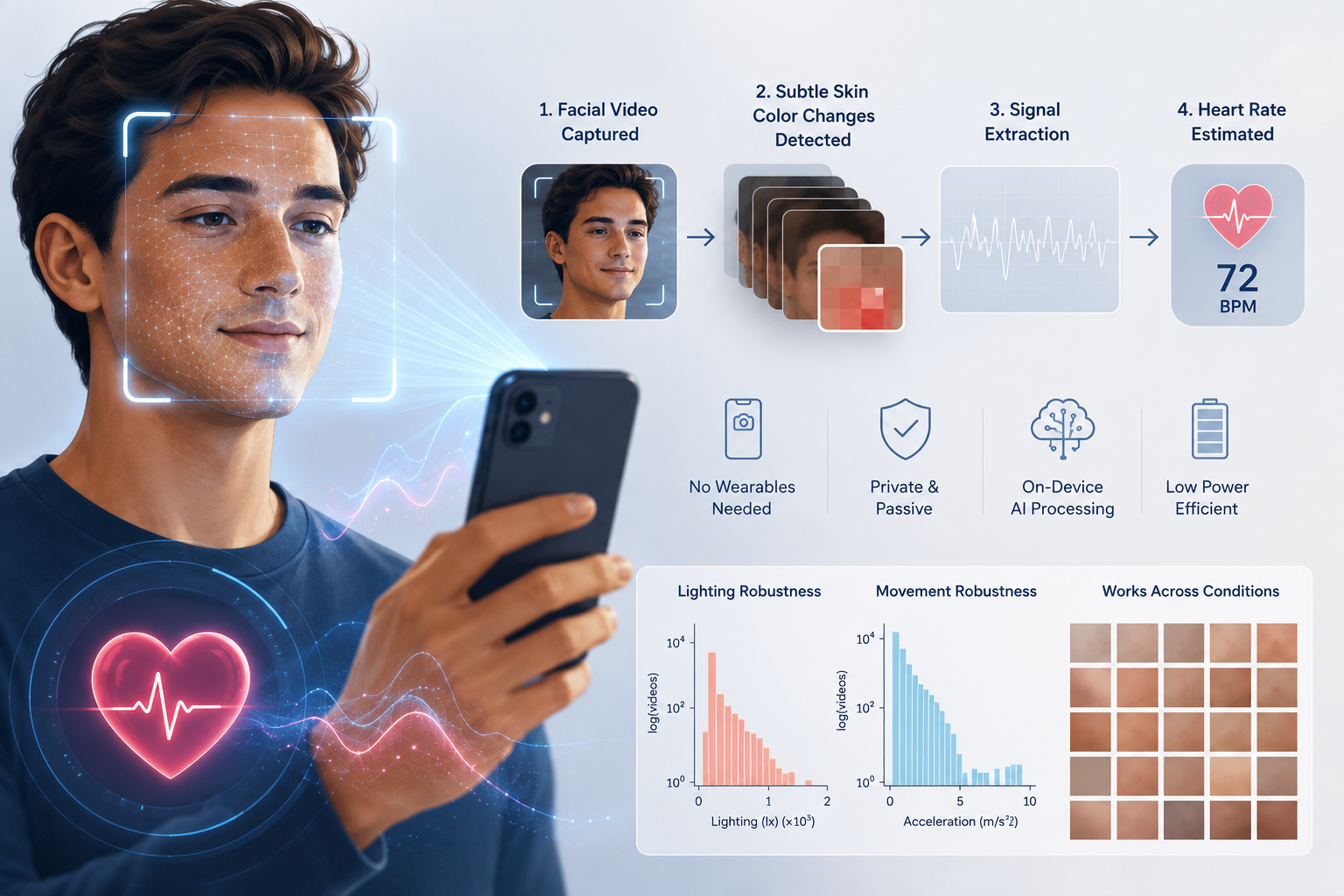
A team at Google Research has demonstrated that a smartphone’s front-facing camera can passively measure a user’s heart rate during ordinary phone use, capturing brief facial videos each time the screen is unlocked. The study, published on June 1 in the journal Nature, represents what the authors describe as “the first demonstration that smartphones can be used to passively monitor both HR and RHR during normal phone usage in the real-world.” This achievement points toward a future in which sophisticated health monitoring becomes seamlessly integrated into the everyday devices people already carry, potentially democratizing access to valuable cardiovascular insights on an unprecedented scale.
The technology, known as Passive Heart Rate Monitoring or PHRM, operates through an elegant and unobtrusive process. The system records an 8-second video clip of the user’s face whenever the phone is unlocked, then employs a deep learning system to detect minute changes in light reflected from facial skin caused by blood flow through capillaries. These subtle variations are invisible to the naked eye but detectable by a camera working in concert with artificial intelligence. Multiple readings taken throughout the day are then aggregated using a Kalman filter to estimate daily resting heart rate, a biomarker closely linked to cardiovascular health and mortality risk. This approach transforms a routine daily action into a continuous source of meaningful health data.
The scale and rigor of the validation effort lend considerable credibility to the findings. The system was developed using 225,773 videos from 495 participants and validated on 185,970 videos from 205 participants across both laboratory and real-world conditions, making it the largest validation study of remote photoplethysmography conducted to date. This extensive testing across diverse settings reflects a serious commitment to establishing the reliability of the technology before it might be deployed at scale, addressing the kind of real-world variability that often distinguishes promising laboratory results from genuinely practical applications.
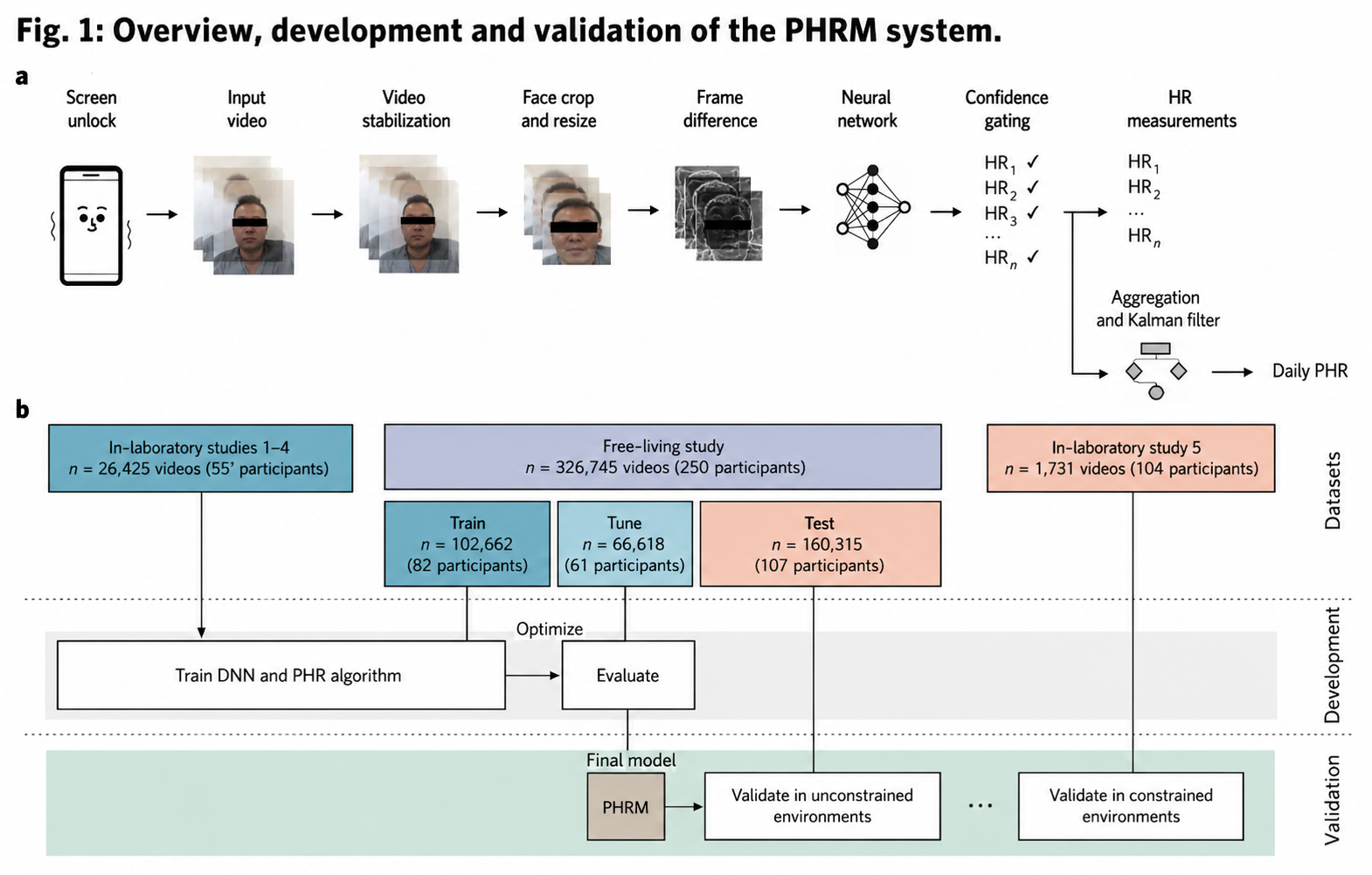
b, Workflow diagram illustrating the datasets and procedures used to develop and validate the PHRM system. The system was trained and evaluated using data from five independent prospective laboratory studies alongside a prospective free-living study, supporting both model development and validation across controlled and real-world environments.
In terms of performance, the results proved encouraging across multiple measures. In laboratory settings, PHRM achieved a mean absolute percentage error of 5.65 percent, and in daily life, the error remained low at 6.09 percent. Both figures fall comfortably within the Consumer Technology Association standard of 10 percent or lower for consumer heart rate monitors. Importantly, the system met this threshold across light, medium, and dark skin pigmentation groups, and the researchers reported that it satisfied prespecified non-inferiority targets across all groups, an outcome that speaks to a conscientious effort to ensure the technology functions equitably for a broad range of users.
Nevertheless, the study revealed a notable disparity in how often the system produced usable readings across different skin tones. The proportion of videos yielding usable readings was 58 percent for light skin, 45 percent for medium skin, and 25 percent for dark skin. The researchers attributed this gap to lower signal-to-noise ratios in darker skin, where higher melanin content absorbs more light before it reaches the pulsatile blood vessels beneath the surface. This honest acknowledgment of a meaningful limitation underscores the importance of continued refinement to ensure that the benefits of the technology can be realized fully and fairly across all populations.
The broader implications of this research are substantial, particularly given the potential reach of smartphone technology. The study highlights the opportunity for billions of smartphone users worldwide to access heart health monitoring without purchasing a dedicated wearable device, removing a significant cost barrier that may otherwise limit access to such tools. Reinforcing the clinical relevance of the approach, PHRM-derived resting heart rate was associated with known cardiovascular risk factors including obesity and low fitness levels. The researchers also noted that their smartphone-based resting heart rate measurements demonstrated greater day-to-day consistency than traditional clinical methods, suggesting that the passive, frequent nature of the measurements may offer advantages beyond mere convenience.
As with any technology that involves capturing sensitive personal data, privacy remains a key concern that the researchers addressed directly. They emphasized that users should provide explicit consent before the system is activated, and the technology was deliberately designed to run entirely on-device within a secure processing environment, thereby keeping sensitive facial video data under the user’s control rather than transmitting it elsewhere. This privacy-conscious design reflects an awareness of the trust required when health monitoring intersects with personal imagery and everyday device use.
Looking ahead, the team candidly acknowledged that further work remains necessary before the technology can reach its full potential. In particular, they identified the need to reduce battery consumption and to improve measurement success rates for darker skin tones, ensuring that the system performs reliably and equitably for all users. While these challenges are significant, the research represents a compelling step toward making continuous, accessible heart health monitoring a practical reality for vast numbers of people. As development continues and these limitations are addressed, Passive Heart Rate Monitoring may ultimately exemplify how the powerful sensors and computing capabilities already present in everyday smartphones can be harnessed to advance personal health in meaningful and far-reaching ways.








