

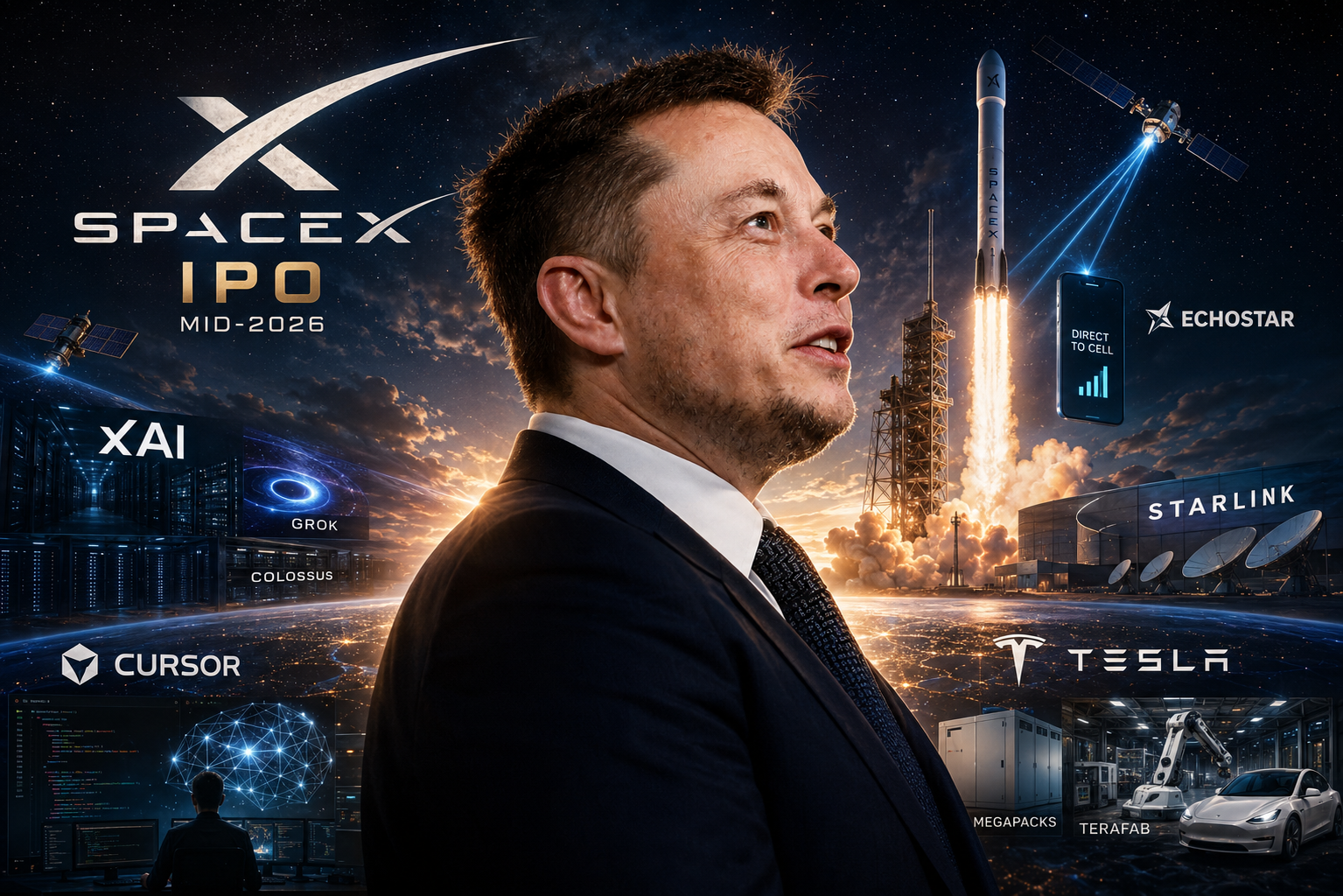
SpaceX is reportedly launching what would be the largest initial public offering in history, with the company preparing to go public on the Nasdaq exchange under the ticker symbol SPCX following an amended filing, and trading expected to begin as early as June 12, 2026. According to reports, this debut would mark a momentous shift for Elon Musk’s rocket, satellite, and artificial intelligence empire, transforming it from a heavily guarded private entity into a publicly traded behemoth. The scale and significance of the offering have captured the attention of investors and observers worldwide, signaling what could prove to be a defining moment in the intersection of space technology, telecommunications, and artificial intelligence. As with all reporting on events still unfolding, the specific figures and timelines described here reflect what has been reported rather than confirmed outcomes.
The financial dimensions of the reported offering are staggering and would, if realized as described, break historical records by eclipsing the previous milestone held by Saudi Aramco’s $25.6 billion float in 2019. Reports indicate a target valuation of approximately $1.77 trillion to $1.78 trillion, with the company aiming to raise $75 billion through the sale of 555.6 million shares at a reported price of $135 per share. This figure could rise to as much as $86 billion if underwriters exercise their greenshoe option. Perhaps most striking among the reported details is what some have termed the “trillionaire milestone,” as Elon Musk is said to be retaining his shares and holding roughly 82.4 percent of the voting power, a structure that, according to projections, could push his personal net worth past $1 trillion and potentially make him the world’s first trillionaire.
While SpaceX is widely recognized for its Falcon rockets and ongoing Starship development, the financial case being presented to Wall Street reportedly relies heavily on artificial intelligence and satellite connectivity rather than space launches alone. The company is described as being structured into three main pillars, each occupying a distinct position in its overall strategy. The Space Operations division, encompassing the company’s rockets, is reported to be loss-making, driven by NASA contracts and Starship development, with revenue in this segment projected to reach $8.3 billion by 2030. This division, though central to the company’s public identity, represents only one component of the broader financial narrative being advanced to potential investors.
The second pillar, Connectivity through Starlink, stands out as the company’s profitable engine and primary steady revenue generator at present. According to reports, Goldman Sachs projects Starlink revenue to reach $144 billion by 2030, underscoring the central role that satellite internet has come to play in SpaceX’s financial story. The third pillar, AI Infrastructure encompassing the integration of xAI and X, is described as the core growth pitch despite currently being loss-making. This segment reportedly includes ambitious plans for “orbital compute” data centers in space by 2028, with Goldman Sachs models projecting AI revenue to surge dramatically from $3.2 billion in 2025 to $322 billion by 2030, a hundredfold increase that forms the speculative heart of the valuation case.
Amid these soaring projections, a sober financial reality tempers the enthusiasm surrounding the offering. Despite the reported $1.77 trillion valuation, SpaceX as a whole is described as currently unprofitable, having posted a $4.9 billion net loss in 2025 on $18.7 billion in revenue. This loss is attributed largely to massive capital expenditures directed toward AI infrastructure and space technology. The contrast between the company’s enormous proposed valuation and its present unprofitability highlights the extent to which the offering’s appeal rests on future expectations rather than current earnings, a dynamic that prospective investors would need to weigh carefully. Nothing in this article constitutes financial advice, and individuals considering any investment should conduct their own research and consult a licensed financial professional.
Reports also describe heightened opportunities for retail investors to participate in the offering, with retail brokers said to be receiving a significantly higher allocation than is typical, reportedly up to 30 percent of the offering rather than the usual 5 to 10 percent. In the United States, major brokerages such as Fidelity have reportedly allowed retail customers meeting certain account thresholds to register an Indication of Interest, while in Australia, CommSec has reportedly acted as a lead retail broker enabling local investors to apply for shares through an international allocation, with applications said to close on June 10, 2026. Reports further describe a “flipping” rule, under which brokers are said to be implementing penalties for investors who sell allocated shares within the first 15 days of trading in order to limit immediate profit-taking volatility. Readers should treat these participation details as reported rather than confirmed, and verify any specifics directly with their broker before acting, as the precise terms, prices, and deadlines associated with such offerings can change or differ from early reports.
Beyond the financial mechanics, the reported offering has drawn serious scrutiny regarding its governance structure, with major institutional investors, including large pension funds such as CalPERS, said to have expressed significant concern over what has been described as a “novel and extreme governance structure.” The central issue reportedly stems from the fact that Musk’s Class B shares carry 10-to-1 voting power, meaning public shareholders would have virtually no meaningful say in company decisions and would be unable to remove Musk as CEO or Chairman. Adding to these concerns, a portion of the IPO proceeds, reported at $20 billion, is said to be explicitly earmarked to pay off a bridge loan used to refinance debt inherited from Musk’s X and xAI ventures, a detail that some observers may view as relevant to assessing the offering’s overall structure and priorities.
Taken together, the reported SpaceX IPO presents a portrait of extraordinary ambition coupled with substantial uncertainty and risk. On one hand, the offering would represent a historic milestone, potentially the largest public debut ever recorded, anchored by the genuine commercial success of Starlink and bold visions for AI infrastructure extending into orbit. On the other hand, the company’s present unprofitability, the speculative nature of its most aggressive growth projections, and the concentration of control in a single individual raise meaningful questions that careful observers and potential investors alike would do well to consider. As the reported June 12 trading date approaches, the world watches with considerable interest, recognizing that should the offering proceed as described, it may not only reshape financial markets and redefine expectations for technology valuations, but also mark a remarkable personal milestone for one of the most closely watched figures in modern business. Whether the reality ultimately matches the soaring expectations remains to be seen, and readers are encouraged to follow developments through reliable, up-to-date sources as the situation evolves.








