

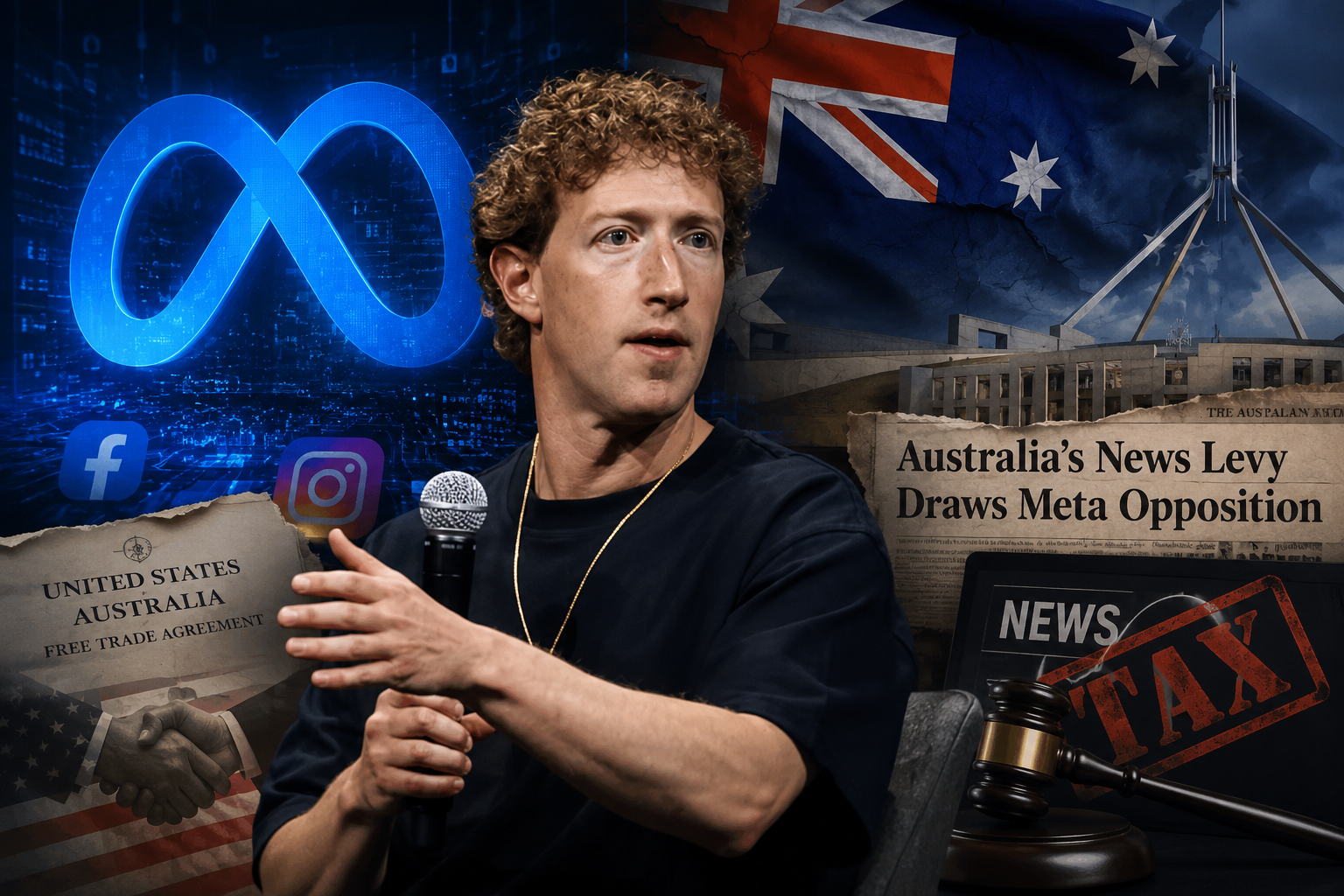
Meta (NASDAQ:META) accused Australia on Thursday of violating its bilateral free trade agreement with the United States by proposing a 2.25 percent levy on the Australian revenue of large digital platforms that do not reach licensing deals with local news publishers, escalating a dispute over paying for journalism that has simmered for five years. This latest development marks a significant intensification of a long-running tension between major technology companies and governments seeking to ensure that journalism receives fair compensation in the digital age. The confrontation highlights the complex interplay between national regulatory ambitions and the international trade commitments that govern relations between major economic partners.
In a blog post published on June 4, Meta articulated its objections in pointed terms, asserting that the proposed News Bargaining Incentive “plainly violates the commitments Australia and the United States made in their bilateral Free Trade Agreement, which commits Australia to grant American companies ‘treatment no less favourable’ than Australian peers.” The company went further, characterizing the measure as “indefensible” and arguing that it applies to all Australian revenue regardless of whether that revenue relates to social media activity. Meta also contended that the proposed levy reached “even broader than existing digital services taxes enacted by some governments which resulted in the United States initiating trade actions,” thereby framing the Australian measure within a context of previous international trade disputes.
The strategic intent behind Meta’s argument appears carefully calibrated to address two distinct audiences: the Australian treasury and the U.S. Trade Representative. The company is not merely contesting whether it must pay the levy; rather, it is framing the measure as precisely the kind of policy that has previously prompted Washington to open trade disputes with other nations. This dual-pronged approach reflects a sophisticated lobbying strategy that seeks to mobilize the weight of U.S. trade policy in support of Meta’s position, transforming what might otherwise be a domestic regulatory matter into an issue of bilateral diplomatic significance.
The specifics of the proposed legislation illuminate the mechanism at the heart of the dispute. Australia’s centre-left government published draft legislation in late April that would impose the 2.25 percent levy on the local revenues of Meta, Google, and TikTok beginning July 1, 2026, unless those platforms negotiate commercial deals with Australian news publishers. The measure would affect platforms earning more than A$250 million locally, while those that strike deals with publishers would receive offsets against the levy. Notably, the legislation offers larger credits for agreements reached with smaller and regional outlets, reflecting a deliberate effort to support the more vulnerable segments of Australia’s news media ecosystem.
Australian officials have framed the initiative as a pragmatic solution to a persistent problem. Communications Minister Anika Wells and Prime Minister Anthony Albanese have described the mechanism as a carrot-and-stick arrangement designed to replace the 2021 News Media Bargaining Code, which the government deemed “ineffective” after Meta walked away from its deals in 2024. This characterization positions the new measure as a corrective response to the perceived shortcomings of earlier regulation, suggesting that the government views direct financial incentives as a more reliable means of securing support for local journalism than the previous voluntary bargaining framework.
The dispute carries broader geopolitical weight that extends well beyond the immediate question of news funding. Under the Trump administration, Australia’s efforts to regulate predominantly U.S.-based technology firms have emerged as a notable point of friction between the two allied nations. Adding to these tensions, a U.S. congressional committee has separately called for Australia’s internet regulator to testify about what it described as a regime of censoring American free speech. These developments suggest that the levy dispute is unfolding within a larger and increasingly contentious conversation about the appropriate boundaries of national regulation when applied to global technology platforms based primarily in the United States.
For its part, the Australian government has emphasized the public-interest rationale underlying the proposed levy. A spokesperson for Australia’s Assistant Treasurer stated that revenue raised by the measure would be returned to support the local news industry’s digital transformation, underscoring the government’s stated commitment to sustaining quality journalism in an era of profound disruption to traditional media business models. This justification frames the levy not as a punitive tax but as an investment in the long-term health and adaptability of Australia’s news sector.
It is important to recognize the current status of Meta’s intervention within this evolving dispute. Meta’s blog post remains a lobbying document rather than a formal legal filing, and whether the trade-agreement claim ultimately gains traction depends largely on whether Washington decides to take up the matter. This distinction is significant, as the practical impact of Meta’s arguments hinges not on their rhetorical force alone but on the willingness of U.S. trade authorities to pursue the issue through official channels. As the July 2026 implementation date approaches, the coming months are likely to prove decisive in determining whether Australia’s ambitious approach to funding journalism will withstand the combined pressure of corporate opposition and international trade considerations. The outcome of this dispute may well establish an influential precedent, shaping how other nations approach the challenge of ensuring fair compensation for journalism in an increasingly digital and globally interconnected media environment.








