

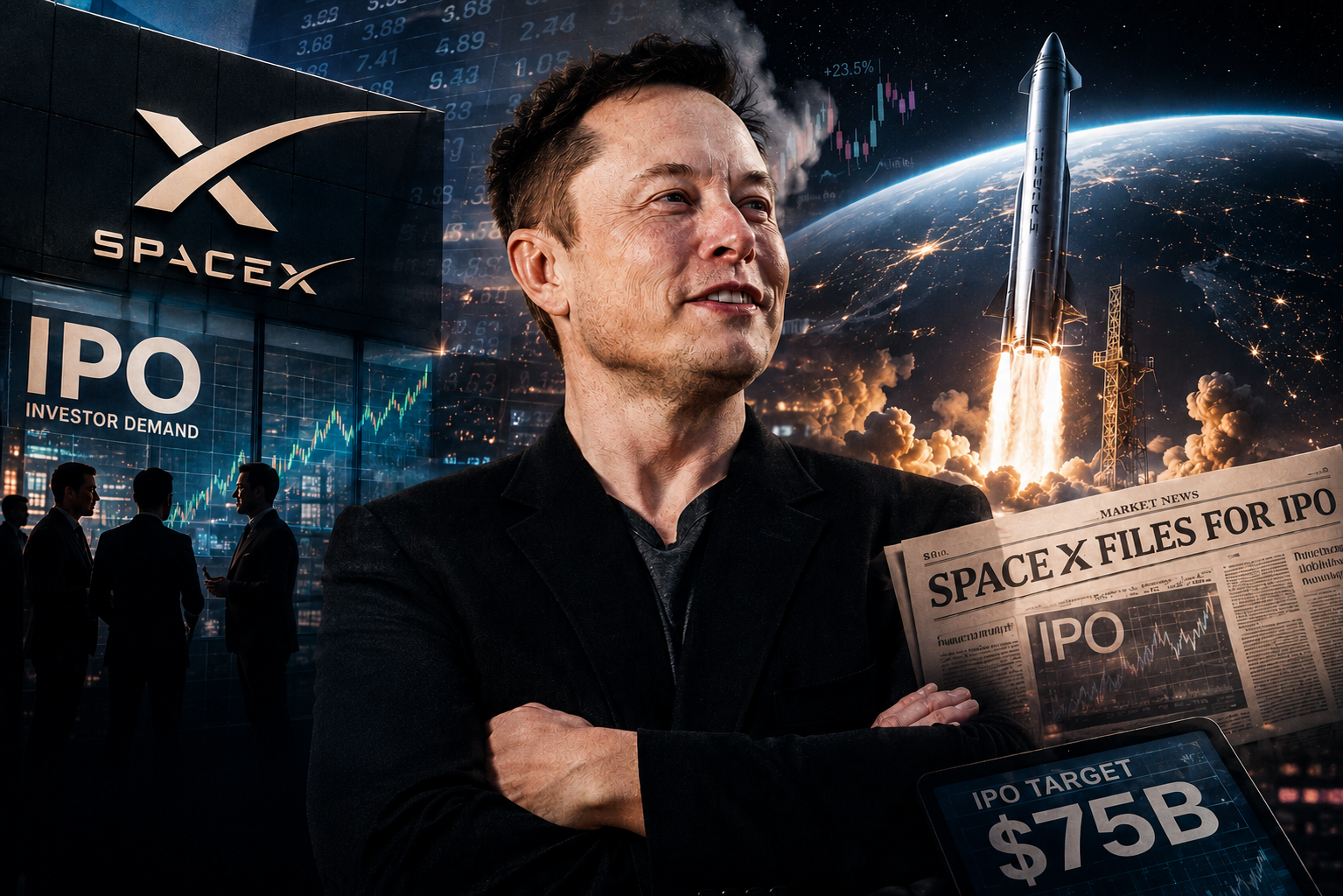
SpaceX’s record-shattering initial public offering is now two times oversubscribed, with approximately $150 billion in investor interest pouring in ahead of the company’s planned Nasdaq debut on June 12, according to Reuters. The $75 billion raise, set at a fixed price of $135 per share, would value Elon Musk’s rocket and satellite company at roughly $1.77 trillion, surpassing even Tesla and marking the largest IPO in history. This extraordinary level of demand underscores the intense enthusiasm surrounding the offering and reflects the considerable appetite among investors to gain exposure to one of the most closely watched private companies in the world as it prepares to enter the public markets. As with any reporting on an unfolding financial event, the figures and details described here reflect what has been reported rather than confirmed final outcomes, and nothing in this article constitutes financial advice.
The company kicked off its investor roadshow on Thursday at JPMorgan headquarters in New York, where CEO Jamie Dimon interviewed Musk, who appeared remotely, in front of 3,500 of the bank’s top clients. The event carried a notable air of spectacle and reverence, with Dimon reportedly opening by praising Musk as the “Edison of our time,” according to Business Insider and Yahoo Finance. Adding a personal touch to the proceedings, Musk’s mother, Maye Musk, made a special guest appearance, lending the roadshow a sense of occasion befitting an offering of such historic proportions. The gathering set the tone for a campaign designed to capture the imagination of investors and convey the grand ambitions underpinning the company’s valuation.
Musk’s pitch leaned heavily on SpaceX’s science-fiction ambitions, framing the offering not merely as a financial opportunity but as a means of funding humanity’s expansion beyond Earth. He told investors that the IPO was necessary to fund solar energy harnessing and planetary colonization, speculating about “moon hotels” and describing Mars as “a fixer-upper of a planet, but it’s got a lot of potential.” These bold visions, characteristic of Musk’s long-standing rhetorical style, were broadcast widely, as the roadshow was streamed to JPMorgan’s affluent clients across 90 locations in 26 states. The presentation sought to position SpaceX as a company whose value lies not only in its current operations but in its capacity to reshape the future of human civilization itself.
The enthusiasm surrounding the offering was vividly reflected in the theatrical displays staged by major Wall Street institutions. Goldman Sachs decorated its Manhattan lobby with rocket ships, while Bank of America lit up its building in the shape of a SpaceX rocket, gestures that captured the celebratory mood and the symbolic significance the financial establishment attached to the debut. These displays, while largely promotional in nature, illustrated the degree to which the SpaceX offering had captured the attention not only of investors but of the broader financial community, transforming what might otherwise be a routine market event into a moment of considerable public fascination.
In a notable departure from typical practice, SpaceX has reserved up to 30 percent of shares for retail investors, far exceeding the typical 5 to 10 percent allocation seen in large-cap IPOs. This expanded access reflects an apparent effort to allow ordinary investors to participate in the historic offering, broadening the base of potential shareholders well beyond institutional players. Reinforcing this accessibility, Fidelity reportedly said that investors would need just $2,000 in their brokerage accounts to access shares, a dramatic reduction from the $500,000 threshold required for previous offerings. Readers considering participation should nonetheless treat these details as reported rather than confirmed and verify the specifics directly with their broker, as terms and eligibility requirements can change.
Adding further fuel to investor enthusiasm, SpaceX disclosed a significant $30 billion deal with Google under which the technology giant will pay $920 million monthly for computing power from xAI’s data centers. The agreement, reported to run from October 2026 through June 2029, would provide access to 110,000 Nvidia GPUs, representing a substantial commercial arrangement that lends tangible commercial weight to the company’s artificial intelligence ambitions. A Google Cloud spokesperson told CNBC and The New York Times that the arrangement was “a short-term, timely agreement” intended to meet surging demand for Gemini Enterprise. This disclosure offered investors a concrete example of the revenue-generating potential embedded within SpaceX’s AI infrastructure pillar, bolstering the broader narrative driving the offering’s valuation.
In terms of the practical timeline, the company plans to list under the ticker SPCX, with pricing targeted for June 11 and trading beginning June 12. Yet amid the excitement, important questions about the company’s underlying financials and valuation persist. SpaceX disclosed a $4.9 billion loss in 2025 on revenues of $18.7 billion, a figure that has prompted some analysts to question whether the $1.77 trillion valuation is truly justified. This tension between the company’s soaring proposed valuation and its present unprofitability remains a central consideration for those weighing the merits of the offering, highlighting the extent to which the valuation rests on optimistic expectations for future growth rather than current earnings.
Further tempering the enthusiasm, S&P announced Thursday that it will not change its rules to allow mega-cap IPOs like SpaceX early entry into the S&P 500, meaning the company will wait at least a year for index inclusion. This decision carries practical implications, as inclusion in major indexes typically generates additional demand from passive investment funds obligated to hold index constituents. The delay therefore removes one potential source of near-term buying pressure, adding a note of caution to the otherwise exuberant atmosphere surrounding the debut. As the targeted June 12 trading date approaches, the SpaceX offering stands as a remarkable convergence of ambition, spectacle, and financial scale, capturing the imagination of Wall Street and the public alike. Whether the company’s lofty valuation will be vindicated by its future performance remains an open question, and readers are encouraged to follow developments through reliable, up-to-date sources as this historic event unfolds.








