

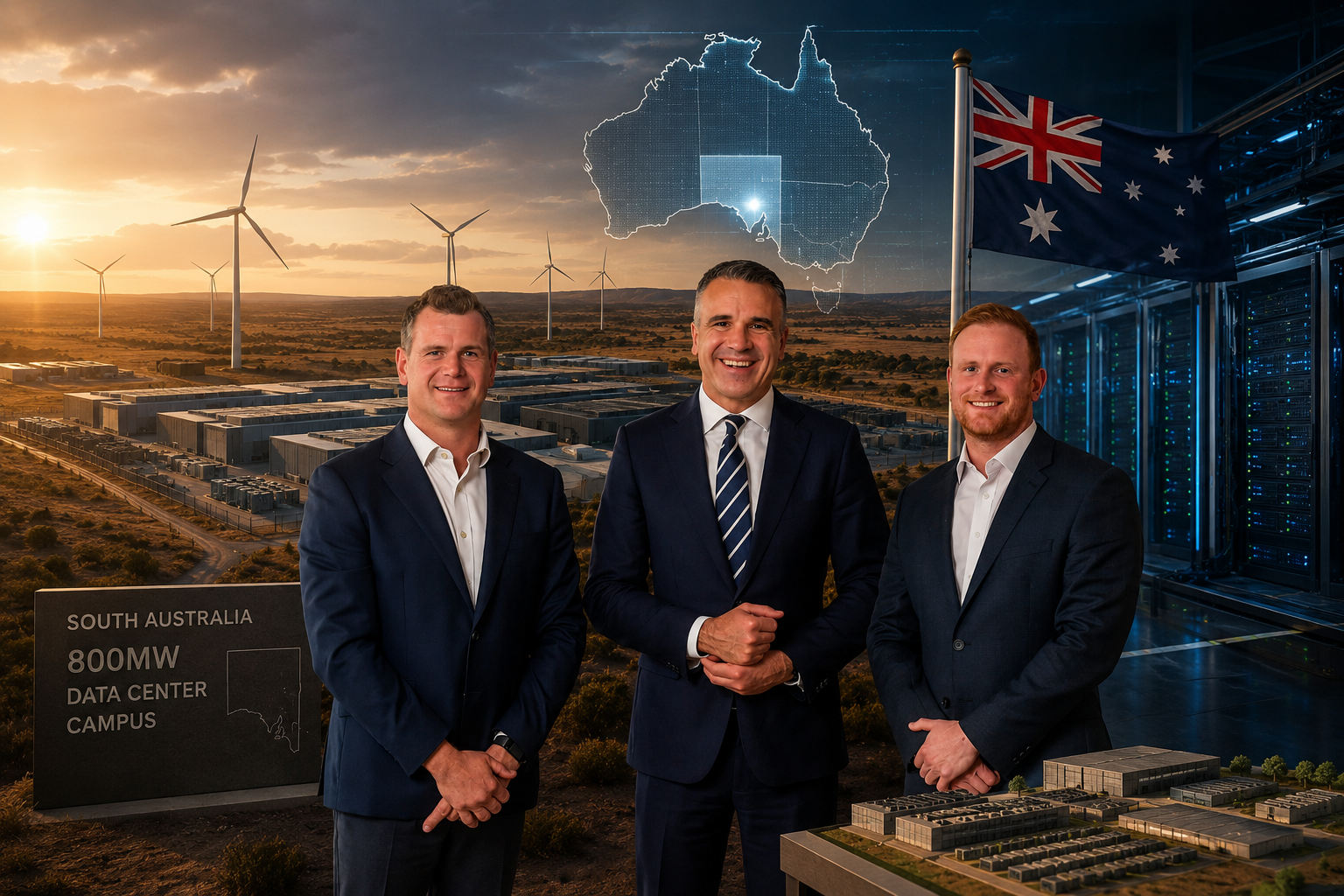
IREN Limited has announced the signing of a transmission connection agreement to support a planned 800MW data center campus in Bundey, South Australia, marking a significant milestone in the company’s expansion across the Asia-Pacific region. Announced from New York on June 3, 2026, the development represents IREN’s first announced Australian data center project and ranks among the largest of its kind in the Asia-Pacific region disclosed to date. The site, located approximately 78 miles northeast of Adelaide, is positioned to capitalize on the surging demand for artificial intelligence infrastructure while drawing upon South Australia’s notable strengths in renewable energy and regional connectivity. This combination of factors situates the project at the intersection of two powerful trends shaping the global technology landscape: the explosive growth of AI computing and the accelerating transition toward clean energy.
The scope and ambition of the project are reflected in its key highlights, which together paint a picture of a substantial and carefully planned undertaking. The 800MW data center campus in Bundey will be supported by a high-voltage transmission connection secured into the utility’s substation, with the facility on track to commence energization from 2028. The site will further benefit from submarine fiber connectivity into key Asia-Pacific demand centers, enhancing its capacity to serve the broader region. Beyond its technical attributes, the development is expected to create over 200 ongoing skilled jobs, in addition to more than 500 positions during the construction phase, underscoring the meaningful economic contribution the project promises to deliver to South Australia and its regional communities.
The strategic rationale behind the project is closely tied to the dynamics of AI demand across the Asia-Pacific region, which stands among the world’s fastest-growing sources of such demand. A significant gap currently exists between projected demand and available infrastructure, creating a compelling opportunity for new developments capable of bridging that divide. South Australia’s grid is particularly well suited to support this kind of energy-intensive facility, as the state targets reaching 100 percent net renewable energy by 2027. The site’s submarine fiber connectivity extends its reach into major regional demand centers including Singapore, Indonesia, South Korea, and Japan, positioning the campus to serve a wide and economically significant market across the region.
From a technical and operational standpoint, the transmission connection agreement provides a robust foundation for the project’s ambitions. The agreement secures four 330kV feeder exits at the utility’s substation, which are expected to support up to 800MW without requiring network upgrades, an important consideration that streamlines the path toward energization. IREN has indicated that it expects to commence early works and procurement in parallel with the satisfaction of regulatory approvals and the conditions stipulated under the transmission connection agreement. This approach suggests a desire to move efficiently toward construction while ensuring that the necessary regulatory and procedural requirements are properly addressed, reflecting a balance between ambition and prudent project management.
The significance of the development was emphasized by Daniel Roberts, Co-Founder and Co-CEO of IREN, who articulated the qualities that make South Australia an attractive location for AI infrastructure at scale. “South Australia offers what AI infrastructure at scale requires: abundant clean energy, the connectivity to serve the APAC region, and a State Government that understands the opportunity and is acting on it,” Roberts stated. He further elaborated on the campus’s broad potential, noting that the Bundey facility “is able to serve global and regional AI demand, as well as South Australia’s own growing need for AI compute.” Roberts expressed enthusiasm for partnering with the Government of South Australia, local communities, and industry to expand domestic access to AI infrastructure, support research and innovation, and help build the skills and jobs that the emerging AI economy requires.
The project also drew strong support from South Australian political leadership, with Premier Peter Malinauskas highlighting the substantial economic opportunity that data centers represent for the state. “Data centres are a significant economic opportunity, which can bring high-quality jobs, stronger renewable energy infrastructure, and new opportunities for regional communities,” Malinauskas observed. He pointed to the state’s distinctive advantages, citing its leadership in renewable energy, record investment in higher education, a pro-jobs and pro-business outlook, and the appointment of the nation’s first dedicated Minister for Artificial Intelligence as factors that uniquely position South Australia to seize the opportunities presented by AI. The Premier characterized IREN’s proposed Bundey campus as a significant investment in the state, with the potential to create hundreds of construction jobs, support long-term skilled roles, and strengthen South Australia’s standing as a technology and innovation hub for the Asia-Pacific region.
As a vertically integrated AI Cloud provider, IREN brings considerable relevant expertise to the undertaking, delivering large-scale data centers and GPU clusters for AI training and inference. The company’s platform is underpinned by an expansive portfolio of grid-connected land and power situated in renewable-rich regions across North America, Europe, and the Asia-Pacific. This established foundation lends credibility to the company’s ambitions in South Australia and reflects a broader strategy of locating energy-intensive AI infrastructure in regions where abundant renewable energy can be harnessed effectively. The Bundey campus thus represents a natural extension of IREN’s existing approach, applied to one of the world’s most promising emerging markets for AI compute.
Taken together, the announcement of the Bundey data center campus signals a meaningful development not only for IREN but for South Australia and the wider Asia-Pacific region. By combining abundant renewable energy, strategic connectivity, supportive government policy, and substantial job creation, the project embodies the kind of large-scale investment that could help define the region’s role in the global AI economy. As the development progresses toward its targeted energization in 2028, it will be watched closely as an indicator of how renewable-rich regions can position themselves to meet the soaring demand for AI infrastructure. Should the project unfold as planned, the Bundey campus may well stand as a landmark example of how clean energy and advanced computing can be brought together to mutual benefit, fostering economic growth, technological advancement, and environmental responsibility in equal measure.








