

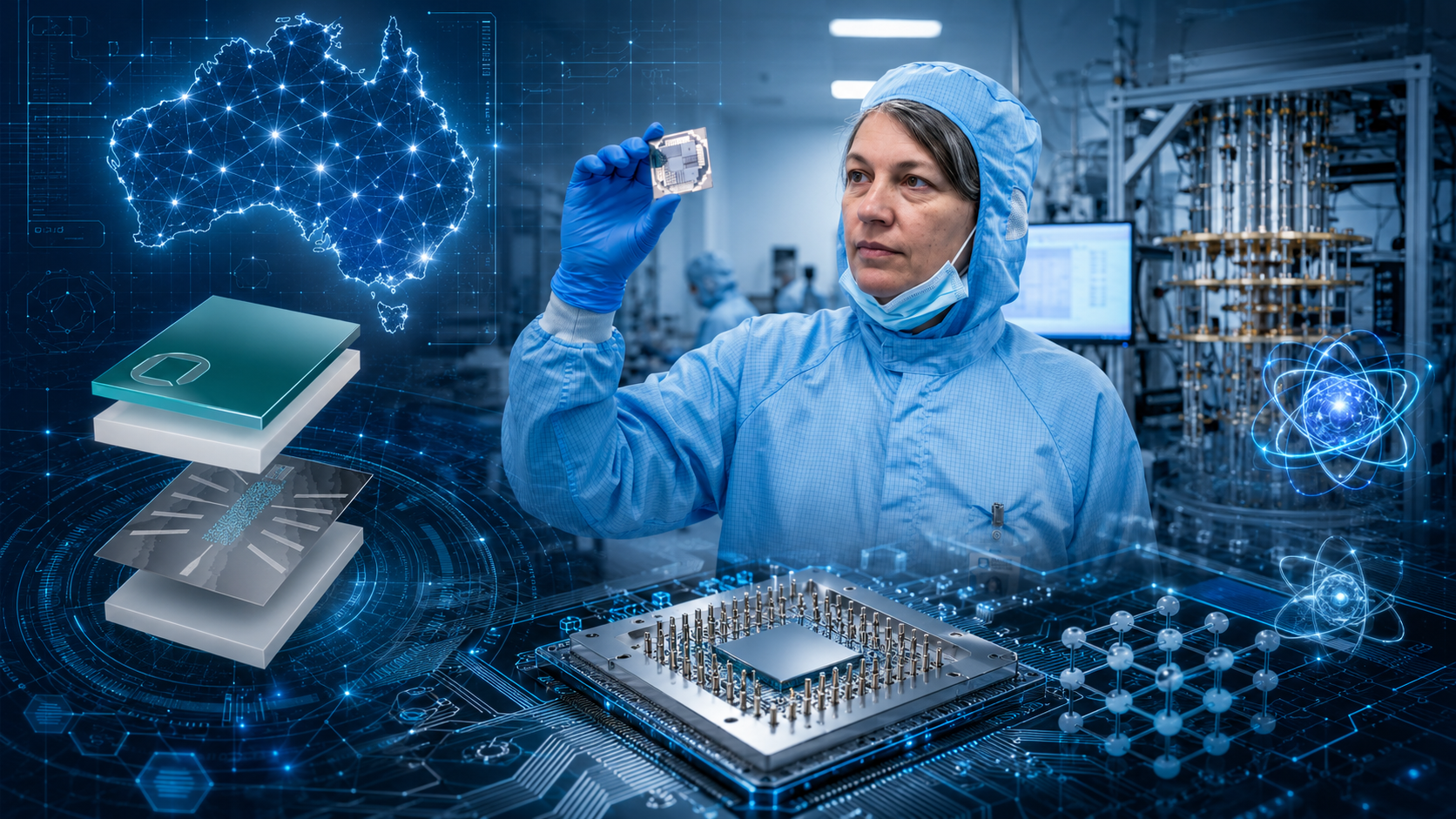
The federal government has tripled its commitment to one of Australia’s most closely watched deep tech companies. The National Reconstruction Fund, known as the NRF, has invested a further $40 million into Silicon Quantum Computing, the Sydney scaleup spun out of the University of New South Wales. The new money arrives barely three months after the fund put in its first $20 million, taking its total backing to $60 million and signalling rare confidence in a field where commercial returns remain years away.
Silicon Quantum Computing, usually shortened to SQC, will direct the capital toward developing and expanding its quantum chip manufacturing capability. That focus matters because manufacturing is where the company believes it holds an edge over the rest of the world. The NRF described SQC as the only company globally able to manufacture quantum chips with atomic precision, while also building quantum enhanced AI products for enterprise and government customers.
The investment sits inside a larger funding round that is still underway. SQC last raised a $50 million Series A in 2023 at a valuation of $195 million, with backers including Commonwealth Bank, Telstra, UNSW and the New South Wales government. Beyond the NRF, the federal government holds roughly a one third stake in the company, the result of $40 million in earlier investments that stretch back to a $25 million commitment in 2017. Few Australian technology companies carry that depth of public ownership, which reflects how strategically Canberra views sovereign capability in quantum hardware.
SQC builds quantum processing units, the chips known as QPUs that sit at the heart of commercial scale quantum systems. The company was founded in 2017 by Professor Michelle Simmons, a former Australian of the Year and a director of the Tech Council of Australia. She remains chief executive and has spent more than two decades pushing the silicon based approach to quantum computing that now underpins the company’s pitch to investors.
What gives SQC its claim to a manufacturing advantage is speed. The company, which employs around 100 people in Sydney, says it can design, produce and test a new quantum chip in under a week. That cycle time is extraordinary in a field where fabrication often takes months, and it allows the company to iterate on designs far faster than rivals who depend on external foundries. SQC has built two products around that capability. The first, called Watermelon, is a quantum machine learning system. The second, Quantum Twins, is a quantum simulator designed to speed up the discovery of new molecules and materials. Customers span energy, logistics, defence and telecommunications, and include Telstra.
Simmons framed the raise as a chance to press home a lead that took 25 years to build. She said the company’s silicon manufacturing capability “gives us a decisive advantage in the global race, and NRFC’s investment allows us to accelerate that mission.” Her argument is that owning the entire fabrication process, rather than outsourcing it, is what separates SQC from a crowded field of well funded competitors in the United States, Europe and China.
NRF chief executive David Gall echoed that view and went further, arguing that Australia sits at the front of the global pack. “SQC’s in-house manufacturing allows the company to iterate significantly faster, and with greater accuracy, than its competitors,” he said. “This gives SQC a critical edge in forging the fastest and most cost-effective path to a commercial-scale quantum computer.” For a government fund created to rebuild Australian industrial capability, quantum hardware represents exactly the kind of high value, hard to replicate technology the NRF was set up to nurture.
The timing of the cheque is notable. The fresh money lands as the federal government’s $470 million investment in American rival PsiQuantum runs into trouble, with that build now facing delays after the project was relocated from Brisbane Airport to Moreton Bay. Against that backdrop, doubling down on a homegrown company with manufacturing already running in Sydney reads as a hedge, and a statement about where Canberra wants the long term value to accrue.
Quantum computing has spent years as a story about promise rather than product, and SQC still has to prove it can scale its chips into a machine that solves problems classical computers cannot. The company is not yet there. What the latest funding buys is time and capacity, and a manufacturing line that can keep churning out new designs while the rest of the industry waits on foundries. If Australia is going to convert its long standing research strength in quantum into a commercial winner, SQC is now the clearest test of whether that bet pays off.
Related reporting: CSIRO Builds Quantum Light Sources to Protect Critical Timing When GPS Is Disrupted.








