

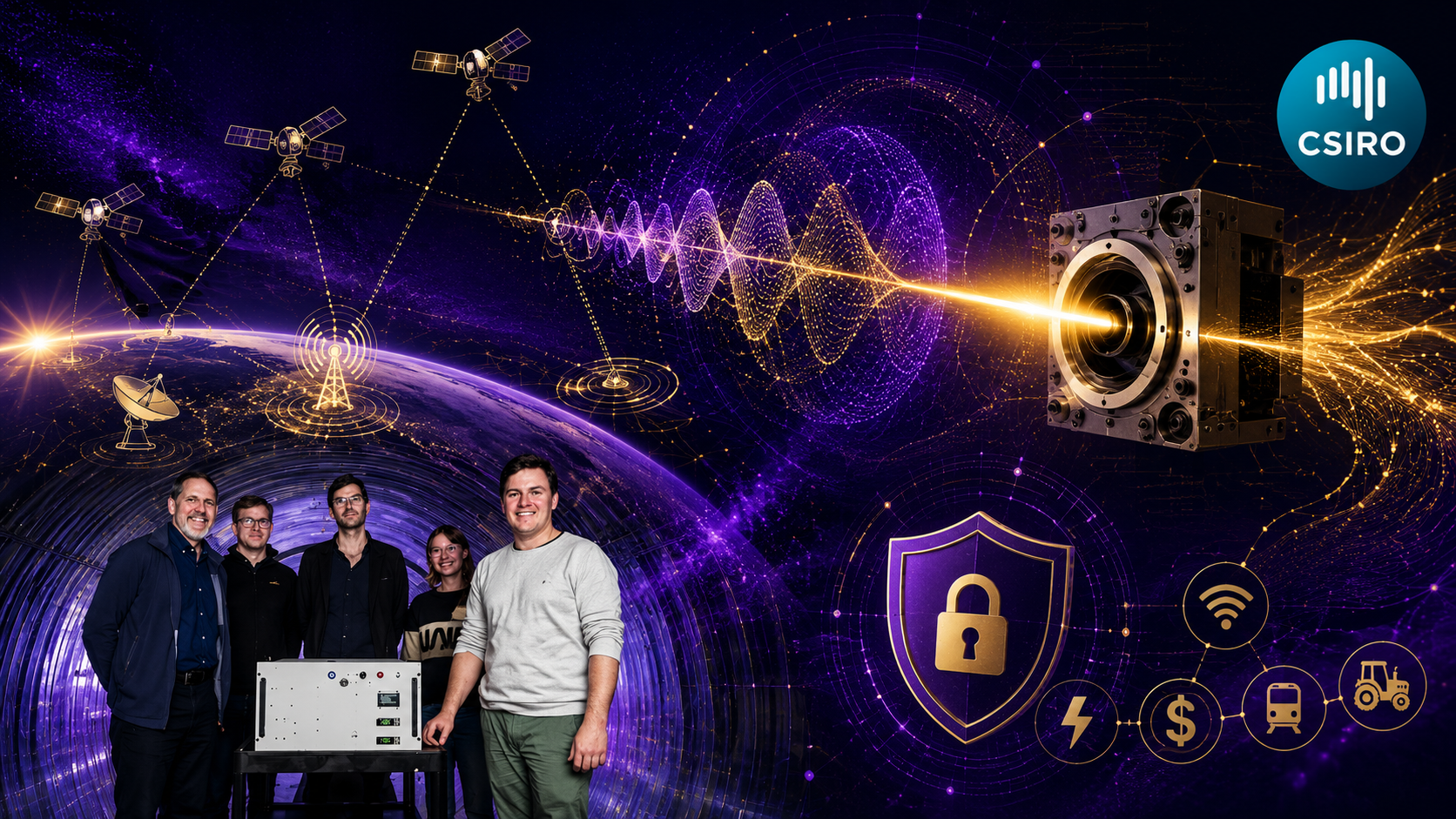
CSIRO has built and delivered two portable quantum light sources designed to keep Australia’s most critical clocks honest when GPS is jammed, spoofed or simply switched off. The devices, handed over to the Defence Science and Technology Group (DSTG) in Adelaide, generate pairs of entangled photons that can carry timing signals between the ground and orbiting satellites, and reveal instantly whether anyone has tampered with them along the way.
CSIRO announced the delivery on 7 July. The quantum light sources are the first completed hardware from a DSTG-led project to build a ground-to-satellite quantum-secured timing network for the Australian Defence Force, a program unveiled by Defence in April 2025 with funding from the Australian Army. The effort also draws in the Australian National University and the University of Western Australia, while the source design itself began life at Heriot-Watt University in Scotland before CSIRO’s engineers translated it into hardware rugged enough to leave the laboratory.
The stakes are bigger than navigation. Satellite timing signals quietly synchronise power grids, mobile networks and the timestamps on financial transactions, and all of it rides on GNSS signals that are faint, unencrypted for civilian use, and increasingly easy to disrupt. Most of that infrastructure takes its time from the satellites for free, with no independent way to check that the signal arriving is the signal that was sent. Jamming drowns those signals out; spoofing, the nastier cousin, feeds receivers convincing lies. A defence force, or a stock exchange, that can’t trust its clocks has a serious problem.
How quantum light sources make timing tamper-proof
At the heart of each device sits a small glass cube that takes photons travelling in opposite directions and locks them into an entangled state, meaning the pair stays quantum-correlated no matter how far apart the photons travel. In the timing network CSIRO and DSTG are working towards, one photon of each pair stays at an optical ground station while its partner is beamed to a satellite hundreds of kilometres overhead. Comparing the two ends of the link gives you a shared clock reference of extraordinary precision.
The security comes from a property spoofers can’t fake. Entanglement is exquisitely sensitive to interference: if anyone intercepts, measures or manipulates the photons in transit, the quantum state changes and the tampering shows up immediately at the receiving end. Because the sources distribute entanglement continuously, operators can verify a link is clean before trusting it, and switch to a different channel the moment something looks wrong. The security rests on physics rather than on encryption schemes that a sufficiently powerful computer might eventually break. A conventional GNSS receiver has no way of knowing it’s being lied to. This system does.
“This work is a significant milestone in the development of quantum-secure time transfer in Australia,” said Dr Matt Broome, the CSIRO technical lead on the project. The engineering challenge was less about the physics, since entangled-photon sources have existed in labs for decades, and more about packaging one as high-flux, portable hardware that can be trucked to an optical ground station and run in the field. That’s the step that separates a physics demonstration from a defence capability.
From contested battlespaces to the power grid
For Defence, the appeal is operating where GPS can’t be trusted. Chief Defence Scientist Professor Tanya Monro framed the program’s ambition when it launched: “Quantum technology presents unique opportunities for Defence, and we continue to leverage these emerging disruptive technologies to provide a capability edge for our soldiers, sailors and aircrew.” Precise, verified timing is what keeps radar networks, encrypted communications and coordinated operations in sync across a contested battlespace, and recent conflicts in Ukraine and the Middle East have shown how routinely GNSS interference now features in modern warfare.
The civilian case may end up mattering just as much. CSIRO points to communications networks, transport systems, power grids and financial services as sectors that depend on satellite timing and would benefit from a tamper-evident alternative. Australia currently has no dedicated sovereign backup for GNSS timing; a hardened national timing capability built on entangled light would change that. “With this work, CSIRO has developed specialised capability, which puts Australia on the path to a more resilient future in global positioning technology,” Broome added. It also slots into Australia’s wider quantum ambitions: sovereign components, secure communications and navigation systems that don’t depend on someone else’s satellites behaving honestly.
There’s something quietly satisfying about the countermeasure here: the defence against the most sophisticated spoofing attacks turns out to be a glass cube that makes light incapable of keeping secrets.
The next phase is the hard one. With the quantum light sources delivered, the project moves towards pairing them with optical ground stations and demonstrating a live quantum-secured timing link between the ground and a satellite, turning two boxes in Adelaide into a working network. If that demonstration succeeds, the same architecture could underpin quantum key distribution for encrypted communications, since the entangled photons that verify a clock can also carry cryptographic keys. Watch for the first ground-to-satellite trials; that’s when Australia finds out whether its timing infrastructure can finally stop taking GPS on faith.








