

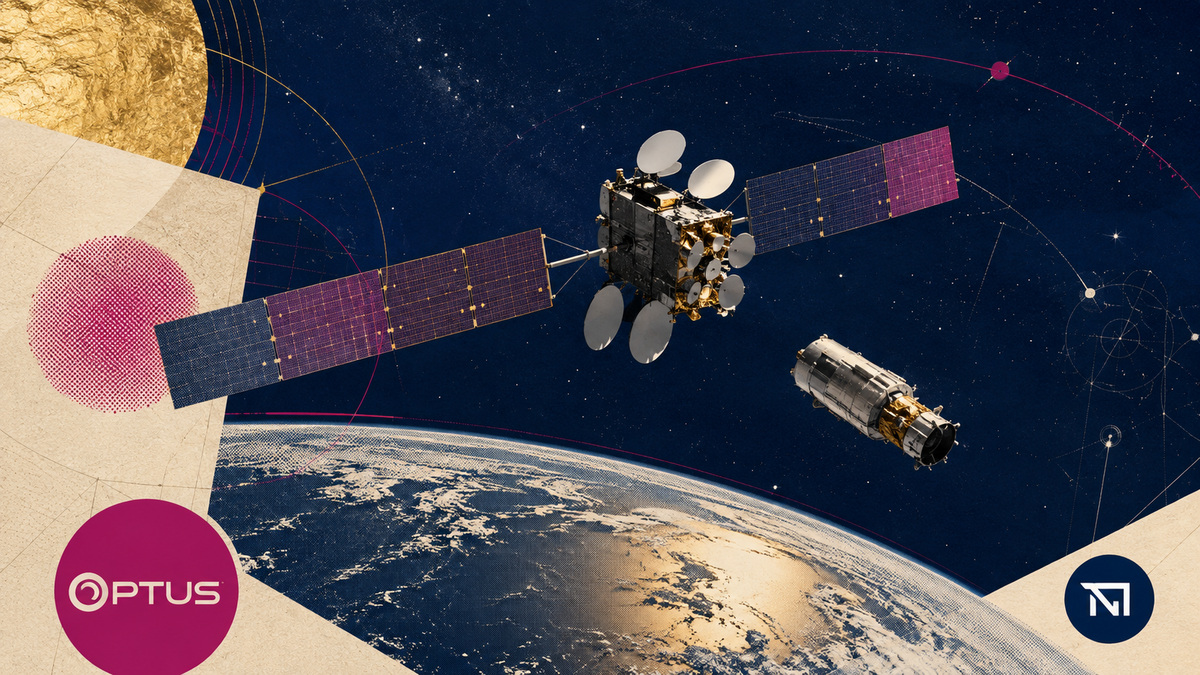
Optus and Northrop Grumman have completed the first phase of Project Aurora, a life extension program for the Optus satellite D3, after a Mission Extension Vehicle undocked from the geostationary communications spacecraft, the companies said in statements released on Tuesday.
The undocking closes out more than a year of on-orbit support. Northrop Grumman’s Mission Extension Vehicle docked with D3 in May 2025 and has provided propulsion and attitude control ever since, keeping the geostationary satellite delivering capacity across Australia and the Asia Pacific while the next stage of the mission was prepared.
That next stage is already in space. Northrop Grumman’s Mission Robotic Vehicle and the Mission Extension Pod launched on a SpaceX Falcon 9 on 21 July, and the robotic vehicle is due to install the pod on D3 in late 2027. Once fitted, the pod is expected to extend the satellite’s working life by up to six years, keeping services running into the 2030s.
The robotic vehicle is built for far more than one job. Spaceflight Now described it as a novel robotic servicing spacecraft beginning a decade-long mission in the geostationary belt, where it can install pods on multiple ageing satellites for different customers over its life.
“These milestones demonstrate how innovative technologies can maximise the value of existing satellite assets while supporting long-term service continuity for customers,” said Harvey Wright, Optus executive general manager for satellite, who leads the division operating the carrier’s geostationary fleet.
The arrangement splits the roles between the two companies. Northrop Grumman operates the robotic servicing vehicle and brings the servicing expertise, while Optus owns and will control the extension pod attached to its satellite.
That ownership structure matters for the Australian operator. Controlling the pod means Optus manages the extended life of D3 with its own team, rather than outsourcing the satellite’s future to a foreign contractor, an approach the company presents as part of building sovereign space capability.
Northrop Grumman’s SpaceLogistics unit remains the only company to have docked commercial servicing spacecraft with satellites in geostationary orbit. Its two earlier Mission Extension Vehicles docked with Intelsat satellites in 2020 and 2021, and the pod design now flying is its lighter, cheaper successor.
For Northrop Grumman, the mission extends a servicing record that began with the first commercial satellite docking in 2020. “Our decade of proven experience in satellite servicing shows that mission-extension technology is here,” said Cassie Wong, the company’s director of logistics and servicing.
Life extension changes the economics of satellites like D3, which has been in orbit since 2009. Geostationary satellites usually retire not because their electronics fail but because they exhaust the fuel needed to hold position, and a replacement spacecraft costs hundreds of millions of dollars and takes years to build and launch.
The Mission Extension Pod approach deals with that directly. The small module attaches to the satellite and takes over station-keeping propulsion, while the satellite’s own systems keep carrying traffic uninterrupted, just as D3 kept serving customers through the year of MEV support.
Servicing also defers the disposal question. Rather than moving D3 to a graveyard orbit and launching a replacement, the pod keeps one existing spacecraft productive, an approach Optus presents as a more sustainable way to run satellite fleets.
The mission also gives Australia a rare position in a young market. Optus has operated Australian communications satellites since the 1980s, and Project Aurora makes it one of the first commercial operators anywhere to buy robotic on-orbit servicing rather than replace a spacecraft.
The Mission Robotic Vehicle and pod will spend the coming months raising their orbit toward the geostationary belt. Docking with Optus D3 is scheduled for late 2027.








