

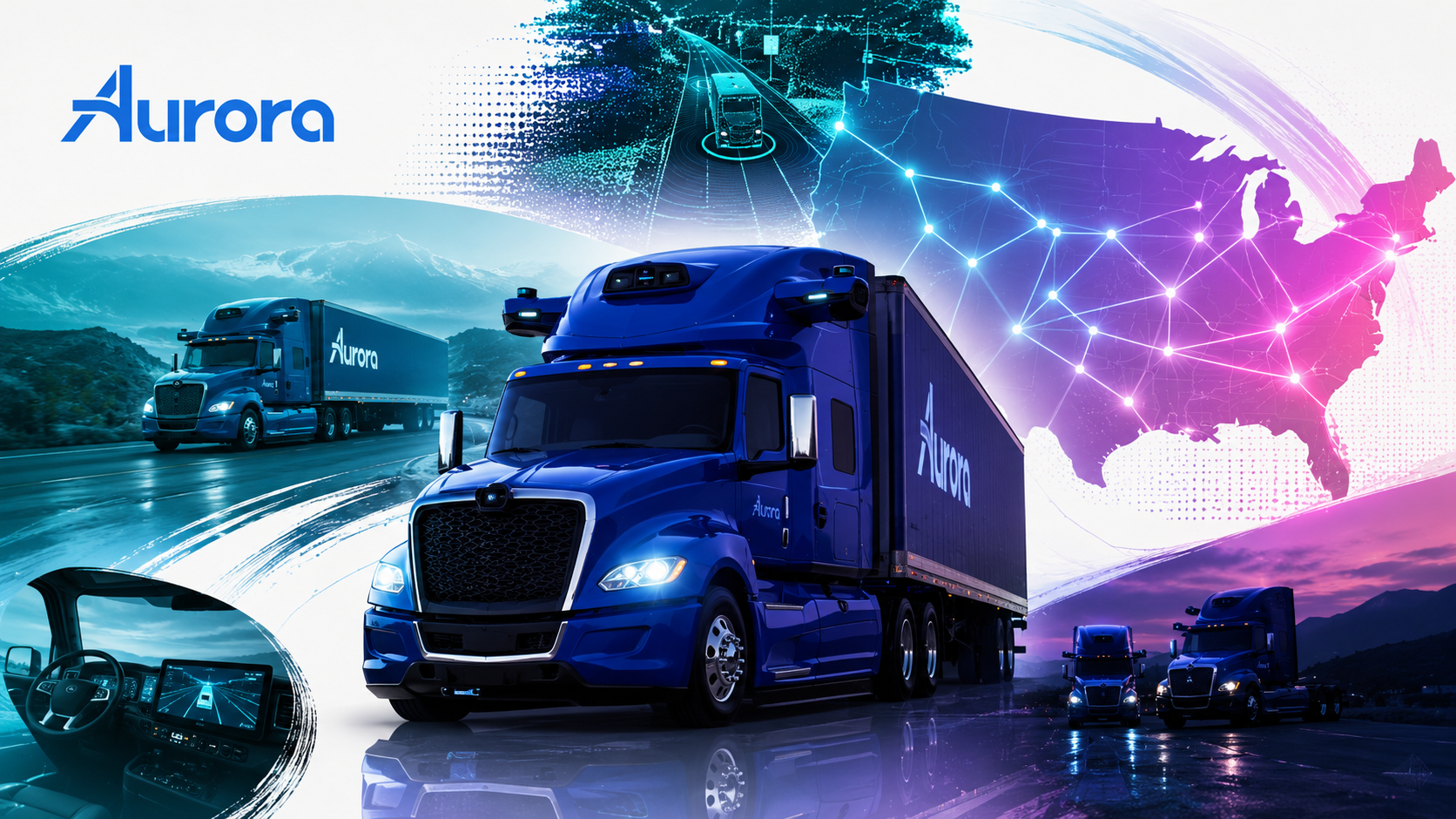
Driverless trucks have officially outgrown the pilot phase. Aurora Innovation this week launched its second-generation autonomous trucks into commercial service in the United States, deploying the new vehicles across its full network of ten driverless routes throughout the American Sun Belt. It is the clearest signal yet that autonomous freight is moving from carefully staged demonstrations towards something resembling ordinary logistics.
The timing tells its own story. Aurora’s fleet had completed nearly 440,000 driverless miles, roughly 708,000 kilometres, as of the end of June, according to the company’s 22 July announcement, and customer demand has outrun what the first-generation trucks could supply. One customer has already committed to purchasing 500 trucks powered by the Aurora Driver, the company’s name for its self-driving system. That is not a trial order. It is a bet that the technology is ready to carry real freight at real volume.
“Deploying our second-generation truck allows us to put hundreds of autonomous trucks on the road and ultimately into the hands of more customers,” Aurora CEO and co-founder Chris Urmson said in the launch announcement. The company had cleared its internal safety case, the structured evidence framework it uses to justify removing humans from the cab, before sending the new platform onto public roads without driver oversight.
Driverless trucks built to last a million miles
The new vehicle is built on the International LT Series truck platform and carries what Aurora describes as next-generation hardware that is more powerful than its predecessor and engineered to survive one million miles of operation. Trade outlets covering the launch have taken to calling the kit Aurora Driver 2, though the branding that matters is on the balance sheet: hardware that lasts the working life of a truck changes the economics of every load it hauls.
Durability is only half the pitch. The other half is endurance of a kind no human driver can legally match. A software update rolled out in February allows Aurora’s trucks to run the roughly 1,000 mile lane between Fort Worth and Phoenix nonstop in about 15 hours, according to TechCrunch. American federal hours-of-service rules cap human truck drivers at 11 hours behind the wheel before a mandatory 10 hour rest, which means the same journey with a person in the seat takes considerably longer. Urmson called that capability “the dawn of a superhuman future for freight” at the time. The Phoenix corridor now sits inside a ten-route network that also links Dallas, Houston, Fort Worth, El Paso and Laredo, a web Aurora tripled in size back in February.
Getting the human out of the cab has been a slower journey than the headlines suggest. Aurora’s original driverless launch came in 2025 on the Dallas to Houston lane, but trucks built on PACCAR platforms kept an observer on board at the manufacturer’s request. TechCrunch reported in February that the International LT platform, the same one underpinning this week’s launch, was the vehicle Aurora planned to run with nobody aboard at all. That plan is now reality across the network.
One number Aurora has not published is the size of its current fleet. The launch announcement talks routes and miles rather than truck counts, and the most recent public figure dates to February, when TechCrunch reported the company was operating about 30 trucks, ten of them without drivers. What Aurora will say is where it is heading: the company told investors in February it expects to field more than 200 driverless trucks by the end of 2026.
From ten routes to a thousand trucks
Scaling is the point of this launch, and Aurora is not doing it alone. Manufacturing partner Roush is installing the redundant vehicle systems and integrating Aurora’s hardware at a dedicated production facility, with the pair targeting an annual production run-rate of 1,000 trucks by the end of the year. “By working with a world-class manufacturing partner like Roush, we can meet our customer demand and continue to make the movement of goods safer and more efficient across the country,” Urmson said in Aurora’s announcement. The company’s orbit of partners now reads like a freight industry directory: PACCAR, Volvo Trucks, NVIDIA, FedEx, Uber Freight, Schneider, Ryder, Werner, Hirschbach and McLane among them.
The safety ledger will decide how fast any of this goes. As of January, Aurora reported zero collisions attributed to the Aurora Driver across its driverless operations, a record it will need to protect as the fleet multiplies from tens of trucks into hundreds. Every additional truck is another roll of the dice on public roads, and a single serious incident could stall the entire industry’s regulatory goodwill. A truck that never sleeps is an easy sell to freight customers; the hundreds of thousands of people who drive them for a living may take a dimmer view of the superhuman future.
The next test is whether the production line can keep pace with the order book. If Roush hits its 1,000 truck run-rate and Aurora’s 500 truck customer takes delivery, driverless trucks stop being a technology story and become a capacity story. Watch the Sun Belt lanes over the next six months. The trucks rolling past may increasingly have nobody inside, and for Aurora, that is precisely the point.








