

No Result
View All Result
Techord
Subscribe
  • AI
  • Tech
  • Robotics
  • Science
  • Gadgets
  • AI
  • Tech
  • Robotics
  • Science
  • Gadgets
No Result
View All Result
No Result
View All Result
Techord
Subscribe
Home Robotics

Tesla Cybercab Surfaces on New Zealand Roads for Winter Testing

Aman Chamlagain by Aman Chamlagain
September 8, 2026
in Robotics, Tech
0
Tesla Cybercab Surfaces on New Zealand Roads for Winter Testing
0
SHARES
9
VIEWS
Share on FacebookShare on Twitter

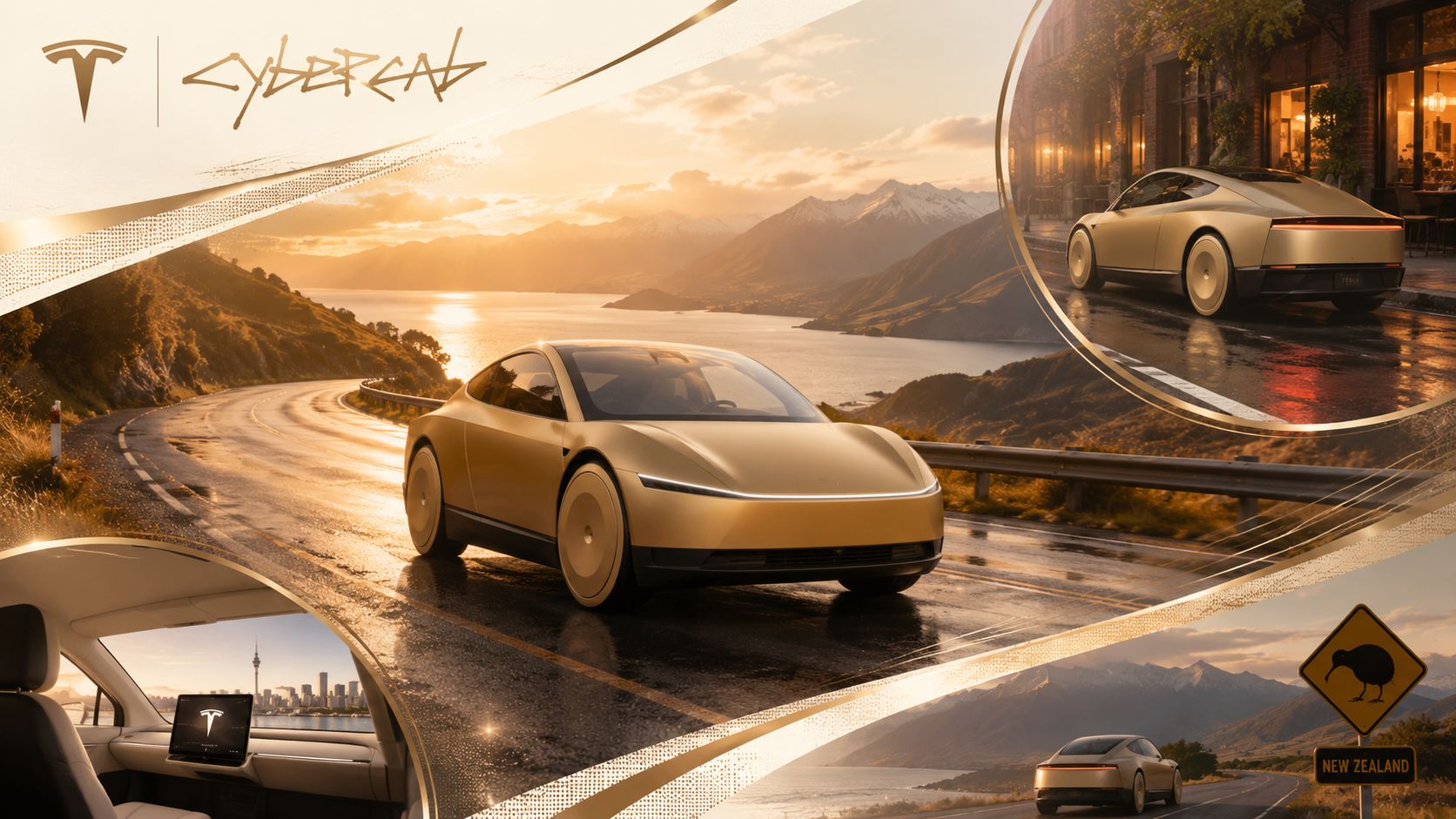
The Tesla Cybercab has turned up about as far from Texas as a prototype can get. Video footage shared by New Zealand car spotters shows a pair of gold-wrapped Cybercab prototypes travelling on South Island roads, the first time Tesla’s purpose-built robotaxi has been seen anywhere in the Southern Hemisphere. The catch, for anyone hoping the two-seater was chauffeuring itself past the Southern Alps: the footage shows the cars riding on the back of a transporter, not driving.

The destination explains the journey. The vehicles are widely reported to be bound for the Southern Hemisphere Proving Grounds near the Cardrona ski field, in the mountains between Queenstown and Wanaka, a facility international carmakers routinely use to put vehicles through cold-weather validation while the northern half of the planet is enjoying summer. Filmed in mid June by a member of the Rare and Unique Car Spotting New Zealand Facebook group and shared widely on X, the sighting kicked off a round of coverage from CarExpert, Not a Tesla App and New Zealand’s motoring press. For a car Tesla wants in volume production within months, a Central Otago winter is a free stress test.

@Teslarati spotted a cybercab in Wānaka New Zealand – probably snow testing pic.twitter.com/MGr03mEZh6

— Stephen Hillier (@thebigwillymase) July 24, 2026

Tesla itself has stayed quiet. Auto Trader NZ reported that NZ Autocar approached a Tesla Australia representative who was unable to comment on the sighting, so the company has not publicly confirmed what the programme covers. The educated guess from most observers is the obvious one: batteries, sensors and autonomy hardware all behave differently in freezing temperatures and on icy roads, and Tesla’s camera-only approach to self-driving gives it particular reasons to care about frost, glare and low winter sun. A fleet designed to run around the clock in any city Tesla can win approval for cannot afford to be a fair-weather machine, and cold-climate validation is a box every global carmaker has to tick before committing to production.

Why the Tesla Cybercab is testing in Central Otago

Cold is the enemy of almost everything a robotaxi depends on. Lithium-ion batteries lose range and charge more slowly in low temperatures, camera lenses fog and ice over, and packed snow rewrites the lane markings an autonomy stack relies on. That is why the proving ground near Cardrona has become a winter fixture for global manufacturers, and why a June arrival makes sense for a vehicle Tesla is racing to finish. New Zealand offers deep winter conditions in the middle of the American summer, which effectively doubles the number of cold-weather development windows in a year.

There is one detail in the footage that undercuts the sci-fi image. According to CarExpert, the test units seen in New Zealand appear to be fitted with steering wheels, marking them as left-hand-drive development cars rather than the production robotaxi, which famously does without a steering wheel or pedals altogether. A robotaxi with a steering wheel is a fair metaphor for where autonomy sits in 2026: nearly ready, still hedging.

The Tesla Cybercab itself has been public since October 2024, when Elon Musk unveiled the two-seat, butterfly-doored runabout at Tesla’s We, Robot event in California, pitching it at a price of about US$30,000 and promising volume production before 2027. The program has been gathering pace on the other side of the Pacific. Not a Tesla App reported that production ramp-up began at Gigafactory Texas around April, with more than 100 units staged at the facility by June, and on 30 June Tesla’s own X account posted footage of the car navigating Austin with the caption “Engineering tests of the first production Cybercab have begun in Austin”. Those American test cars carry no steering wheel, no accelerator and no brake pedal. The Cybercab is eventually meant to slot into the robotaxi network Tesla has been operating in Austin since June 2025, replacing the Model Y vehicles that currently do the work.

OMG look how many Tesla Cybercab are out on the track at Giga Texas rn

With @scotsrule08 doing all the boots on the ground work today together pic.twitter.com/sHqL9nSVYE

— David Moss (@DavidMoss) July 7, 2026

What happens next

The New Zealand cars will spend the Southern winter doing unglamorous work: cold soaks, battery cycling, sensor checks and lap after lap of frozen test track, with the possibility of appearances on nearby public roads as the programme progresses. If more footage emerges from the Queenstown Lakes district over the coming weeks, it will offer the best public look yet at how the Tesla Cybercab copes outside the Texas sunshine.

The bigger questions sit with regulators and factories rather than proving grounds. Tesla still has to show that a car with no manual controls can satisfy safety rules in every market it wants to enter, and the company has not confirmed any plans to bring the Cybercab to Australia or New Zealand as a commercial product. Nothing about a southern test campaign guarantees a southern launch; plenty of cars have frozen at Cardrona and never gone on sale here.

Still, the sight of Tesla’s most radical vehicle being trucked past paddocks on the South Island says something about how close the Cybercab is to the finish line. Companies do not ship prototypes 12,000 kilometres for fun. The next time a Tesla Cybercab is filmed in New Zealand, it may well be moving under its own authority, and that video will travel a great deal further than the transporter did.

Related reporting: Tesla Cybercab Robotaxi Launches Paid Rides in Austin.

Tags: autonomous systemsautonomous vehiclescold-weather testingCybercabElon MuskNew ZealandRobotaxiTesla
Aman Chamlagain

Aman Chamlagain

Aman Chamlagain is the founder and editor of Techord, the Australian technology news site he started in 2026. He writes across the site's coverage of artificial intelligence, robotics and consumer tech, with a consistent interest in what global technology decisions mean for people living and working in Australia. His reporting tends to follow the same thread: the distance between what a company announces and what actually ships, and who carries the cost of that gap. He covers the major AI labs and the models they release, robotics as it moves from demonstration into real work, and the hardware readers are weighing up buying. He also sets Techord's editorial standards, including its rules on primary sourcing, verbatim quotes and disclosed AI use. Aman handles tips, corrections and pitches personally. He can be reached at amannchamlagai07@gmail.com.

  • Trending
  • Comments
  • Latest
SpaceX IPO Draws $150 Billion in Demand, Doubling Its Target Ahead of Historic Debut

SpaceX IPO Draws $150 Billion in Demand, Doubling Its Target Ahead of Historic Debut

September 5, 2026
Apple Appoints New Leader to Advance Non-Invasive Blood Glucose Monitoring Project

Apple Appoints New Leader to Advance Non-Invasive Blood Glucose Monitoring Project

August 14, 2026
Bosch Partners with UK Startup Humanoid to Manufacture HMND 01 Robots at Scale

Bosch Partners with UK Startup Humanoid to Manufacture HMND 01 Robots at Scale

September 8, 2026
Nvidia CEO Jensen Huang Says Field of Study Won’t Matter in the AI Era

Nvidia CEO Jensen Huang Says Field of Study Won’t Matter in the AI Era

August 14, 2026
Nvidia CEO Jensen Huang Says Field of Study Won’t Matter in the AI Era

Nvidia CEO Jensen Huang Says Field of Study Won’t Matter in the AI Era

0
Apple Appoints New Leader to Advance Non-Invasive Blood Glucose Monitoring Project

Apple Appoints New Leader to Advance Non-Invasive Blood Glucose Monitoring Project

0
BYD Launches Dolphin G DM-i, Its First Vehicle Designed Exclusively for Europe

BYD Launches Dolphin G DM-i, Its First Vehicle Designed Exclusively for Europe

0
Hyundai Launches Atlas Robot World Cup Campaign Ahead of Massive 25,000-Unit Factory Rollout

Hyundai Launches Atlas Robot World Cup Campaign Ahead of Massive 25,000-Unit Factory Rollout

0
Editorial collage of Singapore's waterfront skyline with a schematic link between Singapore and Australia.

Australian AI Companies Target Singapore’s Enterprise Market

October 15, 2026
Editorial illustration of an Arkeus Warden sensor with a separate Drone Forge portfolio aircraft in the background.

Drone Forge and Arkeus Explore New Sensing Capabilities for Autonomous Aircraft

October 15, 2026
Editorial collage of Kingswood railway station and a Hume Highway bridge with restrained amber monitoring motifs.

NSW Trials Smart Sensors to Detect Danger on Railways and Highways

October 15, 2026
Editorial montage of CSIRO's yellow uncrewed survey vessel on coastal water and seagrass in murky water below.

Australian Researchers Trial Robots to Map Seagrass in Murky Water

October 15, 2026

Recent News

Editorial collage of Singapore's waterfront skyline with a schematic link between Singapore and Australia.

Australian AI Companies Target Singapore’s Enterprise Market

October 15, 2026
Editorial illustration of an Arkeus Warden sensor with a separate Drone Forge portfolio aircraft in the background.

Drone Forge and Arkeus Explore New Sensing Capabilities for Autonomous Aircraft

October 15, 2026
Editorial collage of Kingswood railway station and a Hume Highway bridge with restrained amber monitoring motifs.

NSW Trials Smart Sensors to Detect Danger on Railways and Highways

October 15, 2026
Editorial montage of CSIRO's yellow uncrewed survey vessel on coastal water and seagrass in murky water below.

Australian Researchers Trial Robots to Map Seagrass in Murky Water

October 15, 2026
Techord

Techord: Australian technology news.

Techord is an Australian technology publication covering AI, robotics, science, gadgets and electric vehicles, with news and context for Australian readers.

Browse Categories

  • AI

Recent News

Editorial collage of Singapore's waterfront skyline with a schematic link between Singapore and Australia.

Australian AI Companies Target Singapore’s Enterprise Market

October 15, 2026
Editorial illustration of an Arkeus Warden sensor with a separate Drone Forge portfolio aircraft in the background.

Drone Forge and Arkeus Explore New Sensing Capabilities for Autonomous Aircraft

October 15, 2026
  • About Techord
  • Contact
  • Privacy Policy
  • Terms
  • Submit a Tip

© 2026 Techord. All rights reserved.

Welcome Back!

Login to your account below

Forgotten Password?

Retrieve your password

Please enter your username or email address to reset your password.

Log In
No Result
View All Result
  • Home
  • AI
  • Robotics
  • Science
  • Future Tech
  • Big Tech
  • Latest News

© 2026 Techord. All rights reserved.


