

No Result
View All Result
Techord
Subscribe
  • AI
  • Tech
  • Robotics
  • Science
  • Gadgets
  • AI
  • Tech
  • Robotics
  • Science
  • Gadgets
No Result
View All Result
No Result
View All Result
Techord
Subscribe
Home Tech

Tesla Lithium Refinery Feeds Its First US-Sourced Cybertruck

Aman Chamlagain by Aman Chamlagain
September 5, 2026
in Tech
0
Tesla Lithium Refinery Feeds Its First US-Sourced Cybertruck
0
SHARES
15
VIEWS
Share on FacebookShare on Twitter

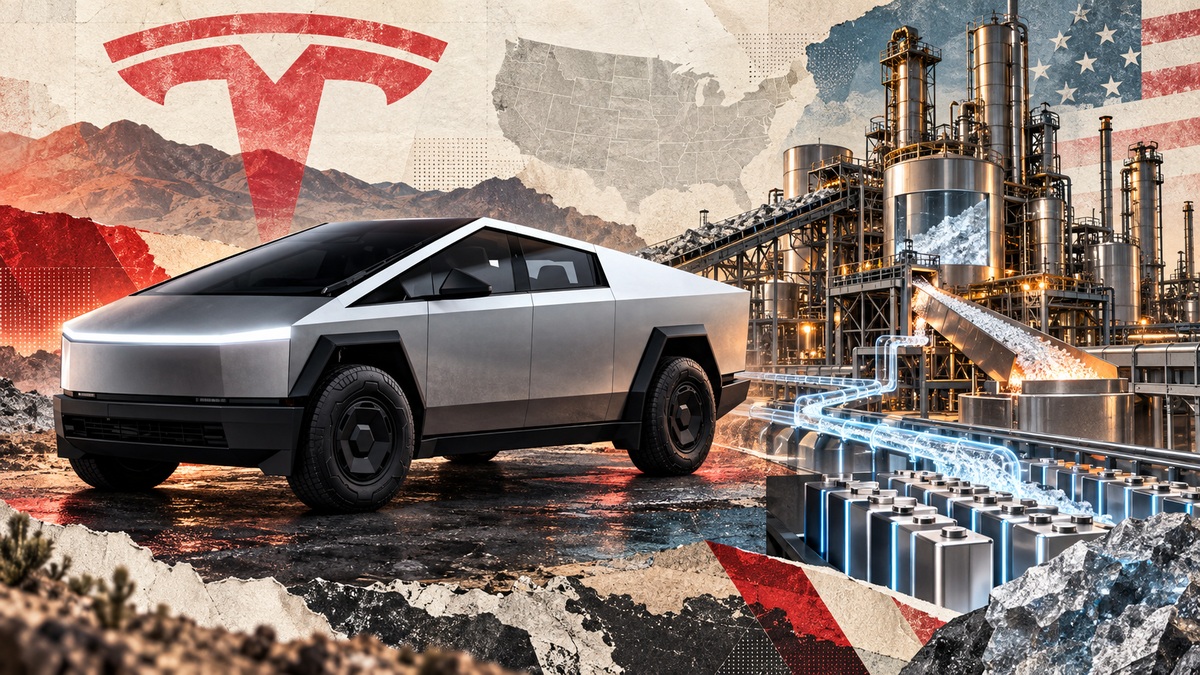
The first Cybertruck built with cells using lithium from the Tesla lithium refinery in Texas has come off the line, the company’s Cybertruck account said on X on Saturday: “First Cybertruck made with 4680 cells containing lithium from our Gulf Coast Lithium Refinery.”

Elon Musk marked the milestone with three words. “Lithium made in America,” he wrote, sharing the post.

Lithium made in America https://t.co/3AOd3RLpcp

— Elon Musk (@elonmusk) September 4, 2026

Cybertruck lead engineer Wes Morrill, who made TIME’s 2024 climate list for the truck program, marked the moment in his own post as the close of a loop that began when Musk arrived at the Robstown site in May 2023 with a Cybertruck full of shovels for the groundbreaking. Lithium now flows from that plant to Giga Texas, into the large-format 4680 cells made there, and into the vehicle the refinery was built to feed.

The company set the target at that 2023 groundbreaking of producing enough refined lithium to support about a million electric vehicles a year. Today’s confirmed output is more modest, but the direction has held.

Accounts differ on exactly when refining began at the site outside Corpus Christi, with Teslarati dating first operations to December 2024, about 19 months after ground was broken, while other coverage marks large-scale production from January 2026. What is settled is the current state: at the company’s Lithium Day event in July, EVwire reported plant manager Jason Bevan calling the facility “complete and fully ramped,” and infrastructure vice president Rodney Westmoreland Jr describing it as “North America’s only lithium refinery of its kind.”

The plant is the first large-scale battery-grade lithium refinery in the United States, built for roughly US$375 million. It produces about 20,000 metric tonnes of lithium hydroxide monohydrate a year, enough to support roughly 30 GWh of battery production, and earlier company guidance pointed to as much as 50 GWh of support at full volume.

The process is as unusual as the location. Tesla’s alkaline leaching route is the first industrial deployment of acid-free lithium refining, eliminating the sulfuric acid used in conventional hard-rock processing, cutting greenhouse gas emissions by 30 per cent and reducing water discharge by about 80 per cent through closed-loop operation. Tesla is still hiring at the site as output ramps.

“This investment is critical to our mission to accelerate the world’s transition to sustainable energy and represents our efforts to aggressively increase the supply of battery-grade lithium hydroxide available in North America,” Tesla said of the project when it committed to the site. The company set out that goal before a single tonne had been processed at Robstown.

The strategic weight sits in one statistic. Estimates published around the refinery’s launch put China’s share of the world’s lithium chemical output at about two-thirds, with industry figures running as high as 73 per cent, and before Robstown the United States had no large-scale battery-grade lithium refinery at all. Australia has long mined more lithium than any other country and ships most of it to China for processing, though Fastmarkets projects China could take the mining top spot in 2026.

Washington has spent the year hardening that supply argument. The Federal Communications Commission banned imports of new foreign-made humanoid robots in July on national security grounds, the Pentagon keeps expanding its list of Chinese companies with alleged military ties, and domestically refined battery minerals fit the same push to pull critical technology inside US borders.

Tesla is also working on what happens after the cells wear out. A recycling patent published this year, application WO2026048253A1, describes recovering high-purity materials from spent cells using water vapour condensation and heat-recovery loops instead of sulfuric acid leaching, and battery vice president Bonne Eggleston presented the approach at the July event.

Between the refinery, the cell lines and the recycling patent, Tesla is assembling a loop that runs from ore to cell to recovered material inside the United States. The refinery’s output now flows to Giga Texas as 4680 production scales through the rest of 2026, with the first domestically supplied Cybertruck already off the line.

Tags: batteriescritical mineralsCybertruckElon MuskEVlithiumTeslaWes Morrill
Aman Chamlagain

Aman Chamlagain

Aman Chamlagain is the founder and editor of Techord, the Australian technology news site he started in 2026. He writes across the site's coverage of artificial intelligence, robotics and consumer tech, with a consistent interest in what global technology decisions mean for people living and working in Australia. His reporting tends to follow the same thread: the distance between what a company announces and what actually ships, and who carries the cost of that gap. He covers the major AI labs and the models they release, robotics as it moves from demonstration into real work, and the hardware readers are weighing up buying. He also sets Techord's editorial standards, including its rules on primary sourcing, verbatim quotes and disclosed AI use. Aman handles tips, corrections and pitches personally. He can be reached at amannchamlagai07@gmail.com.

  • Trending
  • Comments
  • Latest
SpaceX IPO Draws $150 Billion in Demand, Doubling Its Target Ahead of Historic Debut

SpaceX IPO Draws $150 Billion in Demand, Doubling Its Target Ahead of Historic Debut

September 5, 2026
Apple Appoints New Leader to Advance Non-Invasive Blood Glucose Monitoring Project

Apple Appoints New Leader to Advance Non-Invasive Blood Glucose Monitoring Project

August 14, 2026
Bosch Partners with UK Startup Humanoid to Manufacture HMND 01 Robots at Scale

Bosch Partners with UK Startup Humanoid to Manufacture HMND 01 Robots at Scale

September 8, 2026
Nvidia CEO Jensen Huang Says Field of Study Won’t Matter in the AI Era

Nvidia CEO Jensen Huang Says Field of Study Won’t Matter in the AI Era

August 14, 2026
Nvidia CEO Jensen Huang Says Field of Study Won’t Matter in the AI Era

Nvidia CEO Jensen Huang Says Field of Study Won’t Matter in the AI Era

0
Apple Appoints New Leader to Advance Non-Invasive Blood Glucose Monitoring Project

Apple Appoints New Leader to Advance Non-Invasive Blood Glucose Monitoring Project

0
BYD Launches Dolphin G DM-i, Its First Vehicle Designed Exclusively for Europe

BYD Launches Dolphin G DM-i, Its First Vehicle Designed Exclusively for Europe

0
Hyundai Launches Atlas Robot World Cup Campaign Ahead of Massive 25,000-Unit Factory Rollout

Hyundai Launches Atlas Robot World Cup Campaign Ahead of Massive 25,000-Unit Factory Rollout

0
Editorial collage of Singapore's waterfront skyline with a schematic link between Singapore and Australia.

Australian AI Companies Target Singapore’s Enterprise Market

October 15, 2026
Editorial illustration of an Arkeus Warden sensor with a separate Drone Forge portfolio aircraft in the background.

Drone Forge and Arkeus Explore New Sensing Capabilities for Autonomous Aircraft

October 15, 2026
Editorial collage of Kingswood railway station and a Hume Highway bridge with restrained amber monitoring motifs.

NSW Trials Smart Sensors to Detect Danger on Railways and Highways

October 15, 2026
Editorial montage of CSIRO's yellow uncrewed survey vessel on coastal water and seagrass in murky water below.

Australian Researchers Trial Robots to Map Seagrass in Murky Water

October 15, 2026

Recent News

Editorial collage of Singapore's waterfront skyline with a schematic link between Singapore and Australia.

Australian AI Companies Target Singapore’s Enterprise Market

October 15, 2026
Editorial illustration of an Arkeus Warden sensor with a separate Drone Forge portfolio aircraft in the background.

Drone Forge and Arkeus Explore New Sensing Capabilities for Autonomous Aircraft

October 15, 2026
Editorial collage of Kingswood railway station and a Hume Highway bridge with restrained amber monitoring motifs.

NSW Trials Smart Sensors to Detect Danger on Railways and Highways

October 15, 2026
Editorial montage of CSIRO's yellow uncrewed survey vessel on coastal water and seagrass in murky water below.

Australian Researchers Trial Robots to Map Seagrass in Murky Water

October 15, 2026
Techord

Techord: Australian technology news.

Techord is an Australian technology publication covering AI, robotics, science, gadgets and electric vehicles, with news and context for Australian readers.

Browse Categories

  • AI

Recent News

Editorial collage of Singapore's waterfront skyline with a schematic link between Singapore and Australia.

Australian AI Companies Target Singapore’s Enterprise Market

October 15, 2026
Editorial illustration of an Arkeus Warden sensor with a separate Drone Forge portfolio aircraft in the background.

Drone Forge and Arkeus Explore New Sensing Capabilities for Autonomous Aircraft

October 15, 2026
  • About Techord
  • Contact
  • Privacy Policy
  • Terms
  • Submit a Tip

© 2026 Techord. All rights reserved.

Welcome Back!

Login to your account below

Forgotten Password?

Retrieve your password

Please enter your username or email address to reset your password.

Log In
No Result
View All Result
  • Home
  • AI
  • Robotics
  • Science
  • Future Tech
  • Big Tech
  • Latest News

© 2026 Techord. All rights reserved.


