

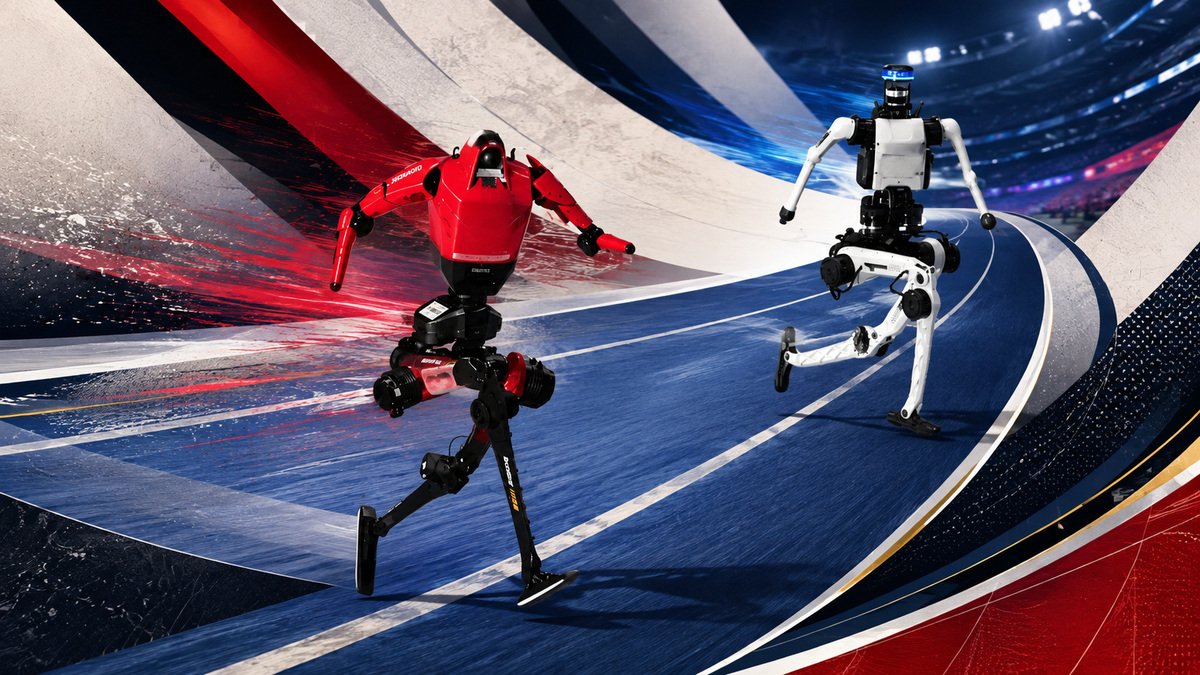
A Chinese humanoid robot ran 100 metres in 9.39 seconds on the opening day of the second World Humanoid Robot Games in Beijing on Saturday, beating Usain Bolt’s 9.58 second human world record before stumbling into the sidelines.
The winner was Tiangong Ultra, built by the state-backed Beijing Humanoid Robot Innovation Center, with Lightning, a robot from smartphone maker Honor, second in 9.47 seconds. Both machines beat the mark Bolt set at the 2009 world championships in Berlin, and both would have lapped last year’s field: Tiangong Ultra won the same race at the inaugural games in 21.50 seconds.
The times sit outside official athletics, which records human performance only, so Bolt’s 9.58 still stands. The robots set a machine benchmark rather than an athletics record, and the finishes showed how raw the technology remains.
The finishes were chaotic. A thick mat sits metres past the line to catch sprinters that cannot brake cleanly, and Tiangong Ultra slammed into it before stumbling wildly into the sidelines as onlookers scattered. Lightning collapsed to the ground and was carried away on a stretcher.
Lightning arrived as the favourite on paper. The robot stood 169 centimetres before researchers added 10 centimetres to its legs for the games, and it clocked 9.32 seconds in a preparatory test with a peak speed of 14.5 metres per second. In April it won the 21 kilometre Beijing half-marathon in 50 minutes and 26 seconds.
Human marks fell elsewhere on the schedule too. A robot from Beijing-based X-Humanoid cleared 2.88 metres in the standing high jump, well past the 2.45 metres Cuba’s Javier Sotomayor set in 1993, though his mark came in the running high jump with a full approach. Another machine ran 400 metres in 39.7 seconds, inside Wayde van Niekerk’s world record.
The games run from 22 to 26 August at the National Speed Skating Oval, built for the 2022 Winter Olympics. This year’s edition brings 2,056 robots from 666 teams across 16 countries and six continents, including entries from Germany, Japan and the United States, competing in 51 events that span football, table tennis and kickboxing along with work trials such as cable connection, EV charging and restaurant tasks. A robotic hands event tests precision handling down to opening bottles and prying lids, and more than 1,000 individual contests are scheduled across the five days.
Spectators treated the record runs as a spectacle in their own right. “These sports are perfectly normal for humans, but now robots can do them. I find it amazing,” said spectator Yang Shangzheng.
Chinese industry figures were more careful about what the sprint times prove. “Only when it can work in those end scenarios does it have real value. Simply running and jumping does not improve efficiency,” said Yu Chao, chief executive of Lumos Robotics, pointing to the work events rather than the track. Hua Rong, chief marketing officer at robotics firm Zeroth, made a similar point, saying what matters is whether products “can really solve users’ problems” once they are sold commercially.
The games share the week with the 2026 World Robot Conference in Beijing, where about 3,000 products are on show, and they land in the middle of a widening technology contest with Washington. The US Federal Communications Commission banned imports of new foreign-made humanoid robots last month on national security grounds, and the Pentagon has added Unitree to its list of companies it says have ties to the Chinese military. Unitree shares still jumped more than fivefold in their Shanghai trading debut on 19 August, valuing China’s best-known humanoid maker at about US$50 billion.
Competition at the National Speed Skating Oval continues through the week. The second World Humanoid Robot Games close in Beijing on Wednesday 26 August.








