

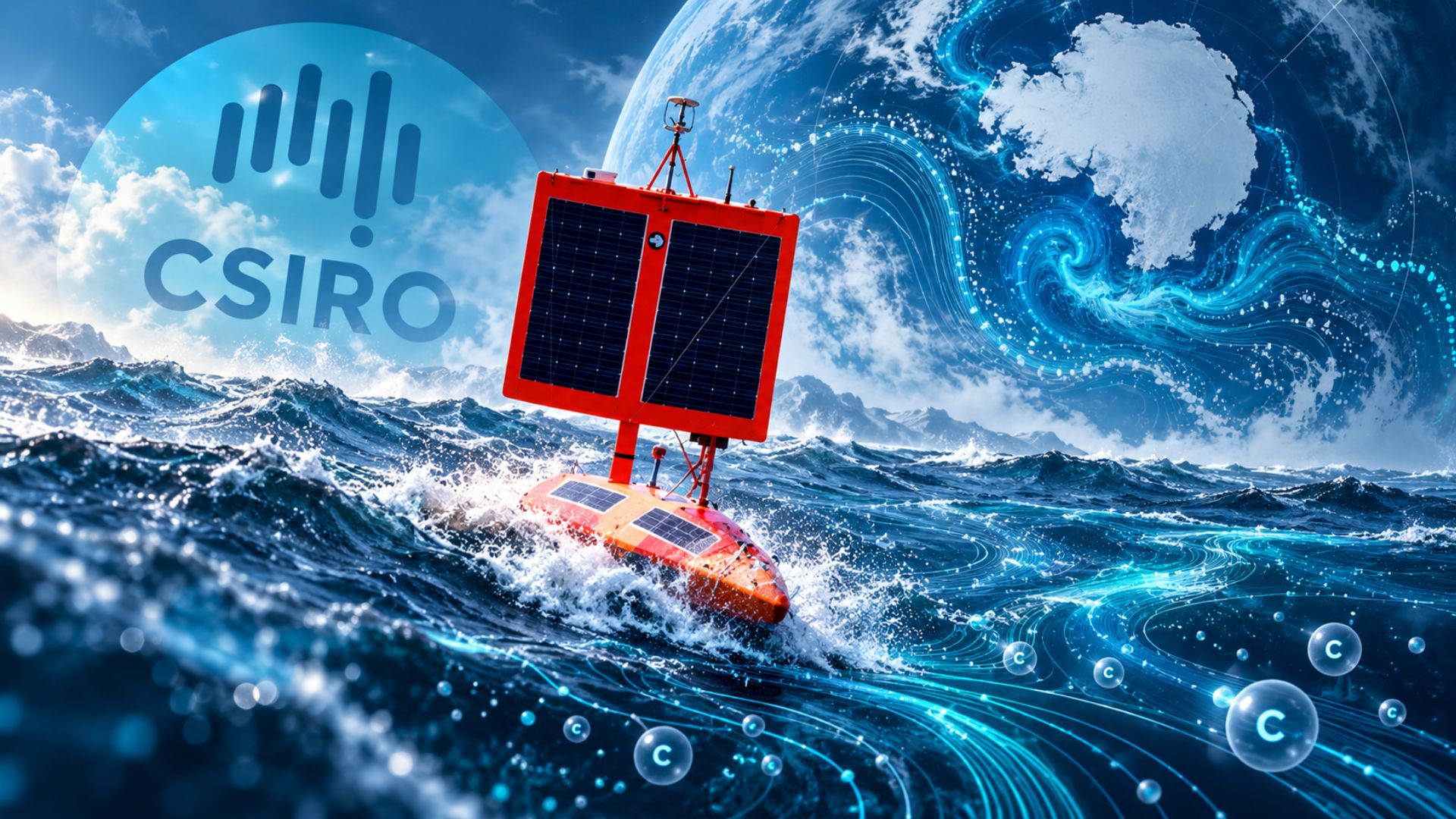
CSIRO announced on 24 September 2026 that its first Saildrone had departed Hobart for research in the Southern Ocean. The agency says the project plans to use four autonomous vehicles over five years, collecting ocean and atmospheric measurements. The aim is to improve understanding of how much carbon dioxide moves between the sea and the air.
The vessels use wind for propulsion and solar energy for onboard systems. CSIRO says they can remain at sea for months, collecting measurements including temperature, salinity, oxygen and carbon dioxide alongside atmospheric conditions. That combination matters because interpreting an ocean carbon measurement requires knowledge of the surrounding physical environment as well as the gas itself.
Hobart provides the departure point for an international research effort. CSIRO lists collaborators including the Australian Antarctic Program Partnership, NOAA, the University of Washington, Columbia University and Saildrone. The planned repeated deployments are intended to build a record through changing conditions. They should not be read as four completed journeys or five years of observations already in hand.
The project’s name describes the central scientific problem being addressed. COCO2, or Constraining Ocean Carbon with Optimized Observing, aims to reduce uncertainty using missions informed by models and adaptive planning. In practical terms, researchers want to learn which measurements would be most useful, then adjust subsequent observing routes rather than simply repeat an unchanged itinerary.
NOAA’s public mission record identifies the 2026 Saildrone 1092 dataset and describes that approach. Its programme summary calls for four vehicles departing Hobart in each project year, with new observations used to improve the following campaign. The record is evidence that measurements are being organised and made available; it is not yet a conclusion about the Southern Ocean’s overall carbon balance.
Earlier voyages show both the possibility and difficulty of this work. NOAA reported that Saildrone 1020 completed a 196-day autonomous circumnavigation of Antarctica in August 2019. The vessel continued gathering carbon dioxide data despite an iceberg encounter that damaged some sensors. That experience provides background for the new campaign, rather than a guarantee that every planned deployment will finish intact.
The carbon question also requires observations across seasons and locations. NOAA’s account describes how winds and circulation can alter uptake, with some conditions allowing the Southern Ocean to release carbon dioxide. Sparse measurements during harsh weather make those exchanges harder to quantify. A vessel’s capacity to remain at sea can help fill gaps, but the resulting measurements still need analysis and comparison.
The Australian contribution is therefore a sustained observing capability based in Hobart. The most meaningful results will come from how the collected data changes estimates and guides the next deployment. For now, the programme has begun putting instruments into remote waters; its scientific conclusions remain work for the years ahead.








