

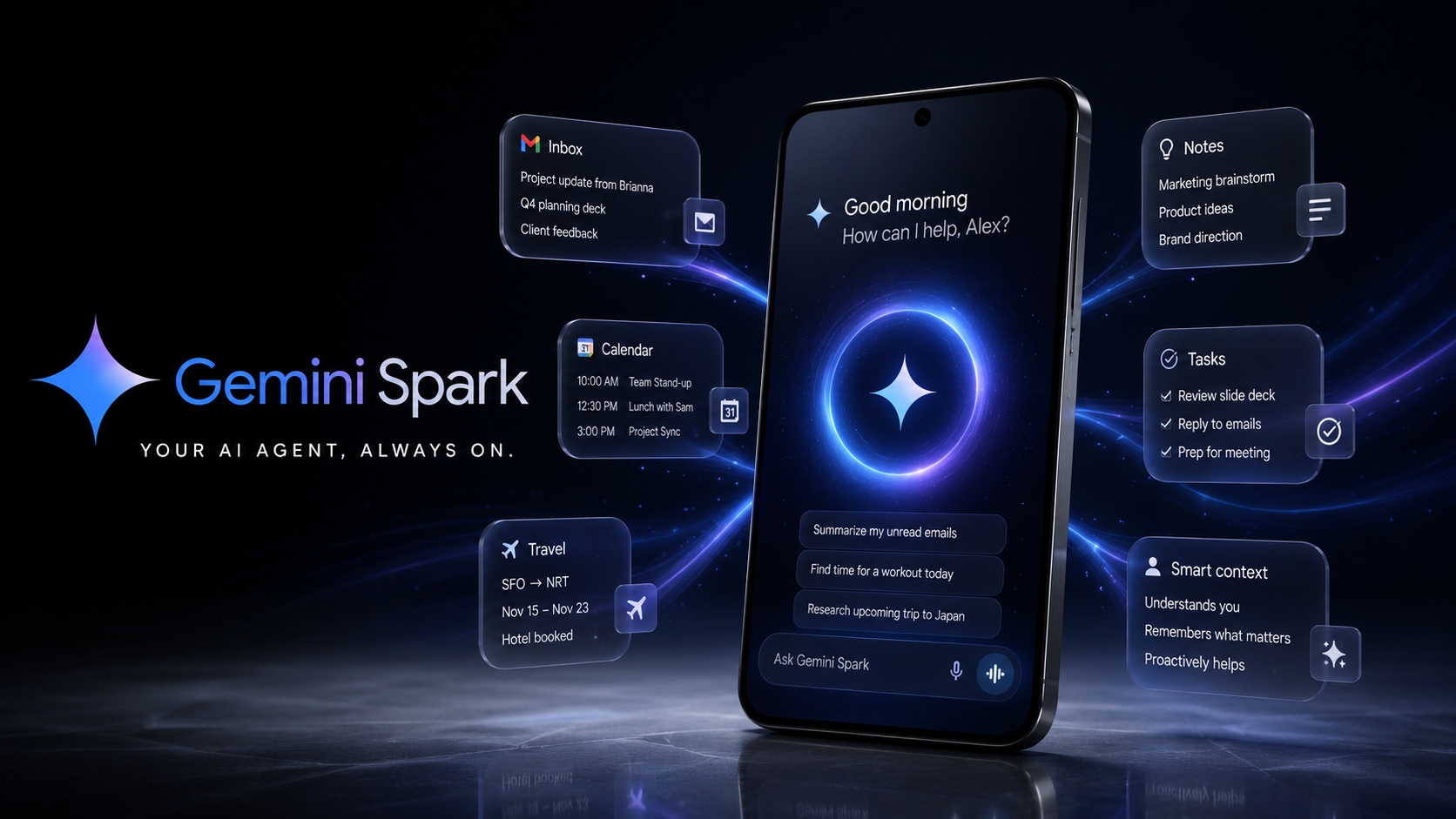
Google has officially rolled out Gemini Spark, its highly anticipated 24/7 personal AI agent, to Google AI Ultra subscribers in the United States. Following its preview at Google I/O, this launch signals a major shift in the artificial intelligence landscape, moving away from conversational chatbots toward autonomous, always-on persistent agents. Remarkably, these agents run continuously in the background on Google Cloud, executing tasks even when a user’s phone or laptop is completely powered down. This development represents a fundamental reimagining of how personal AI assistants operate and the role they can play in users’ daily lives.
What distinguishes Gemini Spark from conventional AI assistants is its proactive and continuous nature. Unlike standard assistants that passively wait for a user prompt before responding, Gemini Spark is built on Google’s new Gemini 3.5 Flash model and the Antigravity platform, enabling it to operate continuously under user direction. The agent integrates natively with Google Workspace and selected third-party applications, allowing it to execute complex, multi-step workflows that previously would have required significant manual effort and ongoing attention from the user.
The system is thoughtfully organized around three core pillars that define how users interact with and direct the agent. The first pillar, Tasks, allows users to define high-level, complex objectives, such as finding and tracking interior design internships in a specific city for the summer. The second pillar, Schedules, enables users to set time-based or conditional triggers, for example instructing Spark to scan an inbox every Monday morning, recap important updates, and block out deep-work time on the calendar. The third pillar, Skills, empowers users to teach Spark repetitive, customized routines to create personalized tools, such as analyzing past emails to build a specific writing style guide that functions as a personalized ghostwriter.
Among its most powerful capabilities is Workspace orchestration, which allows Spark to seamlessly cross-reference information across Gmail, Calendar, Docs, Sheets, and Drive. This integration enables sophisticated automation, such as tracking invoices or identifying hidden subscription fees, automatically extracting inquiry data from emails, logging leads into a Google Sheet, and formatting new project folders in Drive, all without manual intervention. This deep interconnection across Google’s productivity tools transforms how users can manage their digital workflows, eliminating tedious tasks and freeing time for higher-value activities.
Beyond the boundaries of Google’s own ecosystem, Spark offers robust live web browsing and research capabilities. The agent can navigate the live web to perform deep research, compare vendor pricing for projects, or coordinate group trips by aggregating receipts and sending updates to a group. This ability to operate across the broader internet significantly expands the agent’s utility, allowing it to function as a genuinely versatile assistant capable of handling real-world tasks that extend well beyond document management and scheduling.
The expanding ecosystem surrounding Gemini Spark further enhances its practical value through Model Context Protocol integration. At launch, Spark offers direct third-party integrations with several prominent services, including Canva for design, OpenTable for restaurant bookings, and Instacart for groceries. Google has also announced upcoming partnerships with Adobe, Uber, Spotify, and Booking.com, signaling an ambitious roadmap for expanding the agent’s reach across diverse aspects of users’ personal and professional lives. This growing network of integrations positions Spark as a central hub for coordinating an increasingly wide range of digital services.
Recognizing the importance of trust and safety in an autonomous agent with such extensive capabilities, Google has emphasized that Spark operates strictly under user control. The system is specifically designed to seek explicit user authorization and to check in with the user before executing major actions or transactions. This careful approach to security reflects an awareness of the sensitivities involved in granting an AI agent the ability to act independently, ensuring that users retain meaningful oversight and control over the agent’s activities.
In terms of pricing and availability, Gemini Spark is exclusive to the Google AI Ultra plan, the premium tier tailored for developers, power users, and advanced creators. The newly structured Ultra plan is priced at $100 per month and includes a comprehensive suite of perks alongside access to Gemini Spark. Subscribers receive priority access to the Antigravity agentic development platform, 20TB of cloud storage, Gemini Omni for multimodal video creation, and YouTube Premium. The agent operates within a compute-based infrastructure limit, allowing users to run up to 15 automated tasks simultaneously, a constraint that reflects the substantial computational resources required to power such persistent, autonomous operations.
Looking ahead, Google plans to progressively scale Spark over the coming months, introducing a range of new features that will further enhance its capabilities. Upcoming additions include local browser controls, custom sub-agents, and the ability to interact with Spark directly via SMS or email. These planned enhancements suggest that Google views Gemini Spark not as a finished product but as an evolving platform with considerable room for growth. As the technology matures and its capabilities expand, Gemini Spark may well represent a defining moment in the transition toward truly autonomous personal AI agents, fundamentally reshaping how people interact with technology and manage the complexities of modern digital life.
Related reporting: Microsoft Unveils Scout, an Always-On Autonomous AI Agent, at Build 2026.








