

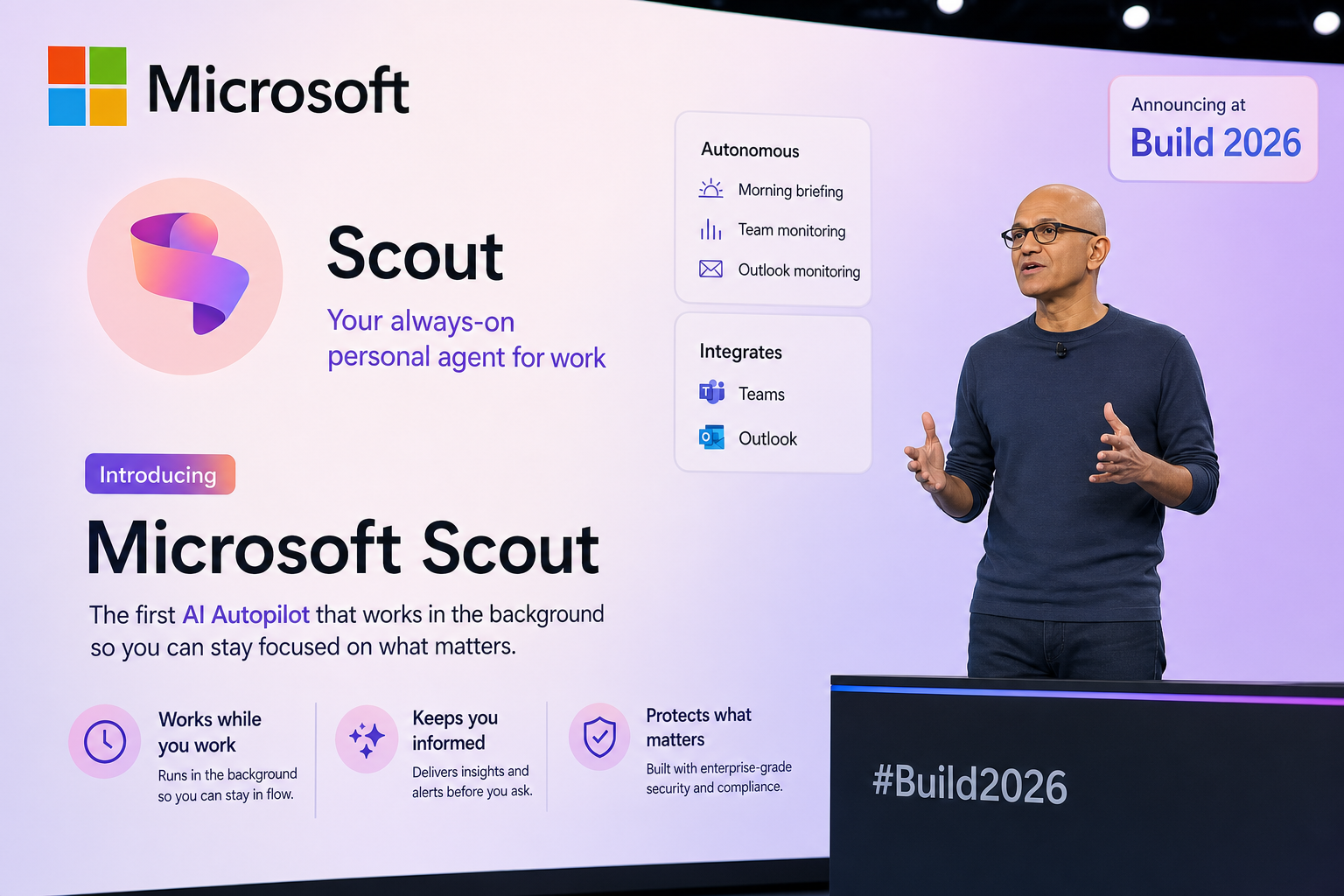
Microsoft introduced Scout at its Build 2026 developer conference on Tuesday, marking the company’s entry into what it calls “Autopilots,” a new class of AI agents that operate autonomously in the background without requiring user prompts. This launch represents a notable evolution in Microsoft’s approach to artificial intelligence, moving beyond the responsive, query-driven model that has characterized many AI assistants toward a more proactive and continuous form of support. By positioning Scout within an entirely new category of agents, Microsoft signaled its ambition to redefine how users interact with AI in the workplace, anticipating a future in which intelligent systems anticipate needs and take initiative rather than simply awaiting instructions.
The technical foundation of Scout reflects a combination of open-source innovation and Microsoft’s own proprietary capabilities. Scout is built on the open-source OpenClaw framework and Microsoft’s proprietary Work IQ intelligence layer, integrating across Microsoft 365 applications including Teams, Outlook, OneDrive, and SharePoint. This deep integration positions Scout to operate seamlessly within the tools that many organizations already rely upon, allowing it to draw upon a rich array of data and context from across a user’s digital work environment. The pairing of an open framework with a specialized intelligence layer illustrates Microsoft’s strategy of building upon community-driven foundations while layering its own distinctive technology to deliver enterprise-focused functionality.
What sets Scout apart from existing offerings becomes clear when comparing it to Microsoft’s established Copilot product. Unlike Copilot, which responds to direct queries within Microsoft 365 applications, Scout works continuously, handling tasks such as scheduling meetings across time zones, flagging upcoming deliverables, drafting emails, and identifying stalled decisions before they become problems. This shift from reactive assistance to proactive engagement marks a fundamental difference in how the agent operates, enabling it to address potential issues and streamline workflows without waiting for explicit direction. The capacity to anticipate and act upon emerging needs represents a meaningful advance in the practical utility of AI assistants within professional settings.
The significance Microsoft attaches to this development was underscored by Omar Shahine, corporate vice president at Microsoft, who framed Scout as a milestone in the company’s offerings. “This is a personal assistant; it’s the first genuine personal assistant we’ve provided to our customers,” Shahine told The Verge. His characterization positions Scout not merely as an incremental improvement but as a qualitatively new kind of tool, one that aspires to fulfill the long-envisioned promise of a truly capable digital assistant. This framing reflects Microsoft’s confidence in the product and its belief that Scout represents a genuine breakthrough in the evolution of AI-powered productivity tools.
A central feature of Scout’s design is its ability to grow more capable over time through sustained interaction with the user. Over time, Scout builds context through Work IQ, learning a user’s priorities and work patterns to become increasingly proactive in its assistance. Recognizing the sensitivity of the data involved in such an undertaking, Microsoft emphasized that the agent operates under governed Entra identities with enterprise-grade security controls, including Microsoft Purview data protection policies. This attention to security and governance addresses the legitimate concerns that arise when an autonomous agent is granted access to a wide range of organizational information, reflecting an awareness of the trust that enterprises must place in any system operating continuously within their environments.
The development of Scout has not been without internal context that has attracted scrutiny. Microsoft disclosed that employees have already been using an early Scout desktop experience internally, providing real-world testing ahead of the broader release. However, according to 404 Media, which obtained planning documents for the tool, Microsoft’s internal strategy describes the goal as making users “addicted” to Scout before expanding its capabilities, and the outlet reported that the tool was piloted internally under the name “ClawPilot.” This reported framing has the potential to raise questions about the design philosophy underlying the product, particularly regarding the balance between fostering genuine usefulness and cultivating habitual engagement. Such considerations merit thoughtful attention as autonomous agents become more deeply embedded in the daily routines of users.
In terms of availability, Scout is currently offered as an experimental release to Frontier customers in the United States, reflecting a measured and controlled approach to its initial rollout. Access requires Frontier enrollment, Intune policy configuration, an opt-in attestation, and a GitHub Copilot license, a set of requirements that underscores the enterprise orientation of the product and the importance Microsoft places on proper configuration and governance. This deliberate gating of access suggests that the company intends to refine the experience and ensure appropriate safeguards are in place before extending the tool to a wider audience, a prudent approach given the autonomous nature of the agent.
The announcement came during a Build conference held June 2 to 3 at Fort Mason Center in San Francisco, a more intimate venue than in previous years, lending the event a distinctive character. In unveiling Scout, Microsoft is positioning the product against similar efforts from Google, which has pursued its own OpenClaw-based agent initiatives, highlighting the intensifying competition among major technology companies in the race to develop autonomous AI agents. In a notable gesture toward the open-source community, Microsoft also announced that it would contribute policy conformance tooling back to the OpenClaw open-source project, allowing organizations to validate their security and compliance configurations. This contribution reflects a collaborative dimension to Microsoft’s strategy, reinforcing the shared foundations upon which these competing efforts are being built.
Looking ahead, Microsoft said that a broader rollout would follow in the coming months after the limited preview period, signaling its intention to expand access once the experimental phase has yielded sufficient insight and refinement. As autonomous AI agents move from concept to practical deployment, Scout stands as a prominent example of the direction in which enterprise productivity tools appear to be heading. The introduction of an always-on agent capable of learning, anticipating, and acting independently represents a meaningful shift in the relationship between workers and their digital tools, one that promises greater efficiency while also inviting careful reflection on questions of engagement, autonomy, and governance. As the technology matures and reaches a wider audience, the reception and real-world performance of Scout will offer valuable lessons about the promise and the challenges of this emerging class of AI agents, shaping the trajectory of workplace artificial intelligence in the years to come.
Related reporting: Google Launches Gemini Spark, an Always-On Personal AI Agent for Ultra Subscribers.








