

No Result
View All Result
Techord
Subscribe
  • AI
  • Tech
  • Robotics
  • Science
  • Gadgets
  • AI
  • Tech
  • Robotics
  • Science
  • Gadgets
No Result
View All Result
No Result
View All Result
Techord
Subscribe
Home AI

Nvidia Launches Vera Rubin, Promising a Fivefold Leap for the Age of AI Agents

Aman Chamlagain by Aman Chamlagain
September 5, 2026
in AI, Tech
0
Nvidia Launches Vera Rubin, Promising a Fivefold Leap for the Age of AI Agents
0
SHARES
6
VIEWS
Share on FacebookShare on Twitter

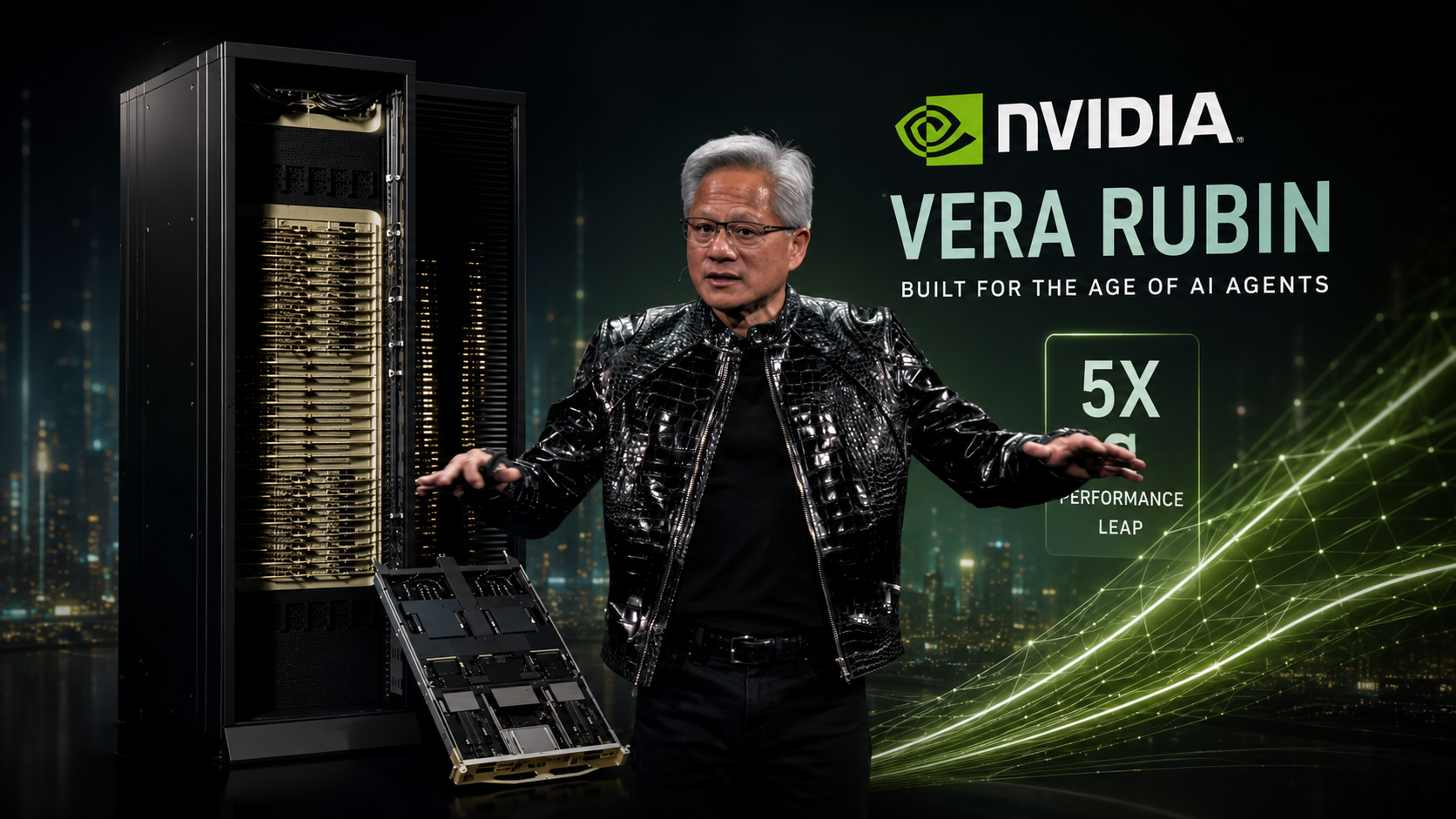
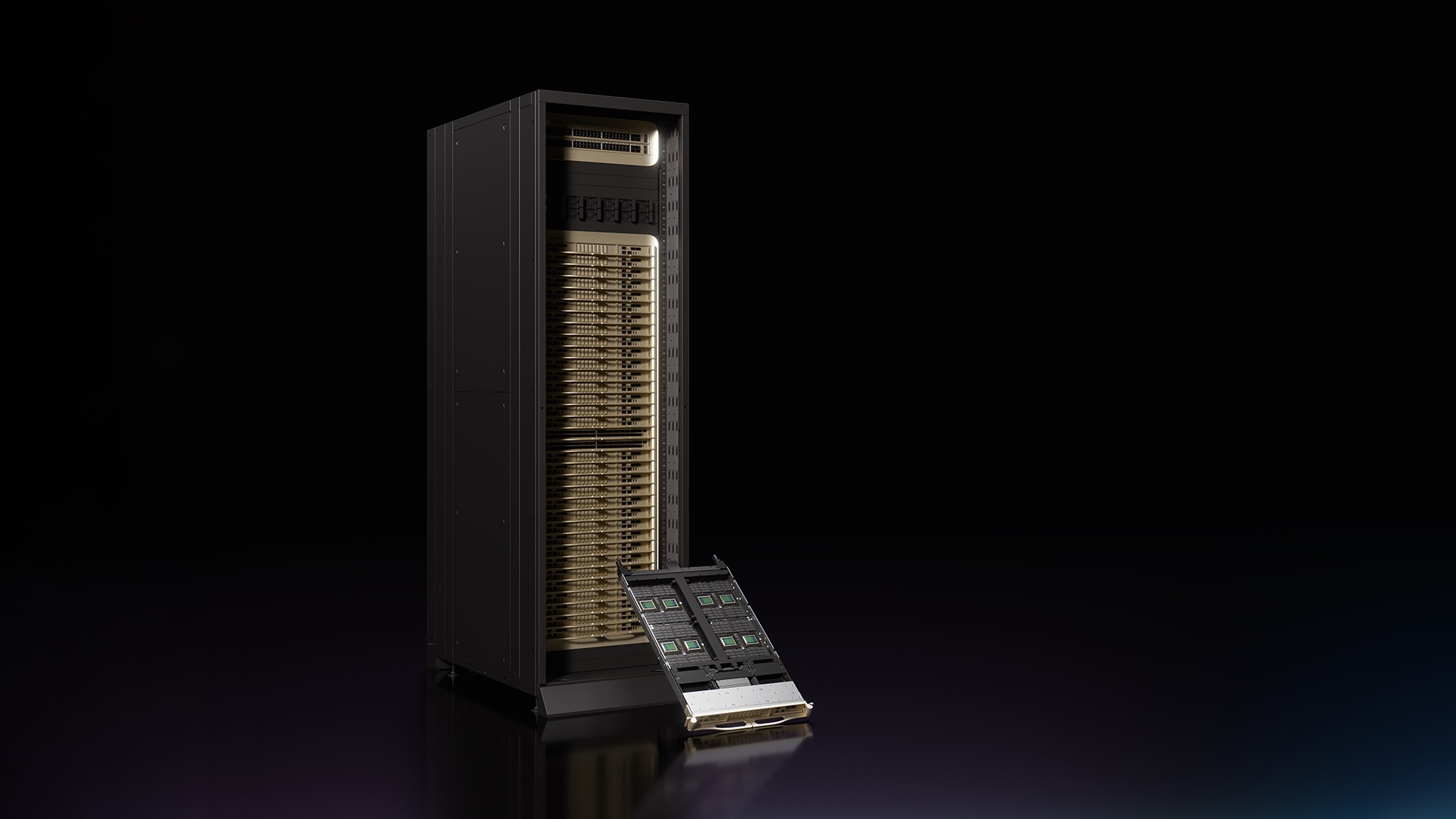
Nvidia has formally launched Vera Rubin, the next generation of its artificial intelligence computing platform, announcing at CES 2026 in Las Vegas that the system is in full production with partner products expected in the second half of the year. The platform pairs a new Vera central processing unit with two Rubin graphics processing units in a single package and forms the centerpiece of an ambitious effort to redefine the economics of the data centers that power modern AI. With the company positioning Rubin as purpose-built for agentic AI, advanced reasoning models, and the increasingly popular mixture-of-experts architectures, the launch reflects how thoroughly the latest wave of AI development is reshaping the demands placed on computing infrastructure.
Nvidia Vera Rubin AI computing rack
NVIDIA Unveils Vera, the CPU for Agents

The technical specifications Nvidia has disclosed are striking in their ambition. Each Rubin GPU is built from roughly 336 billion transistors, delivers around 50 petaflops of performance, and carries 288 gigabytes of HBM4 memory, the latest generation of high-bandwidth memory designed to feed data-hungry AI workloads. At the platform level, Nvidia claims that Vera Rubin offers approximately five times the inference performance of its current Blackwell generation while reducing the cost per token, a key measure of efficiency for AI systems, by as much as a factor of ten. If these figures hold up in real-world deployments, they would represent a substantial generational leap at a moment when the cost of running large AI models has become one of the industry’s most pressing concerns.

Rubin is not a single chip but a family of six, reflecting Nvidia’s strategy of selling integrated systems rather than discrete components. Alongside the Vera CPU and Rubin GPU, the platform includes the NVLink 6 Switch for high-speed interconnection, the ConnectX-9 SuperNIC and Spectrum-6 Ethernet Switch for networking, and the BlueField-4 data processing unit for offloading infrastructure tasks. This systems-level approach has been central to Nvidia’s dominance, since it allows the company to optimize performance across the entire stack and makes its platforms difficult for customers to disaggregate or replace piecemeal. By controlling so many of the components that make up an AI data center, Nvidia has built a position that competitors have found challenging to dislodge.

The choice to frame Rubin around agentic AI and reasoning models is revealing of where the industry believes value is migrating. Where earlier generations of AI infrastructure were optimized largely for training ever-larger models, the emphasis has increasingly shifted toward inference, the process of actually running models to serve users, and particularly toward the demanding workloads created by systems that reason through multiple steps or coordinate multiple specialized components. Mixture-of-experts models, which route each query to the most relevant subset of a larger network, are especially well suited to the kind of efficiency gains Nvidia is promising, and the company’s explicit targeting of these architectures suggests a careful read of where its largest customers are heading.

Those customers represent a roster of the most significant names in cloud computing. Nvidia indicated that among the first to deploy Vera Rubin-based systems would be Amazon Web Services, Google Cloud, Microsoft, and Oracle Cloud Infrastructure, alongside specialized AI cloud providers such as CoreWeave, Lambda, Nebius, and Nscale. The breadth of this early adoption underscores the extent to which the major cloud platforms remain dependent on Nvidia’s hardware even as several of them invest heavily in developing their own custom AI chips, a dynamic that speaks to both the strength of Nvidia’s position and the intensity of the competition it will eventually face.

The launch also arrives against a backdrop of extraordinary demand and persistent questions about the sustainability of AI infrastructure spending. The enormous capital being directed toward data centers has prompted debate about whether the returns will justify the investment, and Nvidia’s promise of dramatically lower cost per token can be read in part as a response to those concerns, offering customers a path to better economics even as absolute spending continues to climb. Whether the efficiency gains translate into the broad profitability that the industry’s investments presuppose remains an open and consequential question.

For all the impressive specifications, the ultimate test of Vera Rubin will be its performance in the hands of the cloud providers and enterprises that deploy it later in the year, and prudence suggests treating vendor-supplied benchmarks as starting points rather than settled conclusions. Even so, the launch is a clear statement of Nvidia’s intent to remain at the center of the AI computing era it has done so much to define. As reasoning models and autonomous agents place ever-greater demands on infrastructure, the platforms that can deliver more capability at lower cost will shape what becomes possible, and with Vera Rubin, Nvidia has once again set the terms of that conversation.

Tags: AIChipsGPUNvidiaVeraRubin
Aman Chamlagain

Aman Chamlagain

Aman Chamlagain is the founder and editor of Techord, the Australian technology news site he started in 2026. He writes across the site's coverage of artificial intelligence, robotics and consumer tech, with a consistent interest in what global technology decisions mean for people living and working in Australia. His reporting tends to follow the same thread: the distance between what a company announces and what actually ships, and who carries the cost of that gap. He covers the major AI labs and the models they release, robotics as it moves from demonstration into real work, and the hardware readers are weighing up buying. He also sets Techord's editorial standards, including its rules on primary sourcing, verbatim quotes and disclosed AI use. Aman handles tips, corrections and pitches personally. He can be reached at amannchamlagai07@gmail.com.

  • Trending
  • Comments
  • Latest
SpaceX IPO Draws $150 Billion in Demand, Doubling Its Target Ahead of Historic Debut

SpaceX IPO Draws $150 Billion in Demand, Doubling Its Target Ahead of Historic Debut

September 5, 2026
Apple Appoints New Leader to Advance Non-Invasive Blood Glucose Monitoring Project

Apple Appoints New Leader to Advance Non-Invasive Blood Glucose Monitoring Project

August 14, 2026
Bosch Partners with UK Startup Humanoid to Manufacture HMND 01 Robots at Scale

Bosch Partners with UK Startup Humanoid to Manufacture HMND 01 Robots at Scale

September 8, 2026
Nvidia CEO Jensen Huang Says Field of Study Won’t Matter in the AI Era

Nvidia CEO Jensen Huang Says Field of Study Won’t Matter in the AI Era

August 14, 2026
Nvidia CEO Jensen Huang Says Field of Study Won’t Matter in the AI Era

Nvidia CEO Jensen Huang Says Field of Study Won’t Matter in the AI Era

0
Apple Appoints New Leader to Advance Non-Invasive Blood Glucose Monitoring Project

Apple Appoints New Leader to Advance Non-Invasive Blood Glucose Monitoring Project

0
BYD Launches Dolphin G DM-i, Its First Vehicle Designed Exclusively for Europe

BYD Launches Dolphin G DM-i, Its First Vehicle Designed Exclusively for Europe

0
Hyundai Launches Atlas Robot World Cup Campaign Ahead of Massive 25,000-Unit Factory Rollout

Hyundai Launches Atlas Robot World Cup Campaign Ahead of Massive 25,000-Unit Factory Rollout

0
Editorial collage of Singapore's waterfront skyline with a schematic link between Singapore and Australia.

Australian AI Companies Target Singapore’s Enterprise Market

October 15, 2026
Editorial illustration of an Arkeus Warden sensor with a separate Drone Forge portfolio aircraft in the background.

Drone Forge and Arkeus Explore New Sensing Capabilities for Autonomous Aircraft

October 15, 2026
Editorial collage of Kingswood railway station and a Hume Highway bridge with restrained amber monitoring motifs.

NSW Trials Smart Sensors to Detect Danger on Railways and Highways

October 15, 2026
Editorial montage of CSIRO's yellow uncrewed survey vessel on coastal water and seagrass in murky water below.

Australian Researchers Trial Robots to Map Seagrass in Murky Water

October 15, 2026

Recent News

Editorial collage of Singapore's waterfront skyline with a schematic link between Singapore and Australia.

Australian AI Companies Target Singapore’s Enterprise Market

October 15, 2026
Editorial illustration of an Arkeus Warden sensor with a separate Drone Forge portfolio aircraft in the background.

Drone Forge and Arkeus Explore New Sensing Capabilities for Autonomous Aircraft

October 15, 2026
Editorial collage of Kingswood railway station and a Hume Highway bridge with restrained amber monitoring motifs.

NSW Trials Smart Sensors to Detect Danger on Railways and Highways

October 15, 2026
Editorial montage of CSIRO's yellow uncrewed survey vessel on coastal water and seagrass in murky water below.

Australian Researchers Trial Robots to Map Seagrass in Murky Water

October 15, 2026
Techord

Techord: Australian technology news.

Techord is an Australian technology publication covering AI, robotics, science, gadgets and electric vehicles, with news and context for Australian readers.

Browse Categories

  • AI

Recent News

Editorial collage of Singapore's waterfront skyline with a schematic link between Singapore and Australia.

Australian AI Companies Target Singapore’s Enterprise Market

October 15, 2026
Editorial illustration of an Arkeus Warden sensor with a separate Drone Forge portfolio aircraft in the background.

Drone Forge and Arkeus Explore New Sensing Capabilities for Autonomous Aircraft

October 15, 2026
  • About Techord
  • Contact
  • Privacy Policy
  • Terms
  • Submit a Tip

© 2026 Techord. All rights reserved.

Welcome Back!

Login to your account below

Forgotten Password?

Retrieve your password

Please enter your username or email address to reset your password.

Log In
No Result
View All Result
  • Home
  • AI
  • Robotics
  • Science
  • Future Tech
  • Big Tech
  • Latest News

© 2026 Techord. All rights reserved.


