

No Result
View All Result
Techord
Subscribe
  • AI
  • Tech
  • Robotics
  • Science
  • Gadgets
  • AI
  • Tech
  • Robotics
  • Science
  • Gadgets
No Result
View All Result
No Result
View All Result
Techord
Subscribe
Home AI

Google Launches Dreambeans, an Experimental AI App That Transforms Your Life Into Daily Stories

Aman Chamlagain by Aman Chamlagain
August 14, 2026
in AI, Tech
0
Google Launches Dreambeans, an Experimental AI App That Transforms Your Life Into Daily Stories
0
SHARES
9
VIEWS
Share on FacebookShare on Twitter

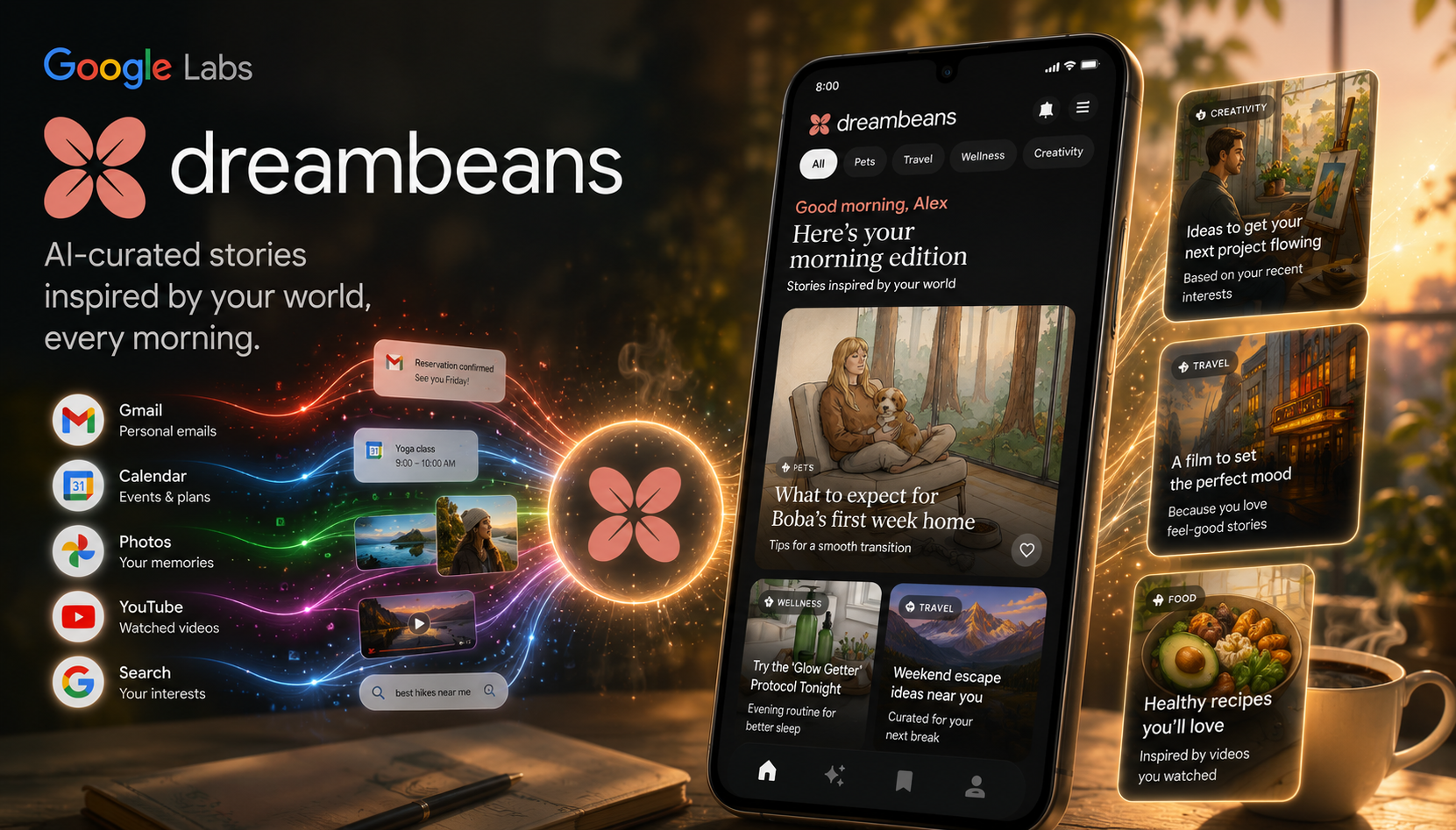
Google Labs on Tuesday launched Dreambeans, an experimental mobile app that draws on a user’s Gmail, Calendar, Photos, YouTube, and Search history to generate a curated set of personalized, AI-illustrated stories each morning. This intriguing new offering represents a creative exploration of how artificial intelligence might be woven into the fabric of everyday life, transforming the accumulated traces of a person’s digital activity into a source of daily inspiration. The app is available on Android and iOS for eligible Google AI Ultra subscribers aged 18 and older in the United States, with a waitlist open to others who hold a personal Google account, reflecting a measured approach to introducing this experimental concept to a wider audience.

🚨 NEW EXPERIMENT 🚨

Dreambeans is a new, experimental mobile app that uses Personal Intelligence to connect to your Google apps. Every day, it delivers collections of personalized stories, surfacing things you might otherwise miss, alongside topics that are relevant to you, to… pic.twitter.com/8urEsuVEzf

— Google Labs (@GoogleLabs) June 3, 2026

At its technical core, Dreambeans uses the same Personal Intelligence system that powers Google’s Gemini app and AI Mode, drawing context from connected Google services overnight and distilling it into what the company describes as a “finite collection of daily stories designed to spark new ideas.” This overnight processing forms the foundation of the app’s distinctive approach, allowing it to synthesize a wealth of personal information into a concise and thoughtfully curated experience. Gozde Oznur, the product lead behind the app, told TechCrunch that Dreambeans generates lifestyle suggestions encompassing “places to visit, topics to explore, things to try, upcoming trips, events that you should be aware of,” all based on data that a user chooses to share. This emphasis on user-directed data sharing underscores the personalized and consensual nature of the experience the company aims to deliver.

One of the app’s most visually compelling features lies in its use of AI-generated artwork to illustrate each story. The imagery is produced by the company’s Nano Banana 2 model, lending each narrative a unique and engaging visual character. Adding a further layer of personalization, if a user grants permission through Google Photos’ Face Grouping feature, the app can render their own likeness, or that of family members and pets, directly into the scenes rather than relying on generic imagery. This capability transforms the stories from abstract suggestions into deeply personal vignettes, potentially fostering a stronger sense of connection between the user and the inspirational content the app provides.

The conceptual inspiration behind the app’s name and function reflects a thoughtful and somewhat poetic vision. “The dream part is literal, because while you sleep, the app is working through everything across your connected apps,” Oznur explained. “It has processed everything overnight and hands you a concentrated drop of inspiration in the morning.” This framing positions Dreambeans as a kind of overnight companion that quietly synthesizes the details of a user’s life while they rest, presenting them with a fresh perspective each morning. The metaphor of dreaming captures the app’s ambition to surface unexpected connections and ideas that a person might not have consciously considered.

In a deliberate departure from the prevailing design philosophy of many modern applications, Dreambeans embraces constraint rather than endless engagement. Unlike social media’s infinite scroll, the app delivers roughly 10 to 14 stories per day, each designed to be consumed in about 30 seconds. Oznur described this limitation as entirely intentional, explaining that “the idea is to get a few inspirational ideas and then go out and live your life.” This philosophy stands in notable contrast to the attention-maximizing strategies that characterize much of the contemporary digital landscape, suggesting an alternative model in which technology serves to inspire action in the real world rather than to capture and hold a user’s attention indefinitely.

Recognizing the sensitive nature of the personal data the app draws upon, Google has emphasized its commitment to privacy and user control. The company states that only the individual user can see their own stories, and users retain the ability to delete their data or disconnect specific services at any time. These safeguards address the understandable concerns that arise when an application accesses such an extensive range of personal information, providing users with meaningful agency over how their data is used and the ability to withdraw from the experience should they wish to do so. This attention to privacy reflects an awareness of the trust required when technology engages so intimately with the details of a person’s life.

The launch of Dreambeans follows a wave of artificial intelligence announcements at Google I/O 2026 last week, where the company unveiled its Gemini Omni model and a redesigned Search experience. Positioned within this broader context of rapid AI innovation, Dreambeans exemplifies Google’s willingness to experiment with novel applications of its underlying technology, exploring how generative AI might be applied in ways that extend beyond conventional productivity and search functions. As an experimental offering, the app represents a forward-looking attempt to imagine new and more personal modes of interaction between people and artificial intelligence. Whether Dreambeans ultimately resonates with users and evolves into a lasting product remains to be seen, but its launch offers a fascinating glimpse into how companies are reimagining the relationship between our digital lives and the AI systems designed to enrich them, pointing toward a future in which technology may serve not merely to inform or entertain, but to inspire.

Tags: AI toolsGoogleGoogle Dreambeans
Aman Chamlagain

Aman Chamlagain

Aman Chamlagain is the founder and editor of Techord, the Australian technology news site he started in 2026. He writes across the site's coverage of artificial intelligence, robotics and consumer tech, with a consistent interest in what global technology decisions mean for people living and working in Australia. His reporting tends to follow the same thread: the distance between what a company announces and what actually ships, and who carries the cost of that gap. He covers the major AI labs and the models they release, robotics as it moves from demonstration into real work, and the hardware readers are weighing up buying. He also sets Techord's editorial standards, including its rules on primary sourcing, verbatim quotes and disclosed AI use. Aman handles tips, corrections and pitches personally. He can be reached at amannchamlagai07@gmail.com.

  • Trending
  • Comments
  • Latest
SpaceX IPO Draws $150 Billion in Demand, Doubling Its Target Ahead of Historic Debut

SpaceX IPO Draws $150 Billion in Demand, Doubling Its Target Ahead of Historic Debut

September 5, 2026
Apple Appoints New Leader to Advance Non-Invasive Blood Glucose Monitoring Project

Apple Appoints New Leader to Advance Non-Invasive Blood Glucose Monitoring Project

August 14, 2026
Bosch Partners with UK Startup Humanoid to Manufacture HMND 01 Robots at Scale

Bosch Partners with UK Startup Humanoid to Manufacture HMND 01 Robots at Scale

September 8, 2026
Nvidia CEO Jensen Huang Says Field of Study Won’t Matter in the AI Era

Nvidia CEO Jensen Huang Says Field of Study Won’t Matter in the AI Era

August 14, 2026
Nvidia CEO Jensen Huang Says Field of Study Won’t Matter in the AI Era

Nvidia CEO Jensen Huang Says Field of Study Won’t Matter in the AI Era

0
Apple Appoints New Leader to Advance Non-Invasive Blood Glucose Monitoring Project

Apple Appoints New Leader to Advance Non-Invasive Blood Glucose Monitoring Project

0
BYD Launches Dolphin G DM-i, Its First Vehicle Designed Exclusively for Europe

BYD Launches Dolphin G DM-i, Its First Vehicle Designed Exclusively for Europe

0
Hyundai Launches Atlas Robot World Cup Campaign Ahead of Massive 25,000-Unit Factory Rollout

Hyundai Launches Atlas Robot World Cup Campaign Ahead of Massive 25,000-Unit Factory Rollout

0
Editorial collage of Singapore's waterfront skyline with a schematic link between Singapore and Australia.

Australian AI Companies Target Singapore’s Enterprise Market

October 15, 2026
Editorial illustration of an Arkeus Warden sensor with a separate Drone Forge portfolio aircraft in the background.

Drone Forge and Arkeus Explore New Sensing Capabilities for Autonomous Aircraft

October 15, 2026
Editorial collage of Kingswood railway station and a Hume Highway bridge with restrained amber monitoring motifs.

NSW Trials Smart Sensors to Detect Danger on Railways and Highways

October 15, 2026
Editorial montage of CSIRO's yellow uncrewed survey vessel on coastal water and seagrass in murky water below.

Australian Researchers Trial Robots to Map Seagrass in Murky Water

October 15, 2026

Recent News

Editorial collage of Singapore's waterfront skyline with a schematic link between Singapore and Australia.

Australian AI Companies Target Singapore’s Enterprise Market

October 15, 2026
Editorial illustration of an Arkeus Warden sensor with a separate Drone Forge portfolio aircraft in the background.

Drone Forge and Arkeus Explore New Sensing Capabilities for Autonomous Aircraft

October 15, 2026
Editorial collage of Kingswood railway station and a Hume Highway bridge with restrained amber monitoring motifs.

NSW Trials Smart Sensors to Detect Danger on Railways and Highways

October 15, 2026
Editorial montage of CSIRO's yellow uncrewed survey vessel on coastal water and seagrass in murky water below.

Australian Researchers Trial Robots to Map Seagrass in Murky Water

October 15, 2026
Techord

Techord: Australian technology news.

Techord is an Australian technology publication covering AI, robotics, science, gadgets and electric vehicles, with news and context for Australian readers.

Browse Categories

  • AI

Recent News

Editorial collage of Singapore's waterfront skyline with a schematic link between Singapore and Australia.

Australian AI Companies Target Singapore’s Enterprise Market

October 15, 2026
Editorial illustration of an Arkeus Warden sensor with a separate Drone Forge portfolio aircraft in the background.

Drone Forge and Arkeus Explore New Sensing Capabilities for Autonomous Aircraft

October 15, 2026
  • About Techord
  • Contact
  • Privacy Policy
  • Terms
  • Submit a Tip

© 2026 Techord. All rights reserved.

Welcome Back!

Login to your account below

Forgotten Password?

Retrieve your password

Please enter your username or email address to reset your password.

Log In
No Result
View All Result
  • Home
  • AI
  • Robotics
  • Science
  • Future Tech
  • Big Tech
  • Latest News

© 2026 Techord. All rights reserved.


