

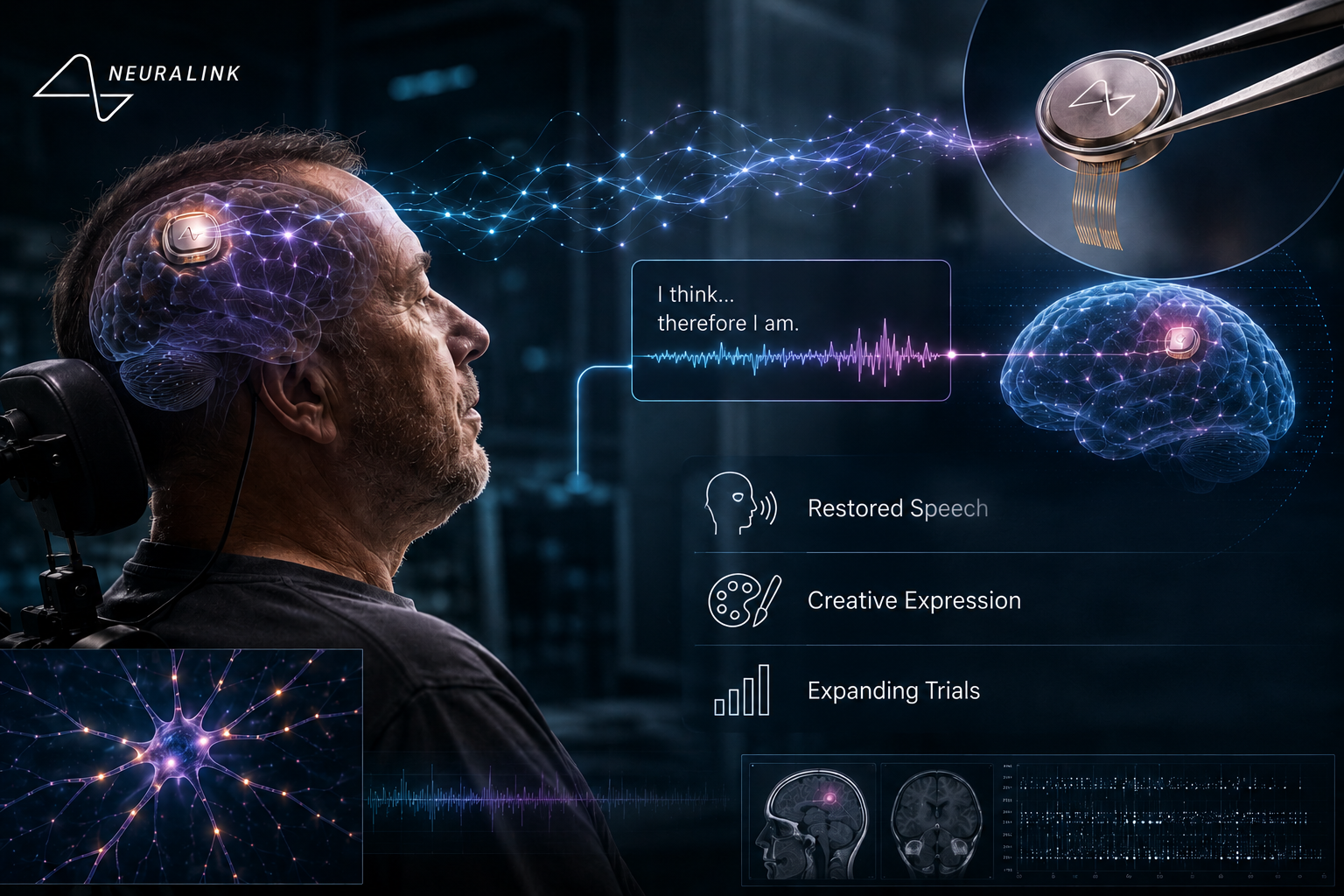
Neuralink’s brain-computer interface technology is giving paralyzed patients back abilities they thought were lost forever, from speaking in their own voices to creating art with their minds. The advances, documented across multiple patients in 2026, represent some of the most tangible results yet from Elon Musk’s brain implant company, which now has 21 participants enrolled in clinical trials worldwide. These developments mark a significant moment in the evolution of neurotechnology, offering compelling evidence that the long-promised potential of brain-computer interfaces may be beginning to translate into meaningful improvements in the lives of people living with severe paralysis and degenerative conditions. As an investigational technology, however, these results should be understood within the context of ongoing clinical research rather than as established medical treatments.
Among the most striking cases is that of Brad Smith, a former technology executive from Phoenix, Arizona, who became the first person with ALS to receive a Neuralink implant as part of the company’s PRIME clinical trial. Since his surgery, Smith has regained the ability to communicate using a voice that sounds like his own, an achievement made possible through AI voice-cloning technology from ElevenLabs that recreated his pre-illness voice from old recordings. This restoration of not merely speech but the distinctive character of his own voice carries profound emotional and personal significance, representing a return of identity that extends well beyond simple functional communication. The combination of neural decoding and voice synthesis illustrates how multiple strands of artificial intelligence can converge to address deeply human needs.
Smith has described the implant as genuinely transformative, offering vivid examples of how it has restored a sense of agency and connection to his daily life. He has said that the technology allows him to “jump into conversations swiftly,” play Mario Kart with his children, edit podcasts, and “generally lead a much more independent and active life.” These details paint a picture of a technology that does more than restore a single lost capability; rather, it appears to reopen a range of activities and interactions that contribute to a fuller and more engaged existence. The ability to participate in family life and pursue meaningful work speaks to the broader potential of such interfaces to enhance not only function but quality of life.
The progress extends to other participants as well, including Kenneth Shock, the second participant in Neuralink’s VOICE clinical trial, who received his N1 chip in January 2026. The system reads neural signals from his motor cortex through 1,024 electrodes, decodes them into phonemes, and outputs speech in his original voice. This technical process, translating the brain’s electrical activity into the building blocks of spoken language, represents a remarkable feat of engineering and neuroscience working in concert. On March 31, Musk publicly confirmed the trial’s success on X, drawing further attention to the company’s progress and the tangible outcomes being achieved through its expanding clinical program.
A report published June 5 in The Free Press detailed how the technology is restoring communication to ALS patients who had gradually lost the ability to speak, a particularly poignant application given the progressive nature of the disease. For individuals facing the steady erosion of their ability to communicate, the prospect of regaining a reliable means of expression carries immense importance, offering a measure of independence and connection that the condition would otherwise strip away. The documentation of these outcomes across multiple patients lends credibility to the notion that Neuralink’s approach is yielding consistent and repeatable benefits rather than isolated successes.
Perhaps one of the most evocative illustrations of the technology’s potential comes from Audrey Crews, the first woman to receive a Neuralink brain implant, who is now using the device to create art with her mind. A quadriplegic artist who was injured 20 years ago, Crews became a participant in the company’s clinical trials and can now perform tasks independently, including producing artwork through the brain-computer interface. Her story is especially moving, as it demonstrates that the technology can restore not only practical functions but also creative expression, allowing an artist to once again engage in the very pursuit that defines her identity. This restoration of creative capability points toward the expansive possibilities that brain-computer interfaces may eventually unlock for individuals across a wide spectrum of circumstances.
In terms of the company’s broader trajectory, Neuralink announced in late January 2026 that it had 21 total participants enrolled in trials globally, a notable increase from the 12 reported in September 2024. This growth in enrollment reflects the company’s expanding clinical footprint and its efforts to gather the data necessary to advance the technology toward wider availability. The company has also launched high-volume production of its devices and plans to automate the surgical implantation procedure this year, steps that suggest an orientation toward scaling the technology beyond the confines of early-stage trials. Such moves indicate that Neuralink is preparing for a future in which its implants might reach a substantially larger population of patients.
Looking ahead, a next-generation implant with three times the capabilities of the current device is expected later in 2026, signaling the rapid pace of iteration and improvement within the company. Nevertheless, it remains essential to recognize that the devices are still investigational and are not FDA-approved, meaning that they have not yet completed the rigorous regulatory review required to establish their safety and efficacy for general use. This important caveat tempers the considerable optimism surrounding the technology, reminding observers that significant work remains before brain-computer interfaces of this kind could become broadly accessible medical treatments. As Neuralink continues to advance its trials and refine its technology, the stories emerging from its participants offer a powerful glimpse into a future in which the boundaries imposed by paralysis and neurological injury may be meaningfully redrawn, restoring voices, capabilities, and forms of expression once thought to be permanently lost.








