

No Result
View All Result
Techord
Subscribe
  • AI
  • Tech
  • Robotics
  • Science
  • Gadgets
  • AI
  • Tech
  • Robotics
  • Science
  • Gadgets
No Result
View All Result
No Result
View All Result
Techord
Subscribe
Home Robotics

Australian University Deploys Robot Scientists to Accelerate Chemistry Research

Aman Chamlagain by Aman Chamlagain
October 5, 2026
in Robotics
0
Australian University Deploys Robot Scientists to Accelerate Chemistry Research
0
SHARES
1
VIEWS
Share on FacebookShare on Twitter

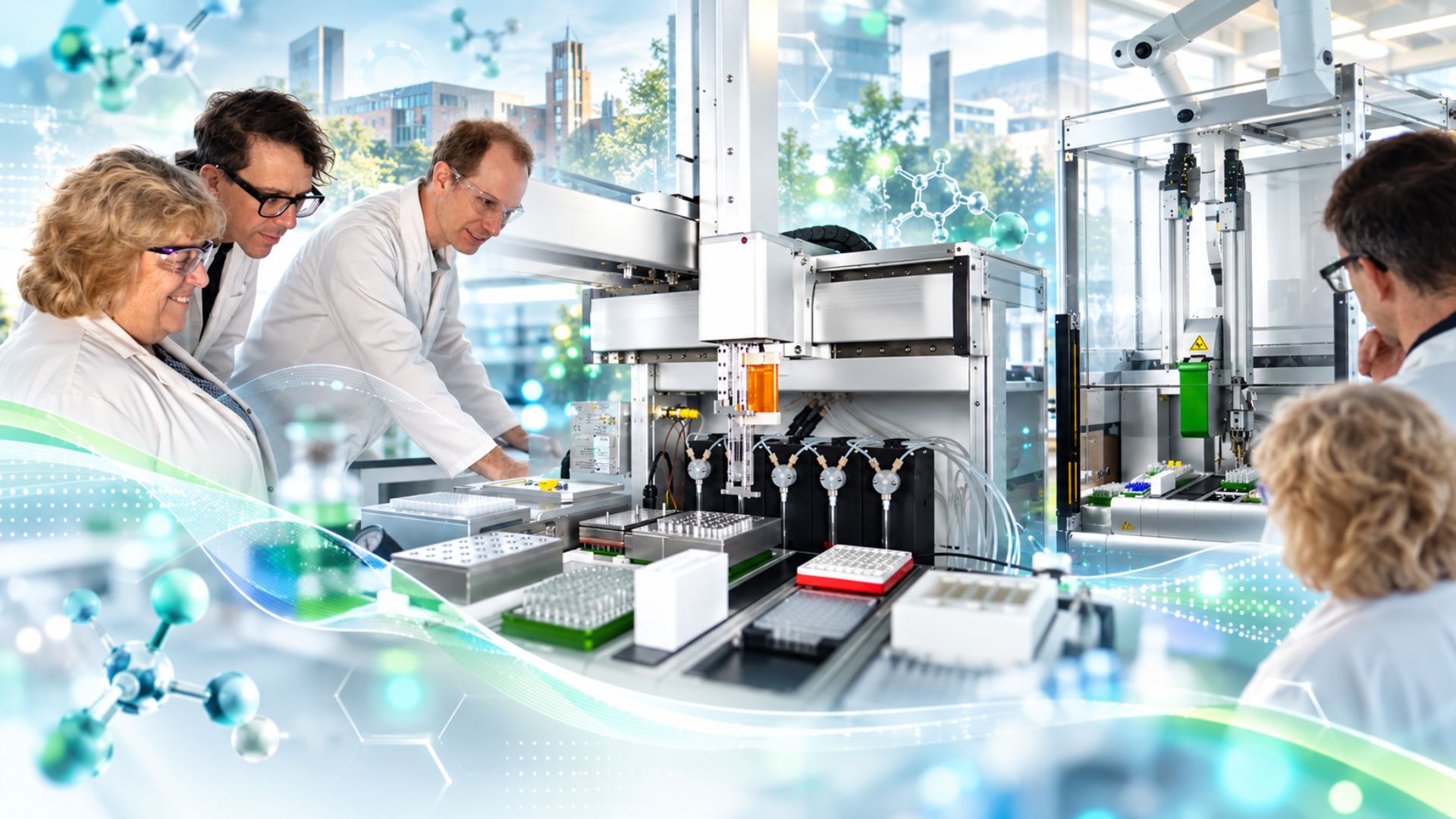
The University of Newcastle announced trials of two chemistry robots on 24 September 2026 as part of a six-platform research network across New South Wales. The university says the systems can test large numbers of chemical combinations and use machine learning to help select promising experiments. The immediate development is additional research capacity, with commercial benefits still to be demonstrated.

Welcome to the two new robots helping our researchers transform #MineralProcessing

See the media release👇https://t.co/9grdjIUknk@arc_gov_au @Uni_Newcastle @UON_NIER #Chemistrynews #CriticalMinerals #Resources #Chemistry pic.twitter.com/Bm63U6v2Z2

— COEMinerals: An ARC Centre of Excellence (@CoeMinerals) September 28, 2026

The Newcastle systems are installed at its Callaghan campus. They support medicinal chemistry and particle–liquid formulations, areas relevant to pharmaceuticals, mineral processing and water treatment. Newcastle says the robots can work around the clock, extending the number of experiments researchers can explore. It has not reported a resulting medicine, commercial water-treatment process or quantified industry productivity gain in this announcement.

The wider network connects Newcastle with three other NSW universities. Wollongong, UNSW and the University of New England are also involved. Newcastle identifies an A$1.99 million Australian Research Council infrastructure grant supporting the collaboration. In its release, Professor Erica Wanless describes the potential to investigate formulations more systematically and give students experience with automation and artificial intelligence.

Wollongong’s laboratory overview provides a more concrete picture of the experimental work. Its part of the capability includes robots that dispense materials, prepare samples and screen reactions. It describes optimisation across variables such as ingredients and process conditions, with objectives including yield, selectivity and physical properties. These are laboratory operations that can be repeated and measured.

The same overview puts the broader investment at A$2.7 million. That total includes the ARC and a consortium of NSW universities, whereas Newcastle’s A$1.99 million figure refers to the grant. The distinction avoids understating the contribution needed to create and operate shared research infrastructure. Wollongong describes six platforms across three sites and a remote node in Armidale.

Automation and machine learning play different roles within that process. A robot can carry out a set of preparation and testing steps, while a model can help prioritise which combination should be examined next. That is the logic of the capability described by the universities. It is not a guarantee that the most promising laboratory result will remain effective when production conditions change.

A practical evaluation should therefore look beyond the number of experiments. Useful evidence would include reproducible results, the resources needed to obtain them and whether a candidate formulation performs under the conditions of its intended use. Those are questions for the network’s subsequent research, rather than outcomes established by installing the equipment.

For Australian researchers and businesses, shared access could make more systematic testing possible. The network’s value will depend on turning experimental capacity into findings that other scientists can validate and industry can assess. Newcastle’s robots make that work more feasible; the next milestone is evidence from the experiments they help conduct.

Tags: ChemistryMachine LearningResearchRoboticsUniversity of Newcastle
Aman Chamlagain

Aman Chamlagain

Aman Chamlagain is the founder and editor of Techord, the Australian technology news site he started in 2026. He writes across the site's coverage of artificial intelligence, robotics and consumer tech, with a consistent interest in what global technology decisions mean for people living and working in Australia. His reporting tends to follow the same thread: the distance between what a company announces and what actually ships, and who carries the cost of that gap. He covers the major AI labs and the models they release, robotics as it moves from demonstration into real work, and the hardware readers are weighing up buying. He also sets Techord's editorial standards, including its rules on primary sourcing, verbatim quotes and disclosed AI use. Aman handles tips, corrections and pitches personally. He can be reached at amannchamlagai07@gmail.com.

  • Trending
  • Comments
  • Latest
SpaceX IPO Draws $150 Billion in Demand, Doubling Its Target Ahead of Historic Debut

SpaceX IPO Draws $150 Billion in Demand, Doubling Its Target Ahead of Historic Debut

September 5, 2026
Apple Appoints New Leader to Advance Non-Invasive Blood Glucose Monitoring Project

Apple Appoints New Leader to Advance Non-Invasive Blood Glucose Monitoring Project

August 14, 2026
Bosch Partners with UK Startup Humanoid to Manufacture HMND 01 Robots at Scale

Bosch Partners with UK Startup Humanoid to Manufacture HMND 01 Robots at Scale

September 8, 2026
Nvidia CEO Jensen Huang Says Field of Study Won’t Matter in the AI Era

Nvidia CEO Jensen Huang Says Field of Study Won’t Matter in the AI Era

August 14, 2026
Nvidia CEO Jensen Huang Says Field of Study Won’t Matter in the AI Era

Nvidia CEO Jensen Huang Says Field of Study Won’t Matter in the AI Era

0
Apple Appoints New Leader to Advance Non-Invasive Blood Glucose Monitoring Project

Apple Appoints New Leader to Advance Non-Invasive Blood Glucose Monitoring Project

0
BYD Launches Dolphin G DM-i, Its First Vehicle Designed Exclusively for Europe

BYD Launches Dolphin G DM-i, Its First Vehicle Designed Exclusively for Europe

0
Hyundai Launches Atlas Robot World Cup Campaign Ahead of Massive 25,000-Unit Factory Rollout

Hyundai Launches Atlas Robot World Cup Campaign Ahead of Massive 25,000-Unit Factory Rollout

0
Editorial collage of Singapore's waterfront skyline with a schematic link between Singapore and Australia.

Australian AI Companies Target Singapore’s Enterprise Market

October 15, 2026
Editorial illustration of an Arkeus Warden sensor with a separate Drone Forge portfolio aircraft in the background.

Drone Forge and Arkeus Explore New Sensing Capabilities for Autonomous Aircraft

October 15, 2026
Editorial collage of Kingswood railway station and a Hume Highway bridge with restrained amber monitoring motifs.

NSW Trials Smart Sensors to Detect Danger on Railways and Highways

October 15, 2026
Editorial montage of CSIRO's yellow uncrewed survey vessel on coastal water and seagrass in murky water below.

Australian Researchers Trial Robots to Map Seagrass in Murky Water

October 15, 2026

Recent News

Editorial collage of Singapore's waterfront skyline with a schematic link between Singapore and Australia.

Australian AI Companies Target Singapore’s Enterprise Market

October 15, 2026
Editorial illustration of an Arkeus Warden sensor with a separate Drone Forge portfolio aircraft in the background.

Drone Forge and Arkeus Explore New Sensing Capabilities for Autonomous Aircraft

October 15, 2026
Editorial collage of Kingswood railway station and a Hume Highway bridge with restrained amber monitoring motifs.

NSW Trials Smart Sensors to Detect Danger on Railways and Highways

October 15, 2026
Editorial montage of CSIRO's yellow uncrewed survey vessel on coastal water and seagrass in murky water below.

Australian Researchers Trial Robots to Map Seagrass in Murky Water

October 15, 2026
Techord

Techord: Australian technology news.

Techord is an Australian technology publication covering AI, robotics, science, gadgets and electric vehicles, with news and context for Australian readers.

Browse Categories

  • AI

Recent News

Editorial collage of Singapore's waterfront skyline with a schematic link between Singapore and Australia.

Australian AI Companies Target Singapore’s Enterprise Market

October 15, 2026
Editorial illustration of an Arkeus Warden sensor with a separate Drone Forge portfolio aircraft in the background.

Drone Forge and Arkeus Explore New Sensing Capabilities for Autonomous Aircraft

October 15, 2026
  • About Techord
  • Contact
  • Privacy Policy
  • Terms
  • Submit a Tip

© 2026 Techord. All rights reserved.

Welcome Back!

Login to your account below

Forgotten Password?

Retrieve your password

Please enter your username or email address to reset your password.

Log In
No Result
View All Result
  • Home
  • AI
  • Robotics
  • Science
  • Future Tech
  • Big Tech
  • Latest News

© 2026 Techord. All rights reserved.


