

No Result
View All Result
Techord
Subscribe
  • AI
  • Tech
  • Robotics
  • Science
  • Gadgets
  • AI
  • Tech
  • Robotics
  • Science
  • Gadgets
No Result
View All Result
No Result
View All Result
Techord
Subscribe
Home Robotics

Australia Is Building a Lunar Rover That Will Be Controlled From Earth

Aman Chamlagain by Aman Chamlagain
October 8, 2026
in Robotics
0
Australia Is Building a Lunar Rover That Will Be Controlled From Earth
0
SHARES
3
VIEWS
Share on FacebookShare on Twitter

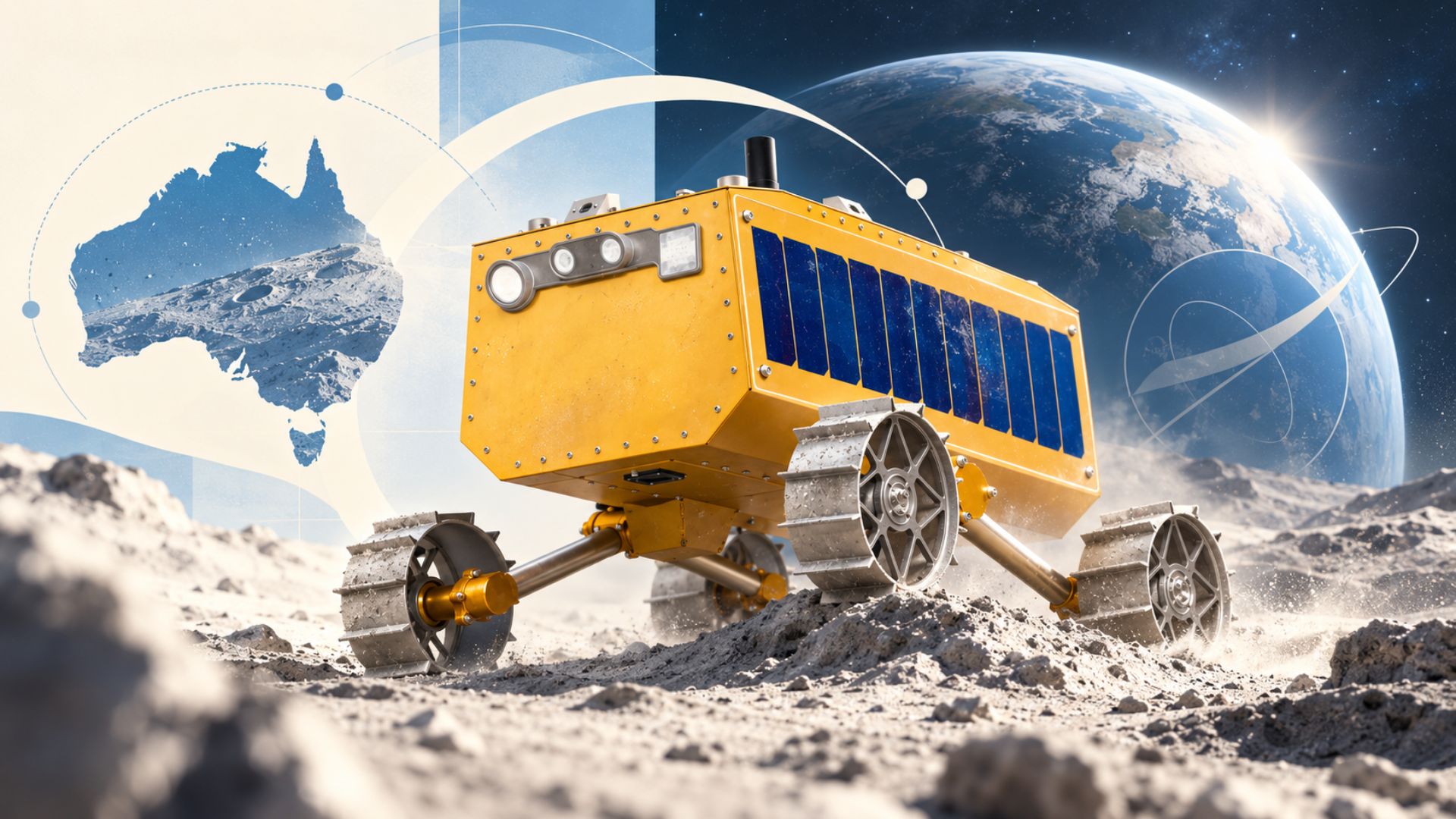
The Australian Space Agency unveiled a new Roo-ver development model at Queensland University of Technology on 7 October 2026, marking another step towards a lunar mission planned for 2030. The agency says the Australian-built rover will target the Moon’s south polar region and be controlled from Australia. The model offers a view of the engineering taking shape, while testing continues towards the final flight vehicle.

Meet the new model of Roo-ver, Australia's first lunar rover.

Unveiled today, the new model shows Roo-ver's design and scale as teams prepare for its historic journey to the Moon. The countdown to 2030 is on!

🎥 Watch to the end for the reveal. More here https://t.co/4OlPB7xN55 pic.twitter.com/nvGH4mfnx6

— Australian Space Agency (@AusSpaceAgency) October 6, 2026

The unveiling forms part of World Space Week activities. Roo-ver is one of several prototypes and development models produced during the program, each giving engineers a chance to examine a different design question. Agency head Enrico Palermo described it as “a representation of Australian ingenuity and innovation” in the announcement.

The venue also helps explain what must happen before launch. QUT’s testbed contains a 19-metre by 11.4-metre yard of simulated lunar soil, with cameras and a gantry that can take some weight off a rover. Controlled lighting can mimic the low-angle illumination expected near the lunar south pole.

Those facilities let engineers examine movement under selected lunar-like conditions. They can study how a wheel grips loose material, how the vehicle approaches an obstacle and how its sensors interpret shadows. A terrestrial testbed cannot establish that a rover is ready for every condition on the Moon, but it can expose weaknesses while changes remain possible.

Recent testing in South Australia shows why that matters. In a 29 September report on Adelaide University, the agency described a two-week mobility campaign using simulated regolith and a gravity-offload system. The tested prototype sank further into the material than the team had expected.

Researchers reported that the rover could cross rocks about 100 millimetres in diameter, but became beached on 120-millimetre rocks. That 20-millimetre difference is specific to those tests, rather than a universal limit for the eventual mission. It nevertheless gives designers and operators a concrete reason to refine clearance, wheel performance and route choices.

Lunar dust creates problems beyond the question of traction. The agency’s earlier account of Swinburne’s research describes work on coatings and electrostatic methods intended to discourage dust from sticking to equipment. These are research approaches, rather than a guarantee that the finished vehicle will remain dust-free.

Radiation protection introduces another set of engineering trade-offs. Swinburne researchers explained that shielding can protect electronics, but high-energy particles interacting with shielding can also produce secondary radiation. Protecting the systems responsible for movement and communications therefore involves studying materials and exposure, rather than simply adding more metal.

The broader mission plan places Roo-ver aboard an Intuitive Machines delivery under NASA’s Commercial Lunar Payload Services program. The ELO2 consortium is developing the rover, which is expected to carry a NASA analysis instrument and collect information about the lunar surface.

For Australia, the mission joins advanced manufacturing with remote operations: a vehicle must remain useful while its operators are on another world. The immediate work is closer to home, where soil pits, cameras and prototype revisions are helping the team turn a public development model into hardware capable of completing that journey.

Tags: Australian Space AgencyLunar RoverRoboticsRoo-verspace
Aman Chamlagain

Aman Chamlagain

Aman Chamlagain is the founder and editor of Techord, the Australian technology news site he started in 2026. He writes across the site's coverage of artificial intelligence, robotics and consumer tech, with a consistent interest in what global technology decisions mean for people living and working in Australia. His reporting tends to follow the same thread: the distance between what a company announces and what actually ships, and who carries the cost of that gap. He covers the major AI labs and the models they release, robotics as it moves from demonstration into real work, and the hardware readers are weighing up buying. He also sets Techord's editorial standards, including its rules on primary sourcing, verbatim quotes and disclosed AI use. Aman handles tips, corrections and pitches personally. He can be reached at amannchamlagai07@gmail.com.

  • Trending
  • Comments
  • Latest
SpaceX IPO Draws $150 Billion in Demand, Doubling Its Target Ahead of Historic Debut

SpaceX IPO Draws $150 Billion in Demand, Doubling Its Target Ahead of Historic Debut

September 5, 2026
Apple Appoints New Leader to Advance Non-Invasive Blood Glucose Monitoring Project

Apple Appoints New Leader to Advance Non-Invasive Blood Glucose Monitoring Project

August 14, 2026
Bosch Partners with UK Startup Humanoid to Manufacture HMND 01 Robots at Scale

Bosch Partners with UK Startup Humanoid to Manufacture HMND 01 Robots at Scale

September 8, 2026
Nvidia CEO Jensen Huang Says Field of Study Won’t Matter in the AI Era

Nvidia CEO Jensen Huang Says Field of Study Won’t Matter in the AI Era

August 14, 2026
Nvidia CEO Jensen Huang Says Field of Study Won’t Matter in the AI Era

Nvidia CEO Jensen Huang Says Field of Study Won’t Matter in the AI Era

0
Apple Appoints New Leader to Advance Non-Invasive Blood Glucose Monitoring Project

Apple Appoints New Leader to Advance Non-Invasive Blood Glucose Monitoring Project

0
BYD Launches Dolphin G DM-i, Its First Vehicle Designed Exclusively for Europe

BYD Launches Dolphin G DM-i, Its First Vehicle Designed Exclusively for Europe

0
Hyundai Launches Atlas Robot World Cup Campaign Ahead of Massive 25,000-Unit Factory Rollout

Hyundai Launches Atlas Robot World Cup Campaign Ahead of Massive 25,000-Unit Factory Rollout

0
Editorial collage of Singapore's waterfront skyline with a schematic link between Singapore and Australia.

Australian AI Companies Target Singapore’s Enterprise Market

October 15, 2026
Editorial illustration of an Arkeus Warden sensor with a separate Drone Forge portfolio aircraft in the background.

Drone Forge and Arkeus Explore New Sensing Capabilities for Autonomous Aircraft

October 15, 2026
Editorial collage of Kingswood railway station and a Hume Highway bridge with restrained amber monitoring motifs.

NSW Trials Smart Sensors to Detect Danger on Railways and Highways

October 15, 2026
Editorial montage of CSIRO's yellow uncrewed survey vessel on coastal water and seagrass in murky water below.

Australian Researchers Trial Robots to Map Seagrass in Murky Water

October 15, 2026

Recent News

Editorial collage of Singapore's waterfront skyline with a schematic link between Singapore and Australia.

Australian AI Companies Target Singapore’s Enterprise Market

October 15, 2026
Editorial illustration of an Arkeus Warden sensor with a separate Drone Forge portfolio aircraft in the background.

Drone Forge and Arkeus Explore New Sensing Capabilities for Autonomous Aircraft

October 15, 2026
Editorial collage of Kingswood railway station and a Hume Highway bridge with restrained amber monitoring motifs.

NSW Trials Smart Sensors to Detect Danger on Railways and Highways

October 15, 2026
Editorial montage of CSIRO's yellow uncrewed survey vessel on coastal water and seagrass in murky water below.

Australian Researchers Trial Robots to Map Seagrass in Murky Water

October 15, 2026
Techord

Techord: Australian technology news.

Techord is an Australian technology publication covering AI, robotics, science, gadgets and electric vehicles, with news and context for Australian readers.

Browse Categories

  • AI

Recent News

Editorial collage of Singapore's waterfront skyline with a schematic link between Singapore and Australia.

Australian AI Companies Target Singapore’s Enterprise Market

October 15, 2026
Editorial illustration of an Arkeus Warden sensor with a separate Drone Forge portfolio aircraft in the background.

Drone Forge and Arkeus Explore New Sensing Capabilities for Autonomous Aircraft

October 15, 2026
  • About Techord
  • Contact
  • Privacy Policy
  • Terms
  • Submit a Tip

© 2026 Techord. All rights reserved.

Welcome Back!

Login to your account below

Forgotten Password?

Retrieve your password

Please enter your username or email address to reset your password.

Log In
No Result
View All Result
  • Home
  • AI
  • Robotics
  • Science
  • Future Tech
  • Big Tech
  • Latest News

© 2026 Techord. All rights reserved.


