

No Result
View All Result
Techord
Subscribe
  • AI
  • Tech
  • Robotics
  • Science
  • Gadgets
  • AI
  • Tech
  • Robotics
  • Science
  • Gadgets
No Result
View All Result
No Result
View All Result
Techord
Subscribe
Home AI

OpenAI’s GPT-5.3-Codex Turns the Coding Assistant Into a General Work Agent

Aman Chamlagain by Aman Chamlagain
September 8, 2026
in AI
0
OpenAI’s GPT-5.3-Codex Turns the Coding Assistant Into a General Work Agent
0
SHARES
14
VIEWS
Share on FacebookShare on Twitter

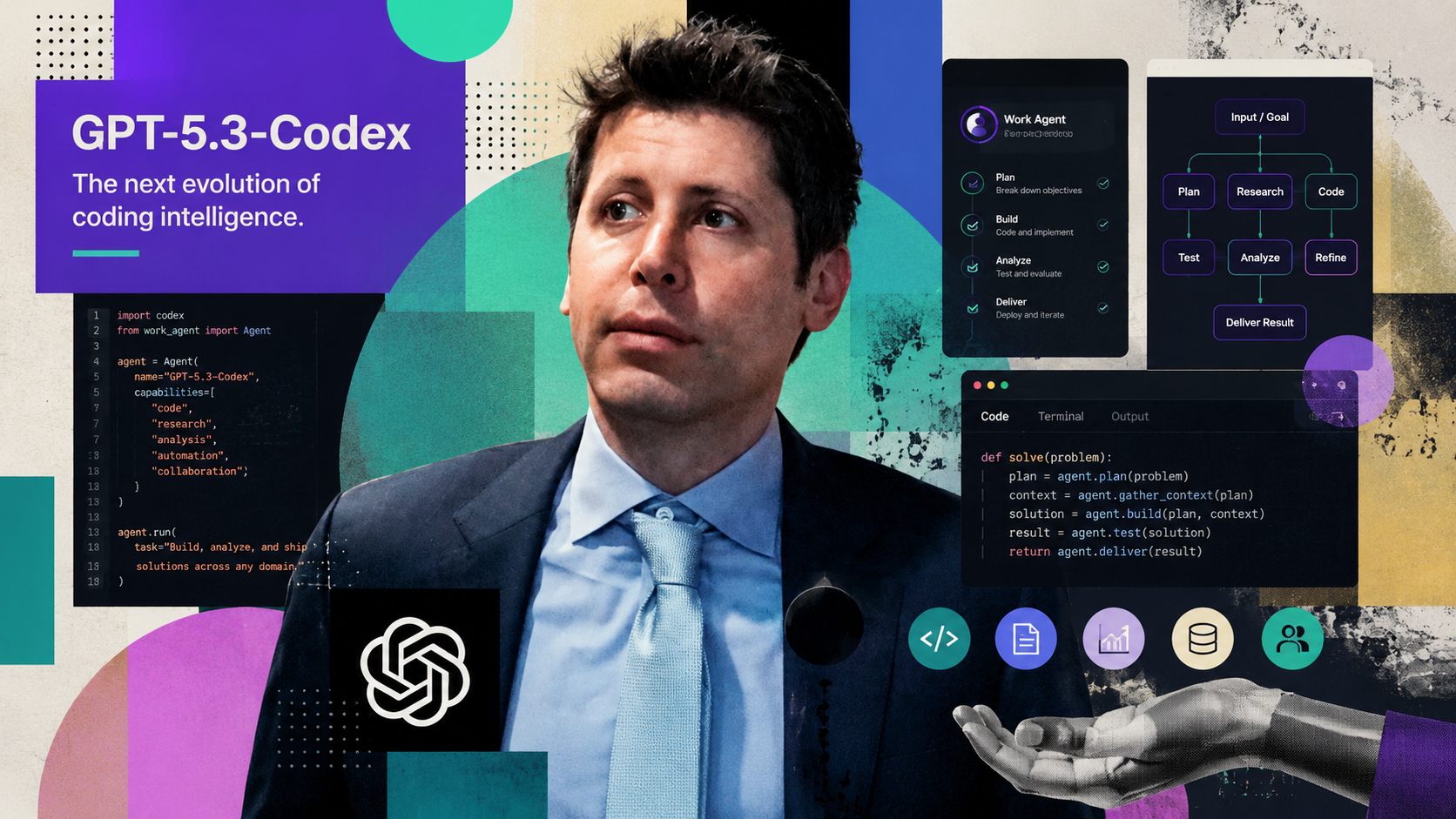
OpenAI has released GPT-5.3-Codex, a model that the company describes as a step-change from a coding assistant toward a general-purpose work agent capable of doing nearly anything a developer or professional can do on a computer. Released on February 5, 2026, the model is the first to combine OpenAI’s Codex and GPT-5 training stacks into a single unified system, bringing together strong code generation, reasoning, and broader general-purpose intelligence. The framing is deliberate and significant, signaling that OpenAI sees the future of these tools not merely in producing snippets of code on request but in autonomously carrying out the full range of work that takes place at a computer.

Building apps has never been easier.

With Sites, Codex can turn your work, ideas, and plans into an interactive website or app your team can explore, use, and share with a URL.

Rolling out to Business and Enterprise plans, before expanding more broadly. pic.twitter.com/fF17Y2EzCP

— OpenAI (@OpenAI) June 2, 2026

The expansion of scope is the release’s defining feature. Where earlier coding models were oriented primarily around writing and reviewing code, OpenAI says GPT-5.3-Codex is built to support the entire software lifecycle, including debugging, deploying, and monitoring software, as well as adjacent professional tasks such as writing product requirement documents, editing copy, conducting user research, and producing tests and metrics. This breadth reflects a broader ambition to position the model as a general work agent rather than a specialized programming tool, an evolution that, if realized, would meaningfully expand the range of tasks that can be delegated to AI in a professional setting.

The model’s reported benchmark performance lends weight to OpenAI’s claims of a meaningful advance. The company says GPT-5.3-Codex sets new industry highs on SWE-Bench Pro, a demanding software engineering benchmark, and on Terminal-Bench, which evaluates a model’s ability to operate in a command-line environment, while also performing strongly on OSWorld, a benchmark for computer-use tasks, and on GDPval, which tests professional knowledge work across a range of occupations. OpenAI further notes that the model is roughly twenty-five percent faster than its predecessor, an improvement that matters considerably for the kind of interactive, multi-step work the model is designed to handle. As always, such vendor-reported figures are best understood as initial indicators pending independent confirmation.

Perhaps the most intriguing detail surrounding the release concerns the model’s role in its own creation. OpenAI says GPT-5.3-Codex was the first model instrumental in building itself, with the Codex team using early versions to debug its own training process, manage aspects of its deployment, and diagnose test results and evaluations. This recursive quality, in which an AI system contributes materially to the development of its successor, is a notable marker of how capable these tools have become, and it hints at a dynamic that could accelerate the pace of progress while also raising thoughtful questions about oversight and understanding as systems take on greater roles in their own development.

A further emphasis of the release is steerability, the ability of a user to actively direct and adjust the model’s work as it proceeds rather than simply issuing a request and waiting for a finished result. This interactive quality is particularly important for the kind of complex, open-ended tasks that GPT-5.3-Codex is designed to tackle, where a user’s judgment and guidance remain essential to achieving a good outcome. By making the model something a developer can guide in real time, OpenAI is acknowledging that the most effective use of these systems often comes from collaboration between human and machine rather than full automation, at least for now.

In terms of availability, OpenAI made GPT-5.3-Codex accessible to paid ChatGPT subscribers across its various Codex interfaces, including a dedicated application, a command-line interface, an integrated development environment extension, and the web, with programmatic access through the API planned to follow once the company determined it could be enabled safely. The model has also been made generally available within GitHub Copilot, the widely used coding assistant, extending its reach to a large community of professional developers and reflecting the close relationship between OpenAI and Microsoft, which owns GitHub and remains a major investor in the company.

The arrival of GPT-5.3-Codex captures a broader trend in artificial intelligence toward systems that do not merely respond to prompts but take action on a user’s behalf across extended, multi-step tasks. The shift from generation to agency carries genuine promise for productivity, while also underscoring the importance of careful design, clear human oversight, and realistic expectations about reliability. Whether GPT-5.3-Codex fully lives up to its billing as a general work agent will become clear only through sustained use across real professional workflows, but as a statement of where OpenAI believes the technology is heading, the release is unmistakable in its direction.

Related reporting: GPT-6 Astra Rolls Out to All Pro and Enterprise Users.

Tags: AIAgentsCodexGPTOpenAI
Aman Chamlagain

Aman Chamlagain

Aman Chamlagain is the founder and editor of Techord, the Australian technology news site he started in 2026. He writes across the site's coverage of artificial intelligence, robotics and consumer tech, with a consistent interest in what global technology decisions mean for people living and working in Australia. His reporting tends to follow the same thread: the distance between what a company announces and what actually ships, and who carries the cost of that gap. He covers the major AI labs and the models they release, robotics as it moves from demonstration into real work, and the hardware readers are weighing up buying. He also sets Techord's editorial standards, including its rules on primary sourcing, verbatim quotes and disclosed AI use. Aman handles tips, corrections and pitches personally. He can be reached at amannchamlagai07@gmail.com.

  • Trending
  • Comments
  • Latest
SpaceX IPO Draws $150 Billion in Demand, Doubling Its Target Ahead of Historic Debut

SpaceX IPO Draws $150 Billion in Demand, Doubling Its Target Ahead of Historic Debut

September 5, 2026
Apple Appoints New Leader to Advance Non-Invasive Blood Glucose Monitoring Project

Apple Appoints New Leader to Advance Non-Invasive Blood Glucose Monitoring Project

August 14, 2026
Bosch Partners with UK Startup Humanoid to Manufacture HMND 01 Robots at Scale

Bosch Partners with UK Startup Humanoid to Manufacture HMND 01 Robots at Scale

September 8, 2026
Nvidia CEO Jensen Huang Says Field of Study Won’t Matter in the AI Era

Nvidia CEO Jensen Huang Says Field of Study Won’t Matter in the AI Era

August 14, 2026
Nvidia CEO Jensen Huang Says Field of Study Won’t Matter in the AI Era

Nvidia CEO Jensen Huang Says Field of Study Won’t Matter in the AI Era

0
Apple Appoints New Leader to Advance Non-Invasive Blood Glucose Monitoring Project

Apple Appoints New Leader to Advance Non-Invasive Blood Glucose Monitoring Project

0
BYD Launches Dolphin G DM-i, Its First Vehicle Designed Exclusively for Europe

BYD Launches Dolphin G DM-i, Its First Vehicle Designed Exclusively for Europe

0
Hyundai Launches Atlas Robot World Cup Campaign Ahead of Massive 25,000-Unit Factory Rollout

Hyundai Launches Atlas Robot World Cup Campaign Ahead of Massive 25,000-Unit Factory Rollout

0
Editorial collage of Singapore's waterfront skyline with a schematic link between Singapore and Australia.

Australian AI Companies Target Singapore’s Enterprise Market

October 15, 2026
Editorial illustration of an Arkeus Warden sensor with a separate Drone Forge portfolio aircraft in the background.

Drone Forge and Arkeus Explore New Sensing Capabilities for Autonomous Aircraft

October 15, 2026
Editorial collage of Kingswood railway station and a Hume Highway bridge with restrained amber monitoring motifs.

NSW Trials Smart Sensors to Detect Danger on Railways and Highways

October 15, 2026
Editorial montage of CSIRO's yellow uncrewed survey vessel on coastal water and seagrass in murky water below.

Australian Researchers Trial Robots to Map Seagrass in Murky Water

October 15, 2026

Recent News

Editorial collage of Singapore's waterfront skyline with a schematic link between Singapore and Australia.

Australian AI Companies Target Singapore’s Enterprise Market

October 15, 2026
Editorial illustration of an Arkeus Warden sensor with a separate Drone Forge portfolio aircraft in the background.

Drone Forge and Arkeus Explore New Sensing Capabilities for Autonomous Aircraft

October 15, 2026
Editorial collage of Kingswood railway station and a Hume Highway bridge with restrained amber monitoring motifs.

NSW Trials Smart Sensors to Detect Danger on Railways and Highways

October 15, 2026
Editorial montage of CSIRO's yellow uncrewed survey vessel on coastal water and seagrass in murky water below.

Australian Researchers Trial Robots to Map Seagrass in Murky Water

October 15, 2026
Techord

Techord: Australian technology news.

Techord is an Australian technology publication covering AI, robotics, science, gadgets and electric vehicles, with news and context for Australian readers.

Browse Categories

  • AI

Recent News

Editorial collage of Singapore's waterfront skyline with a schematic link between Singapore and Australia.

Australian AI Companies Target Singapore’s Enterprise Market

October 15, 2026
Editorial illustration of an Arkeus Warden sensor with a separate Drone Forge portfolio aircraft in the background.

Drone Forge and Arkeus Explore New Sensing Capabilities for Autonomous Aircraft

October 15, 2026
  • About Techord
  • Contact
  • Privacy Policy
  • Terms
  • Submit a Tip

© 2026 Techord. All rights reserved.

Welcome Back!

Login to your account below

Forgotten Password?

Retrieve your password

Please enter your username or email address to reset your password.

Log In
No Result
View All Result
  • Home
  • AI
  • Robotics
  • Science
  • Future Tech
  • Big Tech
  • Latest News

© 2026 Techord. All rights reserved.


