

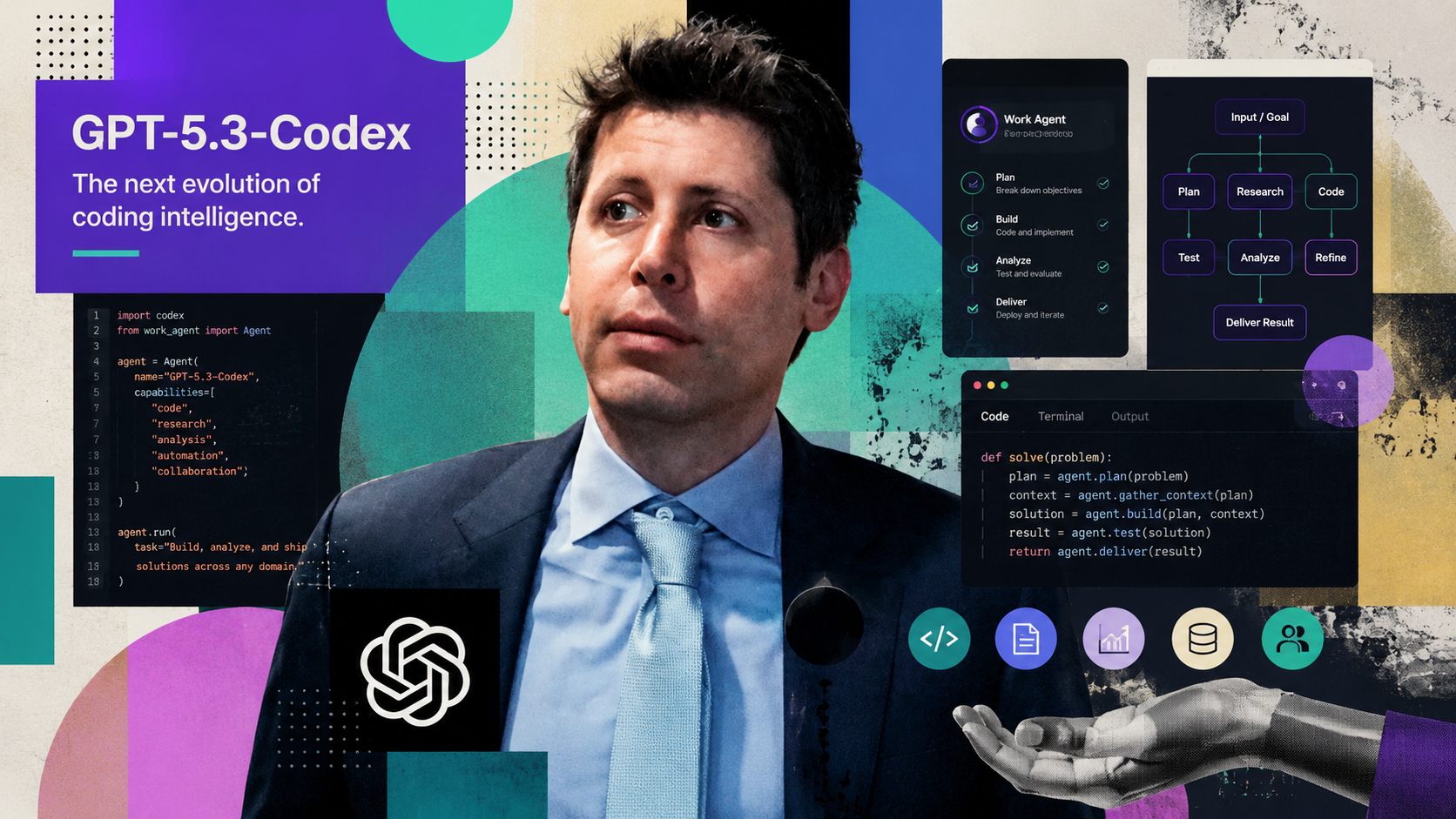
OpenAI has released GPT-5.3-Codex, a model that the company describes as a step-change from a coding assistant toward a general-purpose work agent capable of doing nearly anything a developer or professional can do on a computer. Released on February 5, 2026, the model is the first to combine OpenAI’s Codex and GPT-5 training stacks into a single unified system, bringing together strong code generation, reasoning, and broader general-purpose intelligence. The framing is deliberate and significant, signaling that OpenAI sees the future of these tools not merely in producing snippets of code on request but in autonomously carrying out the full range of work that takes place at a computer.
The expansion of scope is the release’s defining feature. Where earlier coding models were oriented primarily around writing and reviewing code, OpenAI says GPT-5.3-Codex is built to support the entire software lifecycle, including debugging, deploying, and monitoring software, as well as adjacent professional tasks such as writing product requirement documents, editing copy, conducting user research, and producing tests and metrics. This breadth reflects a broader ambition to position the model as a general work agent rather than a specialized programming tool, an evolution that, if realized, would meaningfully expand the range of tasks that can be delegated to AI in a professional setting.
The model’s reported benchmark performance lends weight to OpenAI’s claims of a meaningful advance. The company says GPT-5.3-Codex sets new industry highs on SWE-Bench Pro, a demanding software engineering benchmark, and on Terminal-Bench, which evaluates a model’s ability to operate in a command-line environment, while also performing strongly on OSWorld, a benchmark for computer-use tasks, and on GDPval, which tests professional knowledge work across a range of occupations. OpenAI further notes that the model is roughly twenty-five percent faster than its predecessor, an improvement that matters considerably for the kind of interactive, multi-step work the model is designed to handle. As always, such vendor-reported figures are best understood as initial indicators pending independent confirmation.
Perhaps the most intriguing detail surrounding the release concerns the model’s role in its own creation. OpenAI says GPT-5.3-Codex was the first model instrumental in building itself, with the Codex team using early versions to debug its own training process, manage aspects of its deployment, and diagnose test results and evaluations. This recursive quality, in which an AI system contributes materially to the development of its successor, is a notable marker of how capable these tools have become, and it hints at a dynamic that could accelerate the pace of progress while also raising thoughtful questions about oversight and understanding as systems take on greater roles in their own development.
A further emphasis of the release is steerability, the ability of a user to actively direct and adjust the model’s work as it proceeds rather than simply issuing a request and waiting for a finished result. This interactive quality is particularly important for the kind of complex, open-ended tasks that GPT-5.3-Codex is designed to tackle, where a user’s judgment and guidance remain essential to achieving a good outcome. By making the model something a developer can guide in real time, OpenAI is acknowledging that the most effective use of these systems often comes from collaboration between human and machine rather than full automation, at least for now.
In terms of availability, OpenAI made GPT-5.3-Codex accessible to paid ChatGPT subscribers across its various Codex interfaces, including a dedicated application, a command-line interface, an integrated development environment extension, and the web, with programmatic access through the API planned to follow once the company determined it could be enabled safely. The model has also been made generally available within GitHub Copilot, the widely used coding assistant, extending its reach to a large community of professional developers and reflecting the close relationship between OpenAI and Microsoft, which owns GitHub and remains a major investor in the company.
The arrival of GPT-5.3-Codex captures a broader trend in artificial intelligence toward systems that do not merely respond to prompts but take action on a user’s behalf across extended, multi-step tasks. The shift from generation to agency carries genuine promise for productivity, while also underscoring the importance of careful design, clear human oversight, and realistic expectations about reliability. Whether GPT-5.3-Codex fully lives up to its billing as a general work agent will become clear only through sustained use across real professional workflows, but as a statement of where OpenAI believes the technology is heading, the release is unmistakable in its direction.
Related reporting: GPT-6 Astra Rolls Out to All Pro and Enterprise Users.








