

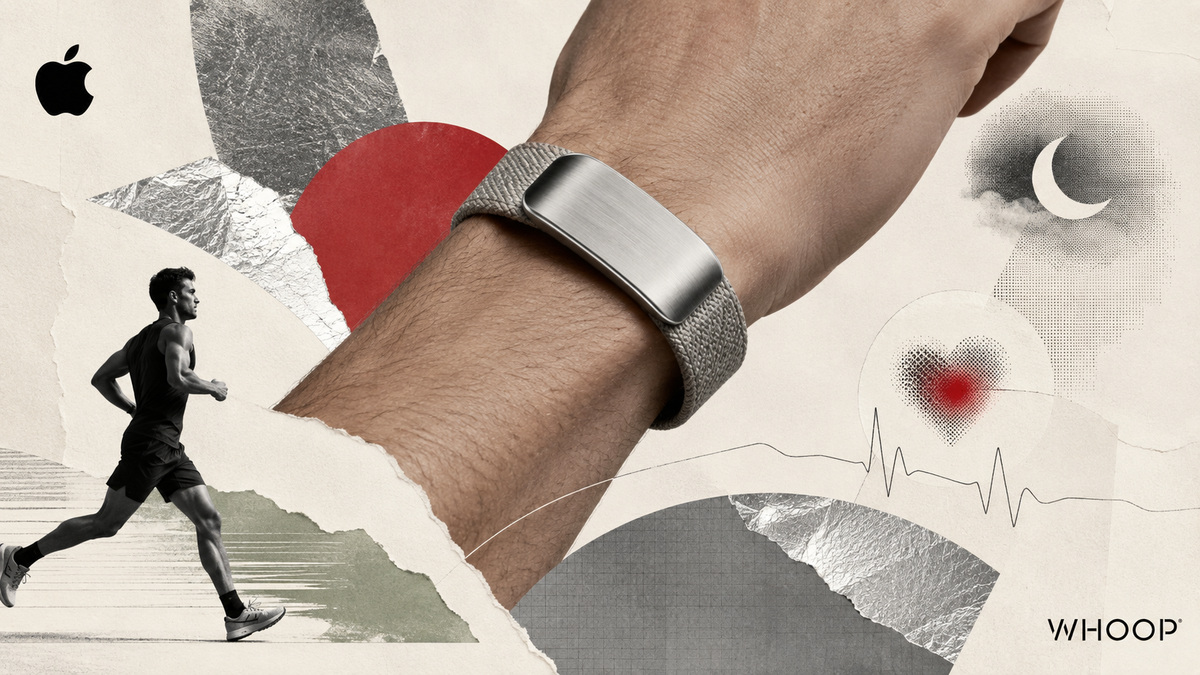
Apple is considering a screenless fitness tracker in the mould of Whoop’s bands as part of a broad rethink of its watch line, Bloomberg’s Mark Gurman reported on Sunday. Nothing is locked in, and the company is said to be weighing several different wearable form factors at the same time.
The screenless fitness tracker is one of several ideas under study. Gurman reported that Apple is also looking at smart rings and at an Apple Watch with a round display, a shape the product has avoided since it launched in 2015 even as Google and Samsung built their smartwatch lines around circular faces.
The current Apple Watch range gives no hint of the rethink. The lineup spans the Series, SE and Ultra models, all built around rectangular displays, and the last structural change was the slightly thinner and larger Series 10 in 2024. Health features have driven most recent updates instead, including sleep apnoea notifications in 2024 and hypertension notifications last year.
The scale of the possible change is unusual for Apple’s most conservative product line. Gurman wrote that the revamp “could be as significant as the iPhone’s transformation from a slab design into a foldable device,” and that Apple is seeking “something that transforms the product for a new era.”
Every part of the report carries caveats. Apple is described as considering and exploring rather than building, it “has not yet settled on the direction” of the redesign, and no timeline or launch window has been reported. Apple has not commented publicly.
The logic of a screen-free band is already proven by competitors. Whoop has built a subscription business on trackers with no display, Oura has done the same with rings, and Google sells the screenless Fitbit Air, with buyers drawn to lighter hardware, longer battery life and fewer distractions than a smartwatch.
Those products have carved out the corner of the market Apple does not serve. A Whoop band runs for days between charges and disappears under a sleeve, which appeals to athletes who train and sleep in their trackers, while Oura’s rings target recovery and sleep tracking with no screen to charge daily. Whoop sells its hardware around a paid membership covering round-the-clock strain, sleep and recovery tracking, a model Apple has never used for a device, though it already sells Fitness+ workout subscriptions.
Nothing in the reporting indicates which idea, if any, will reach production first, or whether the concepts might combine, such as a screenless band sold as a cheaper sibling to the watch. No target year has been given publicly for any of the designs.
Apple has spent a decade heading the other way, stacking health features onto a display-first product. Recent watches added hypertension notifications and sleep scoring, and health sensing has become the line’s main selling point over fitness bands costing a fraction of the price.
The ideas are early stage explorations rather than scheduled products, with no timeline attached and internal direction still unsettled. They follow years of incremental watch updates rather than structural redesigns.
The stakes explain the caution. Apple has led global smartwatch shipments for years, and the watch anchors a wearables business that also carries AirPods, so a wrong turn on form factor would touch one of the company’s most reliable hardware lines. A screenless band would compete head-on with both Whoop and Google’s Fitbit Air.
The Apple Watch continues on its annual cycle in the meantime. Apple is expected to hold its usual September event next month, where new iPhone and watch hardware traditionally appears, and none of the reported form factor experiments are expected to feature.








