

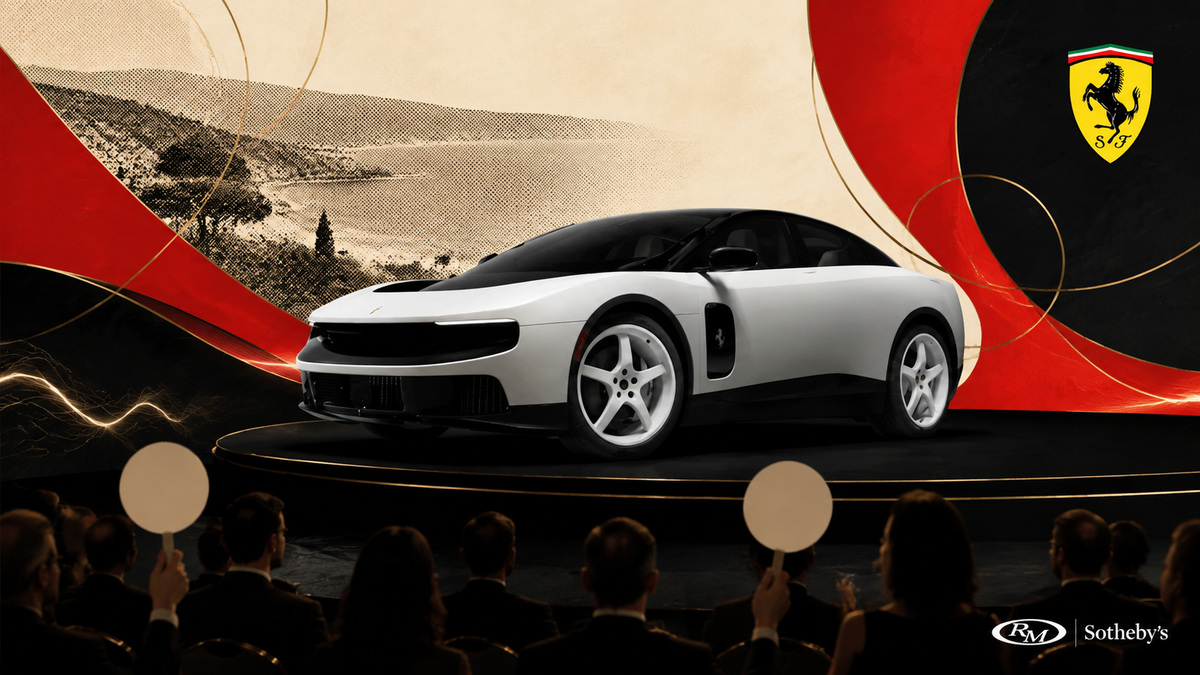
Ferrari’s first electric car has already broken a record, and it isn’t on a track. On 16 August the very first Ferrari Luce, chassis number zero, sold for US$40 million at RM Sotheby’s Monterey auction, roughly 36 times its pre-sale estimate of about US$1.1 million and, by most reckonings, the most anyone has ever paid for a new car under the hammer. The list price of a standard Luce is around US$640,000. Someone paid more than sixty times that for the first one off the line.
The number is absurd, and that’s partly the point. A one-off chassis with a unique Tailor Made specification isn’t a market price; it’s a trophy, and trophy buyers overpay by design. But the sale lands at a pointed moment for Ferrari, whose decision to build a silent, battery-powered five-seater has been the most divisive move in the company’s modern history.
Strip away the auction theatre and the signal underneath is what matters: demand for the Ferrari Luce is real, and it is enormous. Whether a Ferrari that makes no noise is still a Ferrari is a debate the marque’s own customers appear to have already settled with their chequebooks.
A $40 million answer to the sceptics
When Ferrari pulled the covers off the Luce on 26 May, having spent development calling it Elettrica before settling on the production name earlier in the year, the reaction from parts of its fanbase was closer to grief than excitement. A Ferrari, the argument went, is a V12 and an exhaust note, not a 2.2-tonne EV with rear doors. The company bet the objection wouldn’t survive contact with the order book, and so far it hasn’t. Ferrari has reportedly already hit its entire 2026 allocation for the car, just under 500 examples, only about two months after the unveiling.
That is the context the Monterey result sits inside. A record auction price for chassis zero is a novelty, but a sold-out first year is a business. Ferrari has set a target of 2,500 Luces by 2030, or roughly 600 a year, deliberately scarce numbers for a company that treats scarcity as a product feature. The $40 million headline will fade. The waiting list is the story.
The Luce is engineered to make the “it’s just an EV” complaint hard to sustain. Four electric motors, one at each wheel, produce more than 1,000 horsepower and drive the car from rest to 100 km/h in about 2.5 seconds, on to a top speed north of 310 km/h. Ferrari quotes a range of more than 500 kilometres, and the whole thing rides on a bespoke architecture rather than a shared group platform. These are hypercar numbers wrapped in a four-door body.
The bigger departure is who it’s for. The Luce, Italian for “light,” is Ferrari’s first five-seater, with a 600-litre boot and an interior developed with LoveFrom, the design collective led by former Apple design chief Jony Ive. Ferrari is openly courting a buyer it has mostly ignored: the very wealthy who want a genuine Ferrari and a back seat their family can actually use. Priced from €550,000, it is aimed less at the track-day set than at the garages that already hold a Purosangue and a couple of grand tourers.
Ferrari isn’t abandoning the engine, and that’s the strategic tell. The Luce is a fourth pillar alongside its V8, V12 and hybrid ranges, not a replacement for them, which lets the company test electrification at the very top of the market where margins are fattest and buyers least price-sensitive. If any carmaker can charge supercar money for an EV and make it stick, it’s the one whose badge already commands irrational sums, as Monterey just demonstrated in the bluntest possible terms.
Customer deliveries are due to begin in the fourth quarter of 2026, with the first bespoke cars, including that $40 million chassis, heading back to Maranello for final assembly and arriving in early 2027. The real test comes after that, when the novelty of being first wears off and the Luce has to hold its value and its desirability as a used car rather than a unique lot. For now, Ferrari has the one thing every legacy carmaker chasing electrification wants and almost none of them have: customers fighting to pay more than the sticker price. Watch whether that survives the second year.








