

Australia has just handed Tesla record July sales, and the number inside the number is the better story. Tesla delivered 4,778 vehicles in July, its best July on record and more than five times the 917 it managed in July 2025, according to Electric Vehicle Council figures reported by The Driven on Monday. More than half of those deliveries, 2,429 of them, were a variant that only became available for immediate delivery in the last days of the month: the six seat Model Y L, reported separately in the figures for the first time.
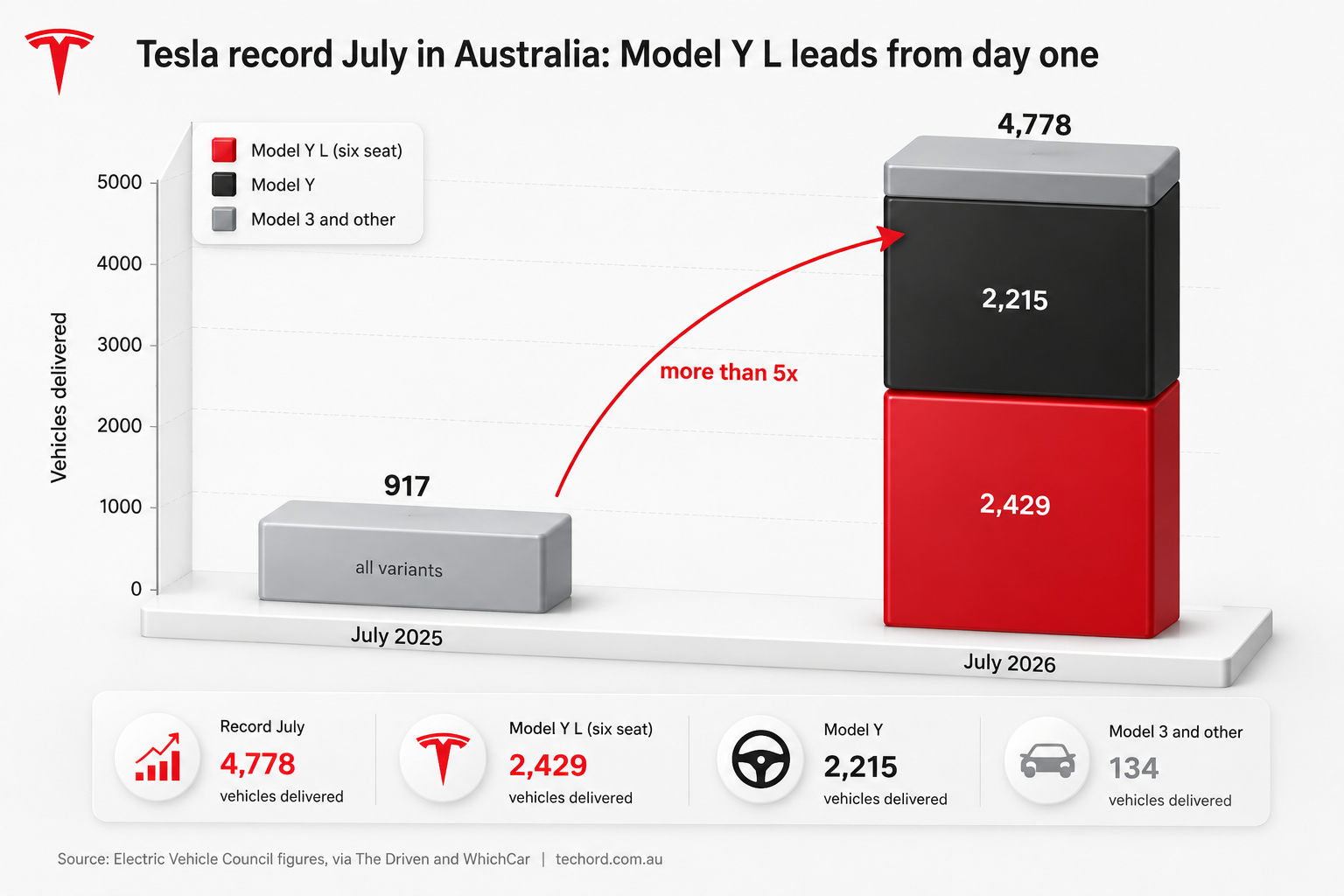
The rest of the ledger shows how completely one bodystyle now carries the brand. The standard Model Y accounted for another 2,215 deliveries, WhichCar reports, meaning the Model Y family made up 4,644 of the month’s 4,778 sales. The Model 3 managed just 134, down 63 per cent on the 362 it recorded in July 2025. Australians, it turns out, want their electric cars tall, and increasingly with a third row.
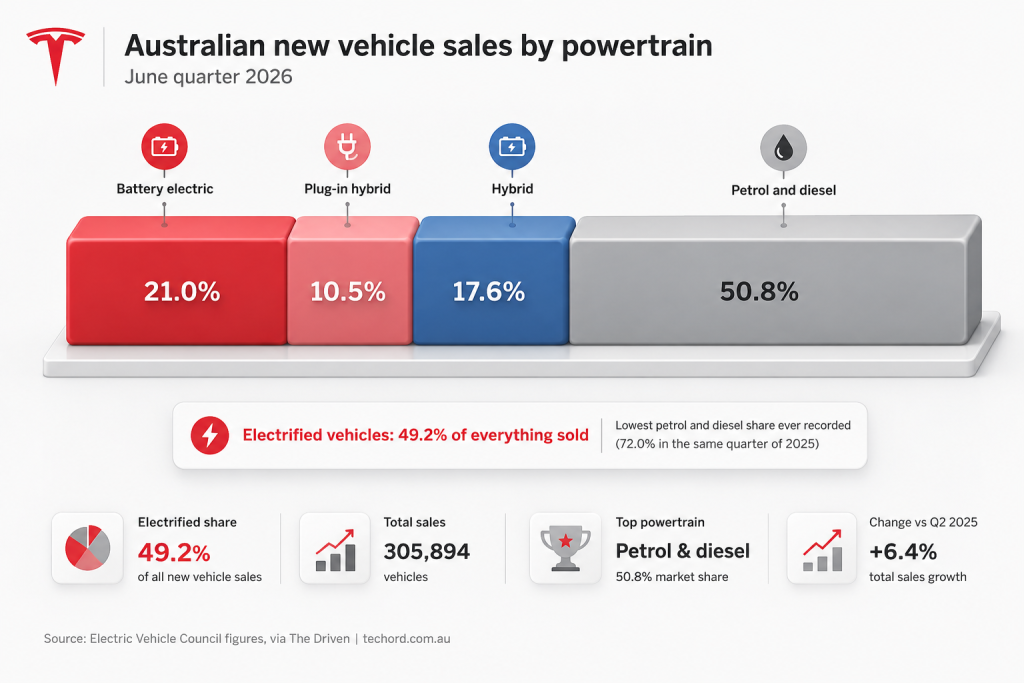
Zoom out and the Tesla record July sales look less like a one off and more like a tipping point. Battery electric vehicles took a record 21.03 per cent of the Australian market in the June quarter with 69,414 units, The Driven reports, up 137 per cent year on year, while petrol and diesel vehicles fell to 50.84 per cent, their lowest share ever recorded and down from 72.03 per cent in the same quarter of 2025. Add plug-in hybrids at 10.48 per cent and conventional hybrids at 17.55 per cent, and electrified vehicles of some description claimed 49.16 per cent of everything sold. The combustion car is not dead in Australia, but for the first time it is barely a majority.
Behind the Tesla record July sales figures
The year to date tally makes the Tesla record July sales trend hard to dismiss as a delivery quirk. Tesla and Polestar, the two brands reporting directly to the Electric Vehicle Council, have moved 29,711 vehicles between them in 2026, up 80.4 per cent on the 16,466 they managed across the same seven months last year. EVC chief executive Julie Delvecchio attributed the demand to “lower running costs, petrol-price uncertainty and a wider choice of models”, per WhichCar, and the choice part is doing real work. Tesla opened Model Y L orders locally in late July with stock available for immediate delivery, The Driven reported at the time, and buyers cleared 2,429 of them before the month was out.
That instant appetite for a six seater says something about who is buying electric now. The early adopter years belonged to commuters; a family bus that outsells every other Tesla variant in its first reported month suggests the buyers arriving in 2026 are replacing the household’s main car, not adding a second one. Tesla is not the only brand feeding that shift, and arguably not even the pacesetter, with BYD climbing the overall sales charts on the back of exactly the same family-first product logic. Competition of that sort tends to compound: every new bodystyle one brand lands, the other has to answer.
The view from China
Australia’s bumper month is a downstream effect of decisions made for China, the market the Model Y L was designed around. The stretched six seater launched there first, in 2025, and Chinese buyers still get it cheaper than anyone: when the variant reached the United States this July, CarNewsChina calculated the American version cost the equivalent of US$12,060 more than the Chinese one. China’s policy settings are churning demand too, in both directions at once. Beijing extended its national vehicle trade-in subsidy scheme into 2026 to keep consumption moving, CnEVPost reports, even as the country wound back its full purchase tax exemption for new energy vehicles, which CarNewsChina reported triggered a year-end buying rush before the change bit in January. A cheaper Model Y Standard has been reported as under development for a Chinese launch in 2026, though Tesla has confirmed neither timing nor price, so treat that one as a rumour with a factory attached.
For Australia, the practical consequence is simple: the Shanghai-built cars this market depends on sit at the centre of Tesla’s most contested battleground, and product decisions made to defend China, longer bodies, more seats, sharper prices, flow here within months. The Model Y L is the proof, and Tesla’s broader push across the region keeps widening.
What happens next is the interesting part. July’s figure was built almost entirely on pent-up demand for a brand new variant, and a record that leans this hard on one launch is a strength right up until it isn’t. The August numbers will show whether the Model Y L settles into four figures a month or spent its whole order bank in one glorious spike. The structural story is harder to argue with: petrol’s share of the Australian market has fallen from 72 per cent to 51 per cent in a single year, on the Electric Vehicle Council’s numbers, and nothing in the product pipeline, Tesla’s or anyone else’s, points that curve back up. The next milestone worth watching is the quarter when combustion slips under half. On current trajectory, it may already be underway.
Related reporting: EV Sales Australia: Electric Outsells Petrol for First Time.








